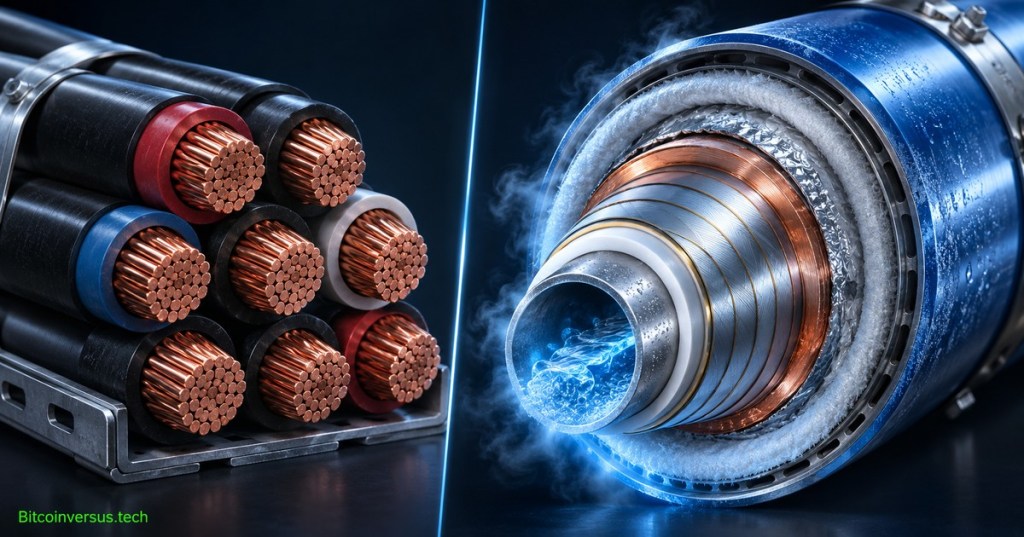
Can one superconducting cable replace eight copper power cables? The physics supports large capacity gains in particular designs, but not a universal eight-to-one rule. A May 27, 2026 Bloomberg Originals report illustrated one superconducting cable against several conventional cables while interviewing developer VEIR. The graphic did not establish a controlled eight-cable field measurement. An independent engineering verdict requires identical operating voltage, allowable temperature, physical footprint, phases and duty conditions.
Copper and aluminum carry electric current with finite resistance, generating heat proportional to the current squared. A high-temperature superconducting (HTS) cable instead uses cryogenically cooled ceramic superconducting tapes within a vacuum-insulated assembly. The conductor can carry very high direct current without ohmic resistance, but refrigeration, terminations and alternating-current effects prevent an entire installation from being loss-free. Copper may still appear inside the new cable as a stabilizer.
Eight times is possible—not guaranteed
Manufacturer Nexans describes 8–10 times the power capacity in the same cable footprint for selected HTS systems. Eight times the conventional reference equals a 700% increase; ten times corresponds to 900%. The percentages are derived from the manufacturer’s range, not independently measured grid averages. Voltage and power factor must be matched before treating current and transmitted power as equivalent.
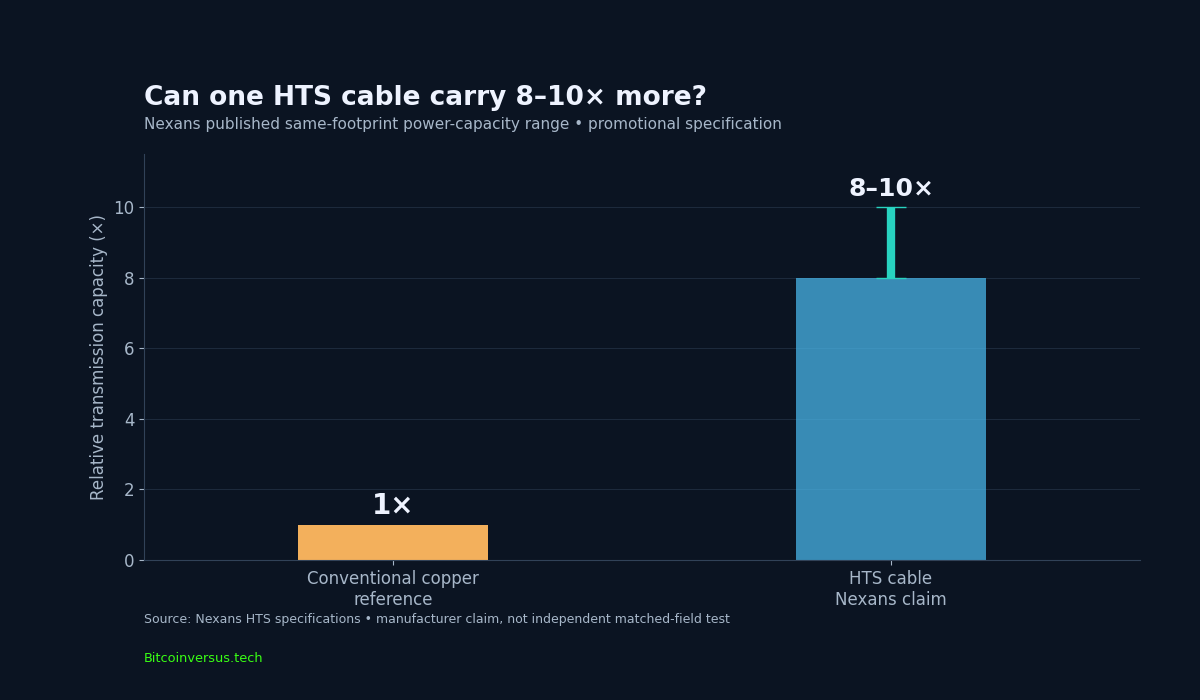
A separate European Best Paths transmission study models one superconducting cable pair against eight conventional HVDC cables at comparable link capacity. A pair is not one cable, and the comparison is a proposed system design rather than an operating 500-kilometer installation. The much larger conductor-level current density sometimes quoted for superconducting ribbons must not be confused with an entire insulated cable’s rating.
What materials can actually superconduct?
The U.S. Department of Energy lists YBCO at 92 kelvin, bismuth-based BSCCO at 110 K, magnesium diboride (MgB₂) at 39 K, niobium-tin at 18 K and niobium-titanium at 10 K. YBCO belongs to the REBCO rare-earth barium copper oxide family; VEIR identifies REBCO tapes in its cables. BSCCO and REBCO are commercially important high-temperature conductor families, while MgB₂ has been tested for high-power DC transmission. Niobium alloys generally require colder cooling. A material’s critical temperature is not its required operating setpoint; current and magnetic field also constrain performance.
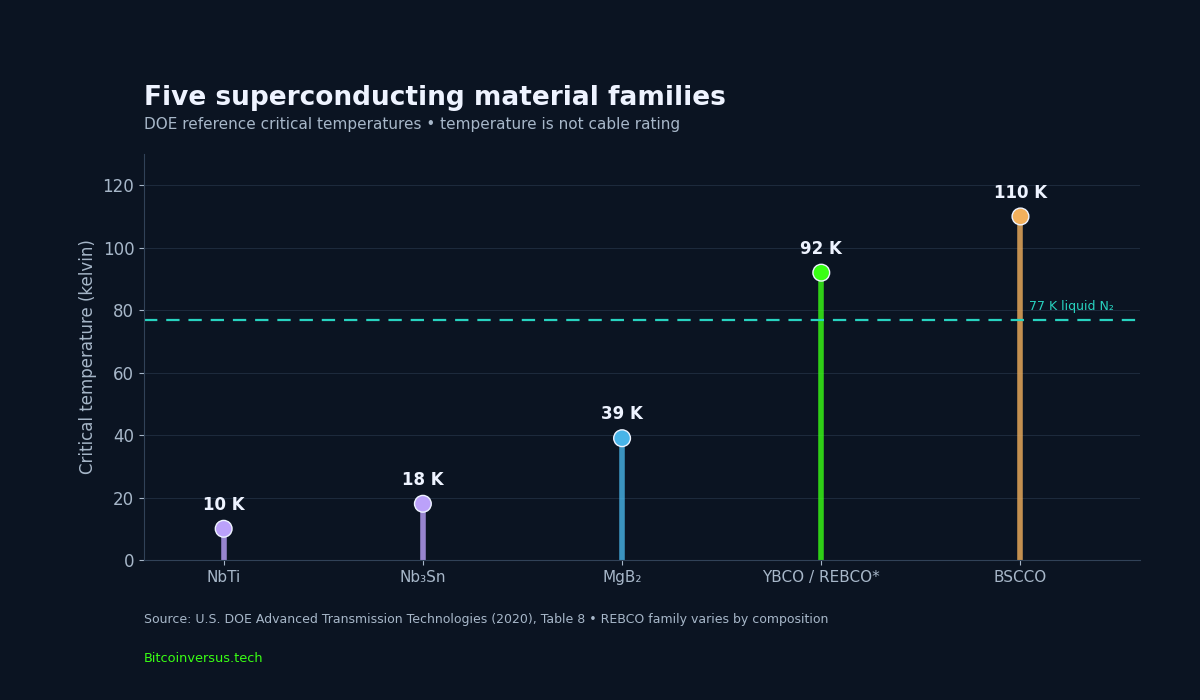
Liquid nitrogen boils near 77 K at atmospheric pressure, allowing suitably designed REBCO and BSCCO cables to operate at practical cryogenic temperatures. MgB₂ cable concepts generally need substantially colder refrigeration. Neither copper nor aluminum becomes a practical 77 K superconductor merely because it is placed inside a cryostat. Research into higher-temperature states remains active; see BitcoinVersus.Tech coverage of Cooper pairing and quantum-material research.
What real installations demonstrate
Field evidence reaches beyond marketing. DOE documents a 200-meter, 69 MVA superconducting link in Columbus, Ohio; a 600-meter, 574 MVA Long Island system; and a 1,000-meter, 600 MVA Jeju Island link. Nexans documents Essen’s 1-kilometer, 40 MVA, 10 kV AmpaCity installation. The projects have different voltages and architectures, so no output-per-meter ranking is scientifically justified. MVA measures apparent power, not necessarily delivered MW.
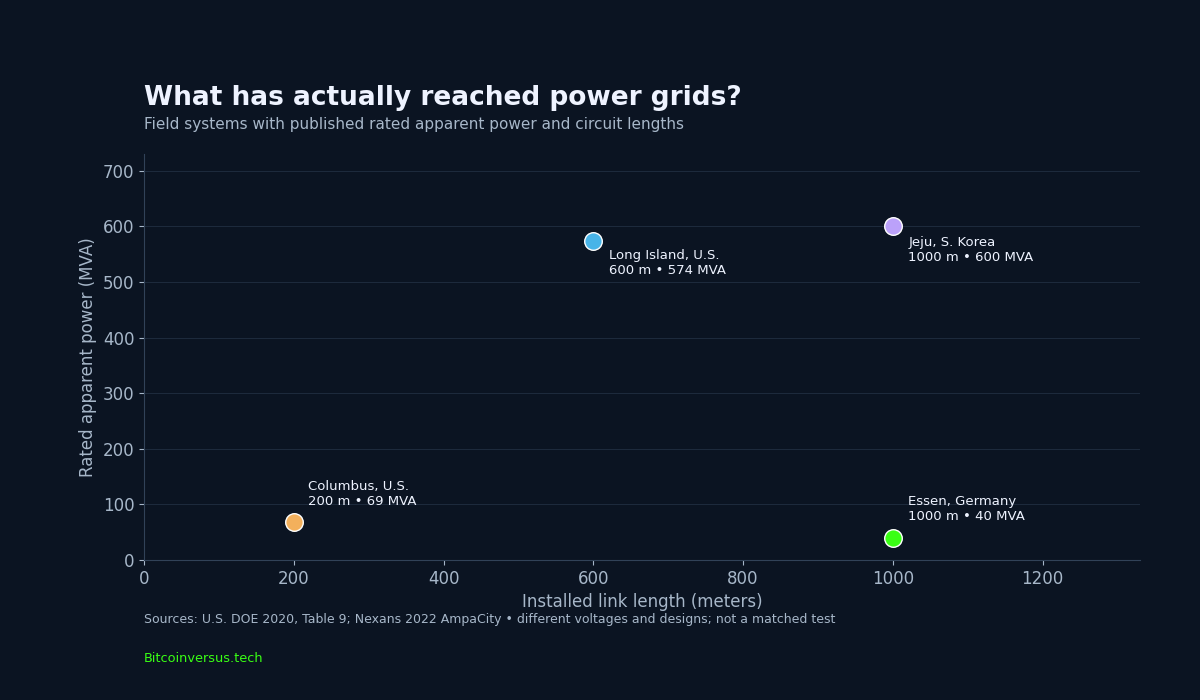
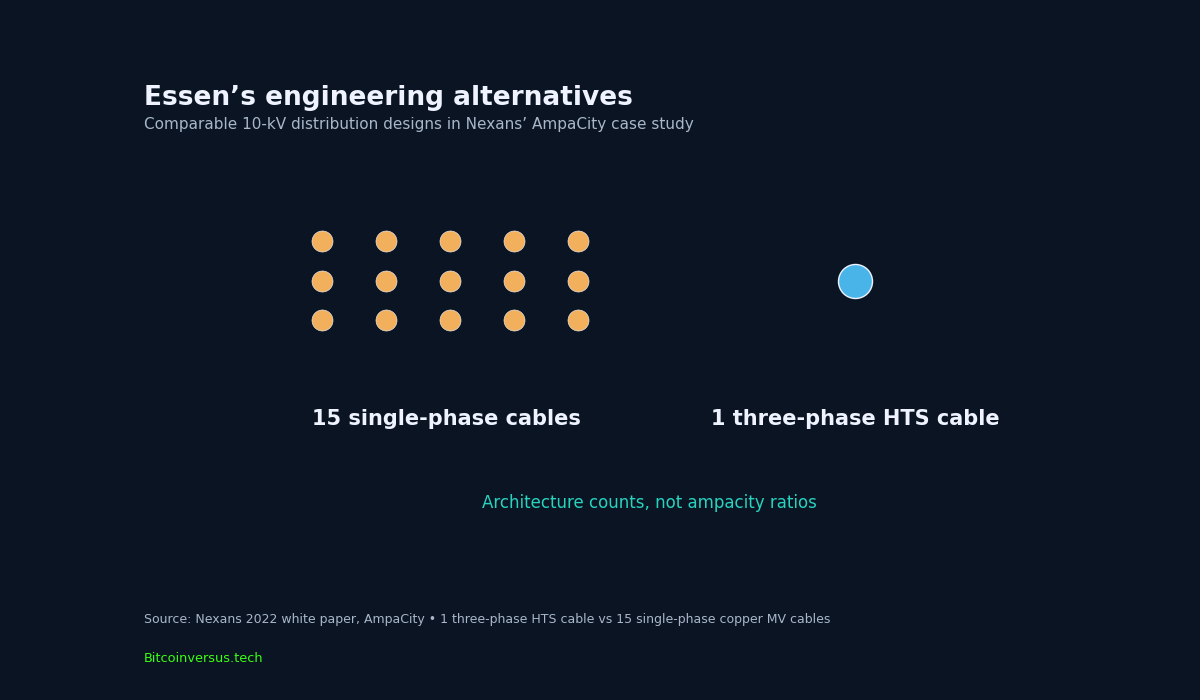
The Essen case study adds an especially useful design comparison: one three-phase HTS distribution cable versus 15 single-phase conventional medium-voltage cables as an alternative for the same city-center connection. The result reflects phase packaging, permitted routing and voltage design—not proof that every HTS conductor carries fifteen times the current.
Data centers, cost and cooling
VEIR reported delivering more than 3 MW through one low-voltage HTS cable in a November 12, 2025 simulated data-center demonstration, alongside an up-to-tenfold power-density claim. A simulation or demonstration does not establish continuous utility-grid service or a proven lifetime economic advantage. Benefits include compact routing, less conductor heating and potentially fewer copper runs; conventional copper wins on ambient-temperature operation, established supply chains and eliminating cryogenic equipment.
Every superconducting proposal still needs pumps, refrigeration, protective controls, terminations, fault management and repair access. Reliability and total ownership cost depend on those components. BitcoinVersus.Tech previously reported on Open Compute’s superconducting power work and rising AI-linked electricity demand. Neither trend provides evidence that one technology is suitable for every building or transmission route.
Verdict
Supported with conditions. An 8–10× same-footprint claim is technically plausible and explicitly published by cable manufacturers, while operating grid projects establish practical feasibility. Bloomberg’s visual should be read as an illustration, not a universal eightfold measurement. The winner for a cramped, high-current corridor may be superconducting cable; for ordinary distribution, copper or aluminum often remains the simpler, less demanding choice.
Bloomberg Originals, “How the Electrical Grid Is Being Rebuilt for AI,” May 27, 2026; the segment on VEIR begins around 8:40. Official publisher video; playable embedding requires a separate live check.
Editor’s Note
Manufacturer capacity multipliers, designed alternatives, operating utility links and simulated demonstrations are separate evidence classes. No universal copper-to-HTS ampacity ratio was independently verified. The DOE transition temperatures are reference material values; real current limits vary with field, temperature and architecture. The featured illustration depicts conceptual cable construction, not a certified equipment cross-section. Figures use primary-source specifications and project records only.
Support BitcoinVersus.Tech
Support independent engineering reporting with an optional 5,000-satoshi contribution. Scan the original approved QR code using a compatible Bitcoin wallet. On mobile, display the QR on another device or use your wallet’s image scanner, and verify the receiving address and payment amount before confirming.

We volunteer daily to ensure the information on this platform is Verifiably True. If you would like to support the research, please scan QR code.


Leave a Reply