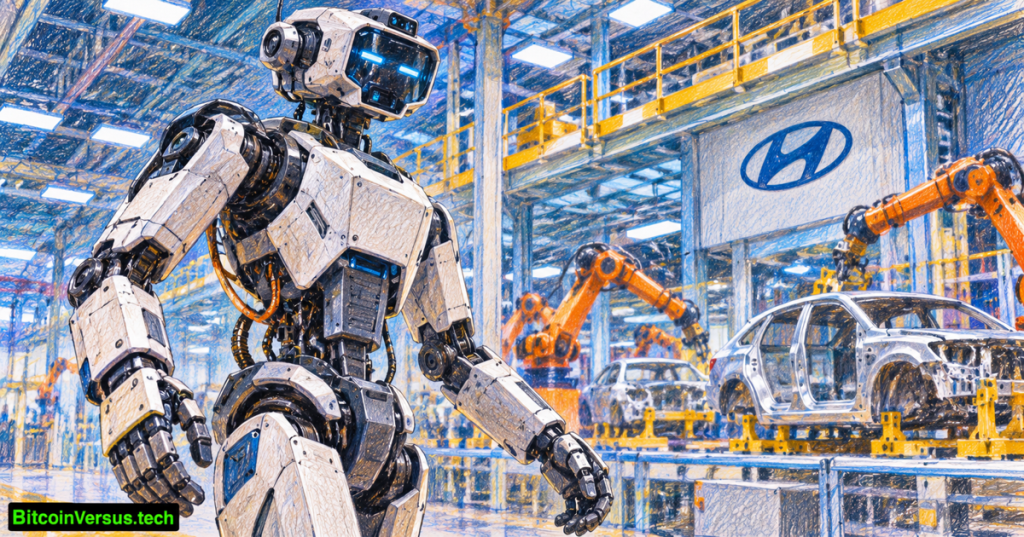
STATS | Robotics. Hyundai Motor Group’s affiliated shareholders and Executive Chair Euisun Chung now collectively own 100% of Boston Dynamics after acquiring SoftBank’s remaining 9.65% stake, according to November 17 reporting citing Hyundai Glovis’s third-quarter regulatory filing. The completion ends SoftBank’s minority ownership and gives Hyundai’s ownership group greater control over the maker of Atlas humanoid robots and Spot quadrupeds. Importantly, the shares are held across several group companies and Chung personally, not solely by Hyundai Motor Company.
The deal was not a surprise purchase announced overnight. Hyundai confirmed in July that shareholders were pursuing SoftBank’s entire remaining stake following a put-option exercise. A November 17 Hyundai Glovis filing reportedly recorded the associated put and call options as exercised and extinguished during the third quarter. The resulting 100% ownership is a completed transaction; claims about future robot production are separate forecasts.
Robotics revenue grows, but losses remain steep
Boston Dynamics recorded 136 billion South Korean won in revenue during the first nine months of 2026, an increase of 29% year over year, according to reporting based on Hyundai’s financial disclosures. The same coverage reports a 626.6 billion won net loss for the nine-month period. Revenue growth therefore has not yet translated into profitability. The loss magnitude is approximately 4.61 times nine-month revenue, although revenue and net loss are different accounting measures and the ratio is not a profit margin.
Using the reported 29% annual growth, the implied comparable nine-month 2025 revenue is 136 ÷ 1.29 = approximately 105.4 billion won, giving an implied increase of 30.6 billion won. Both inferred values are approximate because the percentage and current revenue are rounded. The 2026 figures represent a January through September measurement period, not a full-year total or a quarterly run rate.
Why Hyundai wants full control
Hyundai’s long-term objective is to combine robotics engineering with vehicle manufacturing, logistics and AI software. Atlas is intended for factory tasks requiring manipulation and movement through spaces designed for people. Spot already serves industrial inspection applications, while Stretch handles warehouse box movement. Each platform has different technical requirements, including perception, safety, end-effectors, power management and reliability.
Hyundai has described plans to begin deploying Atlas at its Georgia Metaplant in 2028 for parts sequencing, potentially expanding into assembly by 2030. Reports also cite a target of 30,000 units of annual humanoid production capacity by 2028. Those dates and capacities are plans, not observed robot deliveries. Demonstrations of mobility and manipulation cannot establish manufacturing yield, uptime or cost per completed industrial task.
A new phase for industrial humanoids
The ownership shift arrives as robotics companies seek to move beyond laboratory demonstrations. BitcoinVersus.Tech has covered GlobalFoundries’ robot inspections and planned Atlas trials, Atlas motor-control testing, Stretch Gen 2’s wiring redesign, and Atlas production-time ambitions. The latest ownership milestone adds a financial and governance dimension to those engineering developments.
The financial contrast matters: revenue is increasing, but engineering and commercialization expenses remain substantial. A company can demonstrate sophisticated robots while still facing uncertain margins, lengthy deployment cycles and integration costs. Full ownership may simplify decisions, yet it does not itself prove product-market fit or guarantee a profitable humanoid business.
Editor’s note and sources
The 100% figure describes combined holdings of Hyundai Motor Group affiliates and Executive Chair Chung, rather than a single company’s direct ownership. The nine-month revenue growth is reported historical financial performance; the 2028 production-capacity target and deployment schedule are forward-looking. The featured artwork is a conceptual illustration, not a documented photograph of Atlas in a Hyundai factory.
Sources: Hyundai Motor Group statement, July 16, 2026; The Korea Herald, November 17, 2026, citing Hyundai Glovis filing; The Straits Times, November 17, 2026; Hyundai’s original 2021 acquisition announcement. Financial reporting and forecasts are not investment advice.


Leave a Reply