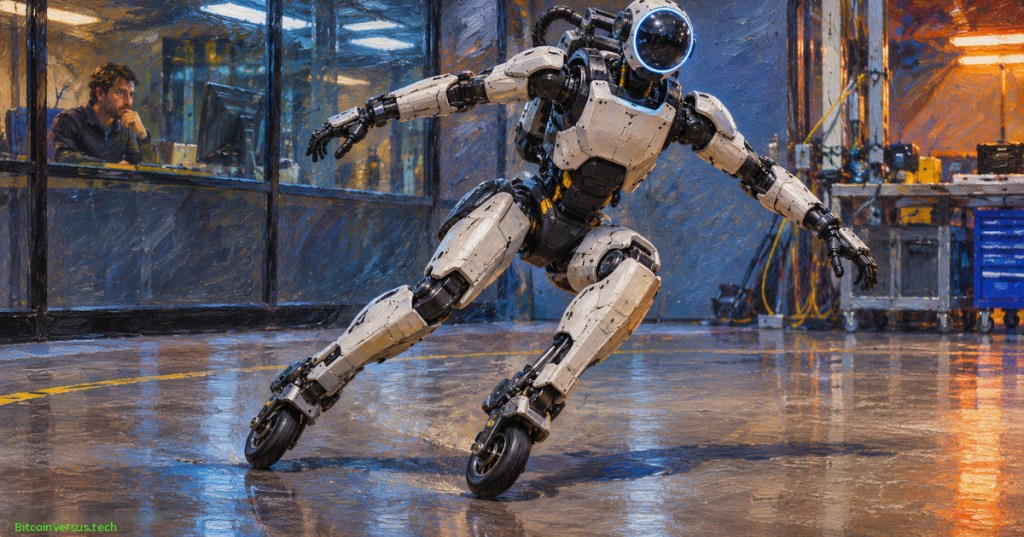
Boston Dynamics swapped the feet of its Atlas humanoid for scooter wheels and demonstrated rolling, sideways dashes and a 360-degree jumping spin in a video released November 9, 2026. The research experiment was not a new wheeled robot announcement. Its main purpose was to stress-test electric actuators and determine whether a reinforcement-learning controller trained in simulation could operate reliably on real hardware.
Atlas controls engineer Xiaoyu (Andy) Wu described the experiment in the company’s technical account. Continuous rolling puts motors under sustained load during acceleration, steering and braking, exposing behavior across their torque-speed operating range. Unlike a short walking step, a wheel drive can demand repeated torque while remaining in motion.
Official November 9, 2026 “Atlas on a Roll” demonstration showing the wheel-equipped test robot and its motor-control research. Credit: Boston Dynamics / YouTube.
A scooter rim became an actuator stress test
The hardware change was deliberately limited. A custom adapter attached an off-the-shelf scooter rim to each existing ankle actuator; Wu described the adapter as the only newly designed part. Software represented each wheel as an ankle capable of continuous rotation, allowing the team to adapt its existing whole-body model rather than build an independent rolling-robot platform.
The setup probes an important weakness in robot learning. A control policy can succeed across millions of simulated episodes yet fail on physical hardware if a motor’s delay, friction, torque response or saturation differs from its digital counterpart. Engineers compared low-level controller settings, characterized the motors and tuned the simulated actuator dynamics against measurements from Atlas.
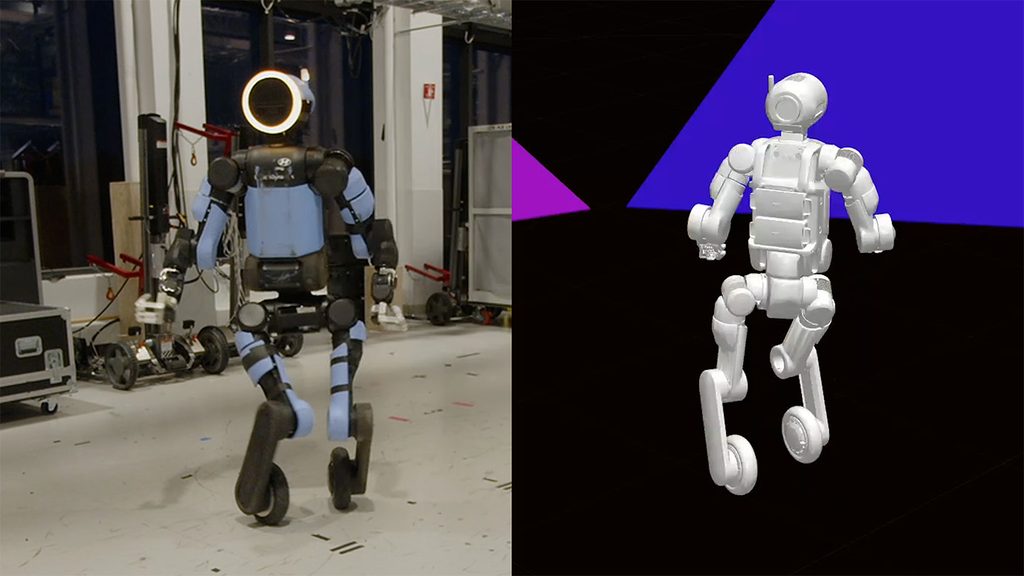
The learned controller turned sliding into rolling
Wu reported that a small set of reinforcement-learning changes—reward composition, command ranges and posture control—produced smooth rolling. During lateral moves derived from human motion-capture sequences, the policy learned to steer and roll where a person would slide a foot. The team says the 360-degree jump followed a recorded human trajectory and worked on the first try. Such a motion-tracking result does not mean the robot independently invented the jump.
Related whole-body control methods coordinate multiple robot joints under balance and contact constraints. Reinforcement learning approaches the problem through trained policies rather than manually specifying every maneuver. Both approaches still depend on accurate actuator models and physical limits.
The visual spectacle should not be mistaken for a production milestone. Boston Dynamics explicitly labels wheeled Atlas a research testbed. The company supplied no comparable speed benchmark, energy-per-meter measurement, sustained duty-cycle record or quantified motor-failure recovery rate for the wheel configuration. The demonstration therefore cannot establish commercial superiority over walking robots or dedicated mobile bases.
Official October 14, 2026 “Machine, Assemble, Repair: How We Build Atlas” film showing Boston Dynamics’ prototyping and assembly environment. Background manufacturing context, not footage of the wheel experiment. Credit: Boston Dynamics / YouTube.
What the result does—and does not—prove
Wu said the lessons are already being adapted to standard legged Atlas, including continued work on how learned policies respond to failed actuators. Such failure handling matters in warehouses and factories, where reliable recovery can be more valuable than an athletic maneuver. The company’s Stretch Gen 2 engineering changes illustrate the same broader focus on serviceability and production reliability.
Atlas is simultaneously progressing toward industrial deployments. Boston Dynamics said in January that its product-version humanoid would enter manufacturing, with 2026 placements committed to Hyundai and Google DeepMind. The 13-degree-of-freedom Atlas hand addresses manipulation, whereas the wheel test concentrates on locomotion and motor dynamics. Neither demonstration alone proves end-to-end autonomous performance on a live factory shift.
Roboticists face a recurring tension between training many behaviors quickly and knowing how machines will respond when a component operates outside nominal conditions. The same concern underpins robot training facilities and physical-AI datasets. Simulation can generate abundant experience, but bad physical assumptions can teach a policy the wrong lesson at scale.
For prospective customers, the useful next evidence would include repeated trials with disclosed success rates, actuator temperature and current measurements, recovery after commanded faults, and trials under real workplace constraints. Boston Dynamics has offered a convincing demonstration of simulation-to-hardware transfer for a novel configuration, supported by an engineer’s technical explanation. It has not announced a wheeled Atlas product or a verified deployment date.
Sources: Boston Dynamics engineering account by Xiaoyu (Andy) Wu; official demonstration published November 9, 2026; official Atlas manufacturing film published October 14; Humanoids Daily, November 9; The Herald Business, November 10; Boston Dynamics product announcement, January 5, 2026. Performance statements beyond filmed movements are attributed to company disclosures, not independently reproduced tests.
Editor’s Note: The wheeled Atlas configuration is a laboratory experiment, not a newly offered product. The 360-degree jump follows a captured human motion; no independent speed, reliability or deployment metric was established. The original 1200 × 630 featured oil painting is conceptual artwork with a neon-green Bitcoinversus.tech watermark, not manufacturer photography. The in-story real-versus-simulation image belongs to Boston Dynamics. Two official YouTube videos illustrate the experiment and Atlas manufacturing, respectively. Rendered video players should not be mistaken for verification of playback on every handset or browser.

BitcoinVersus.Tech is volunteer-run and publishes independent technical journalism. An optional 5,000-satoshi donation supports ongoing research. Scan the original QR from a second screen using a compatible Bitcoin wallet; on the same phone, use a wallet that can import a saved QR image when supported. Independently verify recipient 3C9o19EH5HSiwEPyCTmEKzxhNCbo2X6TTb and the 5,000-satoshi amount before sending. Bitcoin transfers are generally irreversible.
We volunteer daily to ensure the information on BitcoinVersus.Tech is Verifiably True. Technical and financial coverage is educational and informational, not personalized engineering, securities, tax or investment advice.


Leave a Reply