November 15, 2026 — Semiconductors / Networking.
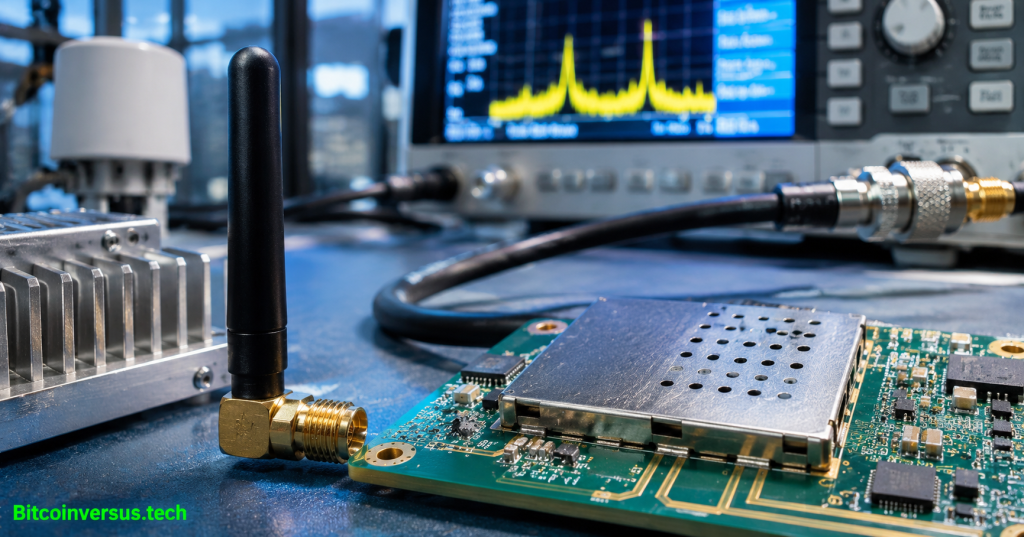
GCT Semiconductor shipped more than 3,200 fifth-generation wireless chipsets during the third quarter of 2026, bringing shipments for the first nine months above 11,300 units. The San Jose-based designer disclosed the figures November 12 alongside quarterly revenue of $1.069 million, up 148.6% from a year earlier. Yet most of its new 5G activity remains tied to customer qualification rather than established high-volume production.
The key distinction is between semiconductor shipments and commercially deployed devices. GCT says a new customer developing terrestrial geolocation technology accounted for most third-quarter 5G chipset deliveries. The customer is testing precise three-dimensional positioning in buildings, dense urban environments and areas where satellite navigation is disrupted. GCT has not identified the customer or released independent accuracy measurements for the application.
Official primary document: GCT Semiconductor’s Q3 2026 results filed with the SEC. Figures cover the quarter ended September 30, 2026.
Why terrestrial positioning matters
Conventional global navigation satellite systems, including GPS, calculate location using timing signals from orbiting spacecraft. Buildings and urban structures weaken or reflect those signals, while deliberate interference can degrade reception. Ground-based radio networks can supplement positioning through carefully synchronized signals and measurements, although performance depends on network geometry, calibration, propagation and receiver implementation. GCT’s reported program is a proof of concept, not a demonstrated replacement for GPS.
Management also acknowledged a slower commercialization schedule. Integration of its 5G chips into customer hardware is taking longer than expected, extending the anticipated volume ramp into the first half of 2027. On the earnings call, executives said several customer programs remain in preproduction or sampling, while one customer has already launched. Future launch dates and orders remain projections.
Related company material: GCT and Globalstar’s official cellular–satellite IoT partnership announcement (March 2025). Earlier partnership context, not footage of the geolocation trial.
Financial performance and deployment risk
The company reported a net loss of approximately $7.4 million for Q3, narrower than roughly $13.8 million a year earlier. Adjusted EBITDA remained negative at about $6.5 million. Cash and cash equivalents stood at $17.2 million on September 30. GCT extended the maturities of $26.5 million in loans by one year, an important financing detail for a chip supplier investing ahead of volume adoption.
One separate source of demand comes from older radio technology. GCT reported a 150,000-unit order for 4G private-network tablet applications, with 18% shipped during Q3. That percentage implies approximately 27,000 units, assuming the disclosed figure is exact. The order does not count as 5G shipment volume and should not be presented as evidence of accelerated 5G adoption.
GCT’s product strategy spans terrestrial broadband, satellite connectivity and specialized industrial networking. The company previously described collaboration with Globalstar on cellular and satellite IoT modules. Hybrid networks could improve connectivity for remote assets, but integrating radio standards, antennas, certification and device power management adds engineering and commercial complexity.
Company product context: GCT’s official connectivity product portfolio. Product specifications do not independently validate the newly announced 5G positioning proof of concept.
What to watch in 2027
The broader networking sector is expanding in different ways. BitcoinVersus.Tech recently covered Cisco’s AI networking outlook, MIT research on 5G and radar interference, commercial satellite deployment and long-cycle battery development. Those stories describe distinct markets and do not establish demand for GCT’s products.
The measurable milestones for GCT are conversion of evaluation programs into production purchase orders, larger repeat shipments, improved gross margins and sustainable operating cash flow. The latest figures show technical engagement and revenue growth, but not yet a completed transition to profitable high-volume 5G chip manufacturing.
Primary sources
SEC-filed November 12 earnings release; GCT corporate announcements; November 12 earnings call transcript.
Editor’s Note: BitcoinVersus.Tech distinguishes verified filings and technical specifications from company expectations and unvalidated prototypes. Coverage is independent and does not constitute investment advice. Contributions are voluntary and do not influence editorial judgments.


Leave a Reply