
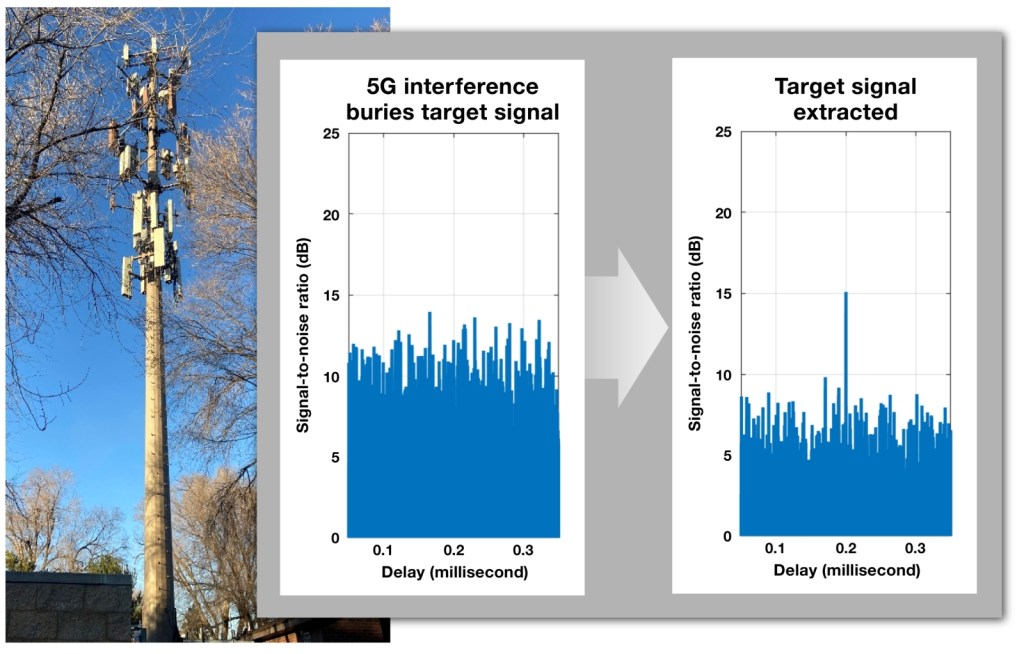
MIT Lincoln Laboratory researchers say a 5G interference-cancellation algorithm recovered a radar test signal obscured by a cellular base station, preserving 89% of the radar’s interference-free detection range in a reported trial. The engineering result was recognized in the 2026 R&D 100 Awards and highlighted in a November 12 report from MIT News. The finding describes a specific test—not a universal guarantee for radar installations.
How the interference cancellation works
Radar receivers measure faint radio-frequency returns. Nearby cellular transmissions can occupy overlapping channels or create interference that masks a weaker target, even when equipment operates as intended. Radio engineers typically manage such problems through frequency planning, filtering, directional antennas and beamforming. MIT’s team instead exploits the known structure of the 5G downlink to calculate what the unwanted signal looks like at the victim receiver.
Under standardized 5G signaling, a receiver can identify portions of the waveform and model how nearby structures reflect and distort it through multipath propagation. The software reconstructs an estimate of the interfering transmission, then subtracts the estimate from the composite received waveform. The residual data can reveal the weaker radar return. Accuracy depends on how closely the reconstructed signal matches the actual interference.
Unlike spatial methods that steer antenna patterns away from interference, the reported approach operates on each receiver antenna channel. Researchers say preserving array channels can leave other interference-management resources available. For related context, see BitcoinVersus.Tech’s explanation of phased-array antennas and electronic beam steering.
What the 89% result means
MIT says its researchers processed over-the-air transmissions from a Nokia 5G base station at Hill Air Force Base and recovered a deliberately obscured radar test signal. After cancellation, the radar signal-to-noise ratio came within 2 decibels of its interference-free condition. The laboratory translates the measured outcome into 89% preservation of the original detection range, under the reported assumptions and test configuration.
Preserving 89% of range does not mean eliminating 89% of all interference, guaranteeing 89% target-detection probability or proving identical performance against every 5G transmitter. MIT has not published a broad, independently reproduced, multi-vendor field qualification alongside the award announcement. Receiver hardware, propagation, signal power, mobility and multiple simultaneous interferers can all complicate real-world deployment.
Where the research goes next
The laboratory reports that the Department of War is evaluating the technology for multiple platforms. Civilian radio observatories, satellite ground stations and other systems sharing crowded spectrum might also have an interest in coexistence methods, although each application would need its own engineering validation. MIT’s Technology Licensing Office lists a related interference-cancellation invention under case 25089L with a pending U.S. patent application.
The development belongs to a larger effort to make radios more adaptive. BitcoinVersus.Tech recently covered DeepSig’s live 5G radio work, NVIDIA’s 6G research toolkit and Qualcomm’s Linux Wi-Fi 8 driver development. Different radio technologies require different approaches to interference, but accurate waveform modeling is a recurring technical theme.
Researchers also suggest similar signal reconstruction may become useful against future 6G transmissions because cellular waveforms continue to follow defined standards. Such extension remains a possibility, not a demonstrated production capability. The immediate achievement is narrower and measurable: one obscured test signal recovered, with a substantial portion of baseline radar range retained.
Primary sources
MIT Lincoln Laboratory — 2026 R&D 100 Awards announcement (October 8, 2026); MIT News — research summary (November 12, 2026); MIT Technology Licensing Office — interference-cancellation technology listing.


Leave a Reply