Wireless networks transmit information through radio waves, while software-defined radio systems move more signal-processing work from specialized hardware into programmable computing. Researchers are now testing whether artificial intelligence can improve signal reception, robotic communication and network energy use. On November 6, 2026, NVIDIA reported that its open-source 5G/6G research tools had exceeded one million downloads, with more than 8,000 academic and research institutions using the platforms.
NVIDIA Developer, “From Theory to Practice—Prototyping 6G With the NVIDIA Sionna Research Kit” (May 4, 2026) — Sebastian Cammerer demonstrates the research kit and discusses over-the-air testing. Official technical presentation, not a commercial 6G deployment.
NVIDIA said developer adoption of AI Aerial and Sionna grew tenfold over the preceding year. Downloads count software retrievals, however, not unique users, paying customers or operational 6G radio sites. Sionna supports differentiable wireless simulations and radio-propagation modeling; Aerial includes GPU-accelerated radio-access-network software and testing platforms. The ATIS 6G foundation-model proposal outlines another research approach to AI at the physical layer.
Researchers Test Faster Robotic Communication
A King’s College London research paper describes a camera-equipped robot arm and an NVIDIA Jetson AGX Orin connected through a 5G testbed. Instead of sending frequent full images, the system transmits compressed descriptions of objects and spatial relationships. Across fruit-packing and cube-stacking tasks with introduced faults, the researchers recorded up to 52.6% shorter task-completion time and up to 45% greater task-success probability than the selected periodic-image baseline. Those results concern the tested tasks, not every industrial robot or wireless deployment.
Elsewhere, SoftBank integrated an AI-based receiver into NVIDIA Aerial and tested it with a commercial 5G handset. NVIDIA reported higher uplink throughput in all 15 tested interference configurations, with a maximum gain near 60%. The result illustrates a potential advantage under controlled interference, not a promised 60% capacity increase across existing cellular networks. Related field work includes the site’s DeepSig AI-RAN testbed report.
NVIDIA Developer, “Design and Test 5G and 6G Networks Using NVIDIA Aerial Omniverse Digital Twin” (April 23, 2024) — Official background demonstration of virtual radio-network design; laboratory and simulation capabilities should not be mistaken for commercial 6G coverage.
Power Savings and Simulation Speed
University of Leeds researchers developed network-demand forecasts looking 10 minutes ahead, using predictions to decide when radio base stations could sleep. NVIDIA reported 45.6% lower radio-access-network power use than a full-power baseline while devices remained connected in a portable 5G test environment. The percentage describes equipment operating under the reported test conditions, not a measured national-grid saving.
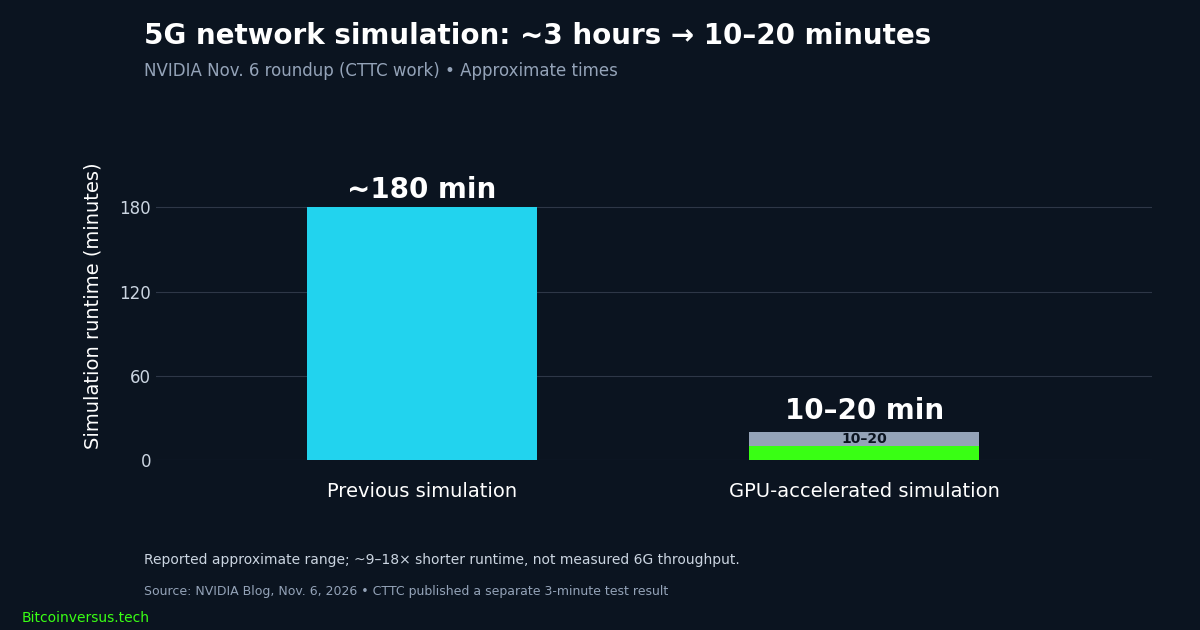
For radio-network simulation, NVIDIA’s November 6 roundup reported an approximate drop from three hours to 10–20 minutes in an early evaluation of GPU-accelerated channel models. The Catalonia-based research center CTTC separately reported a different specified case involving 21 cells and 210 users that ran in roughly three minutes, with a claimed 70× acceleration based on underlying measurements. The two reported configurations should not be treated as a single repeated benchmark.
Early Evidence, Not a Finished 6G Network
At ETH Zurich, site-specific neural-receiver training reduced measured block-error rates by approximately one-third or more against selected pretrained baselines, although results varied by architecture and test setting. Comparable engineering trade-offs appear in previous BitcoinVersus.Tech coverage of Nokia’s AI-RAN spectral-efficiency trial and an outdoor pre-standard 6G test.
The research shows credible progress in programmable radio systems, but published gains depend on selected tasks, radios, hardware and baselines. Future commercial networks will require interoperability, spectrum coordination, operating-cost validation and standardized performance tests. NVIDIA’s developer adoption figures remain company-reported; no independent audit of download and institution totals was identified.
Primary sources: NVIDIA, November 6, 2026; King’s College London, September 2026; ETH Zurich, September 2026; CTTC, November 4, 2026; NVIDIA AI Aerial technical reference.
BitcoinVersus.Tech Editor’s Note
Published November 8, 2026. Download and institution counts, SoftBank results, and Leeds power figures are presented as NVIDIA-reported statistics. King’s College London and ETH Zurich findings were cross-checked against available research manuscripts. NVIDIA’s November 6 simulation summary and CTTC’s November 4 specified experiment have different reported runtimes and are identified separately. The featured cover is a conceptual illustration, not an actual NVIDIA testbench photograph; the in-story chart is an original calculation. Manufacturer videos are background demonstrations, not independent reproduction of reported metrics.
We volunteer daily to ensure the information on this platform is Verifiably True. If you would like to support the research, please scan QR code.

Support independent reporting with an optional donation of 5,000 satoshis. Scan the original QR from a separate screen using a Bitcoin wallet, or use a compatible saved-image scanner on mobile. Verify destination 3C9o19EH5HSiwEPyCTmEKzxhNCbo2X6TTb and amount before sending.
BitcoinVersus.Tech is not a financial advisor. Financial coverage is provided purely for informational purposes.


Leave a Reply