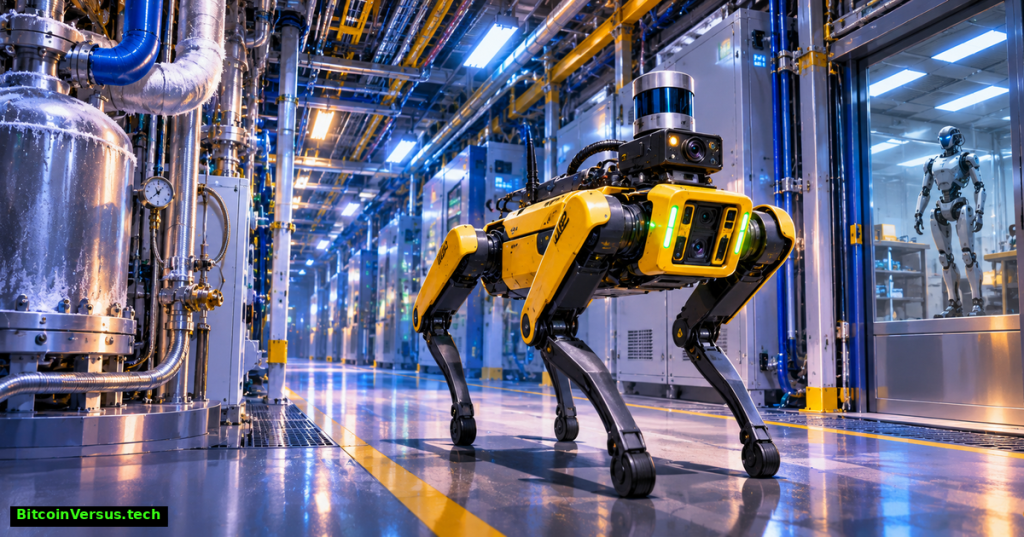
Boston Dynamics and semiconductor manufacturer GlobalFoundries announced on November 17, 2026, that Spot inspection robots will expand across chipmaking facilities in the United States, Germany and Singapore. The companies also plan to test Boston Dynamics’ Atlas humanoid at GlobalFoundries sites beginning in early 2027. The agreement builds on an established deployment, not a newly completed humanoid rollout. According to the companies’ joint announcement, two Spot robots in Singapore have completed more than 90,000 inspections since April.
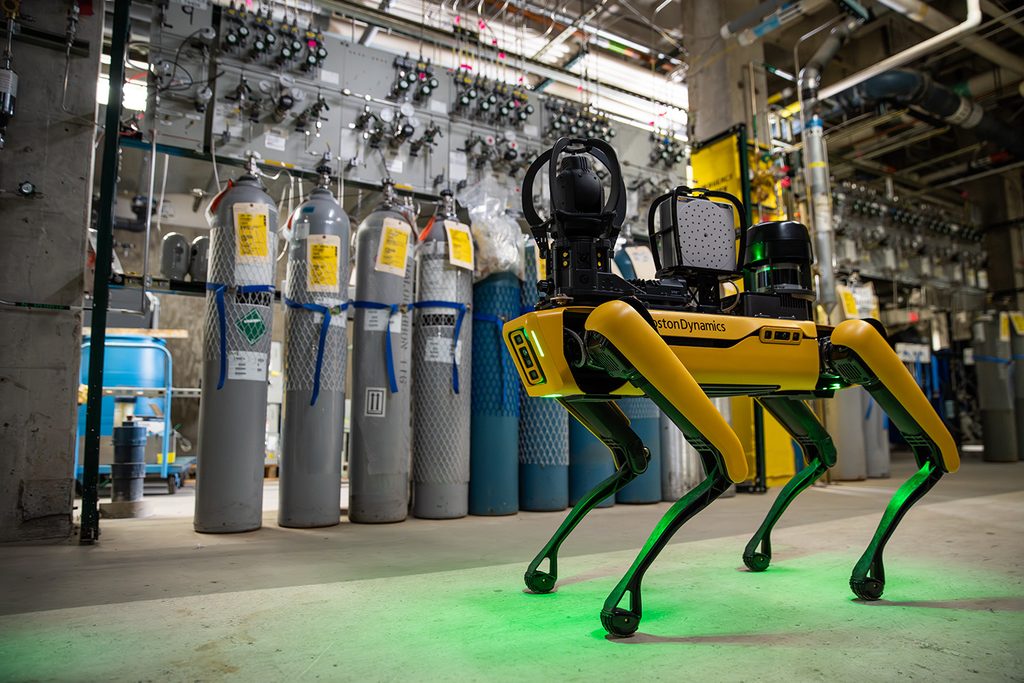
The planned expansion covers GlobalFoundries facilities in Malta, New York; Burlington, Vermont; Dresden, Germany; and Singapore. Spot already operated at the Burlington site for more than four years. Its work focuses on monitoring manufacturing support equipment, including the pumps, motors and gauges that help keep sensitive fabrication processes stable. Unlike a robot that directly handles silicon wafers, Spot acts primarily as a mobile collection platform for maintenance data.
What 90,000 inspections actually show
At its Singapore operation, GlobalFoundries reports that two Spots have traveled nearly 900 kilometers in sub-fab areas since April, completed more than 90,000 inspections and achieved a 99% mission success rate. The figures are company-reported operating metrics, not independently audited evidence of reduced downtime. Mission success should not be confused with perfect accuracy across every temperature reading, gauge interpretation or potential fault diagnosis.
Boston Dynamics official video, May 12, 2022: “Spot at GlobalFoundries | Enterprise Asset Management.” Archival footage of the earlier Burlington deployment, not the November 2026 expansion.
The original installation used a sensor package to gather thermal information from pumps and motors and visually read analog gauges. Integration partner Levatas supplied computer vision for identifying equipment and interpreting readings. Repeated measurements can establish trends that help engineers investigate developing problems before equipment fails. Boston Dynamics describes the wider approach as autonomous enterprise asset management.
The partners also report redeploying 875 routine inspection tasks within two weeks using updated software and hardware, with plans to more than double that coverage. A task count does not disclose how frequently each task is performed or how much labor has actually been eliminated. Effective maintenance programs still need calibrated sensors, trustworthy alerts, technicians, spare parts and review of false positives.
Atlas will enter a different kind of test
GlobalFoundries is scheduled to become the first semiconductor manufacturer in Boston Dynamics’ Atlas early adopter program, and the first customer outside the automotive industry to evaluate the electric humanoid. The companies will study factory use cases, worker training, integration requirements and early task execution. No production-scale Atlas installation, confirmed task list or measured throughput was announced for the fabs.
Boston Dynamics official technical discussion, March 18, 2026: “Form & Function of Enterprise Humanoid Design.” Archival explanation of Atlas engineering, not footage from GlobalFoundries’ planned 2027 trials.
The distinction matters because facility inspection and humanoid manipulation create different engineering risks. Spot patrols predefined routes with sensors, while Atlas would need to manipulate objects reliably in constrained workspaces. A semiconductor site also imposes stringent safety, access, contamination and uptime requirements. Testing in early 2027 is an evaluation milestone, not proof of autonomous wafer handling or replacement of production technicians.
Benefits, costs and the unanswered questions
A mobile robot can inspect many distributed points without installing a fixed sensor at each location. Potential gains include more consistent readings, fewer hazardous entries and faster recognition of thermal anomalies. Yet GlobalFoundries has not published a comparable facility-wide study showing return on investment, avoided breakdowns, error rates or energy consumption for the new expansion. Those measures will determine whether broader deployment produces lasting operational benefits.
Related BitcoinVersus.Tech reporting covered Spot 5.2’s automated inspection software, Atlas motor-control testing, GlobalFoundries’ New York manufacturing plans and factory automation plans at General Motors. The semiconductor partnership offers a concrete case of inspection robots moving beyond a single pilot, while humanoid manufacturing work remains a separate experiment.
The next meaningful results will be site-by-site measurements of inspection reliability, maintenance outcomes and Atlas task performance. Until those arrive, the confirmed development is an expanded Spot program and a scheduled humanoid trial, not a fully autonomous chip factory.
Sources: GlobalFoundries, November 17, 2026; Boston Dynamics, November 17, 2026; Boston Dynamics’ 2022 video case study; Atlas engineering video, March 2026.


Leave a Reply