Europe’s automotive market is undergoing a measurable shift in the technology powering newly registered passenger cars. Data released November 24, 2026, by the European Automobile Manufacturers’ Association (ACEA) show that 2.211 million battery-electric cars were registered in the European Union during the first ten months of 2026. Their share reached 23.4%, compared with 16.4% during the equivalent period in 2025.
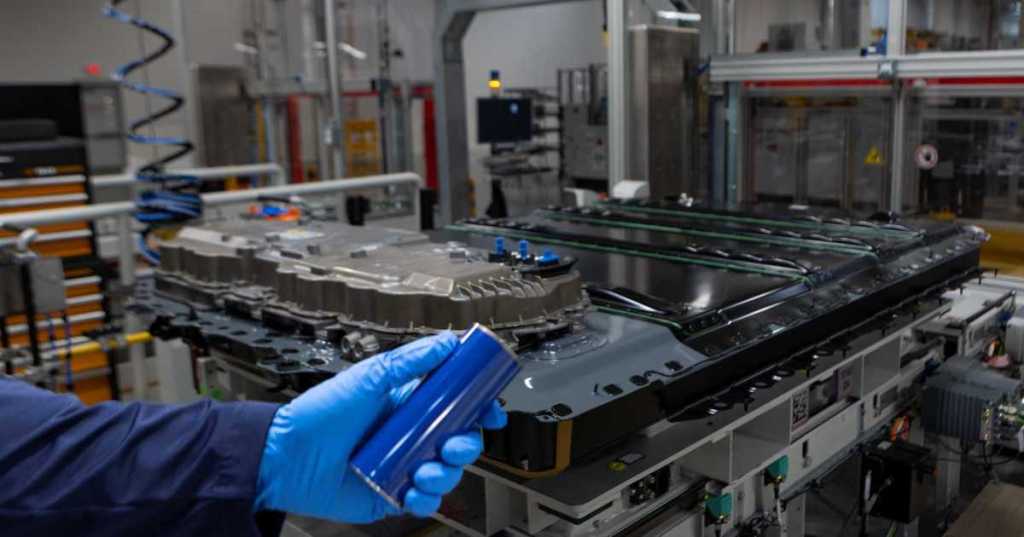
Total registrations grew 5.4% to approximately 9.456 million, while registrations of battery-electric vehicles increased 50%. The shift concerns new passenger cars rather than the entire vehicle fleet already on European roads. Featured image: BMW Group’s archival photograph of battery assembly at Plant Woodruff in South Carolina, illustrating manufacturing technology rather than European registration activity.
ACEA’s May 2024 interview on Europe’s electric vehicle industry provides background on affordability and battery supply chains.
SmartChart #12: A changing powertrain mix
A normalized stacked-column chart compares the composition of each period independently of its total market size. Each column represents 100% of new EU passenger-car registrations. The six mutually exclusive categories reported by ACEA sum to the complete market in both periods.
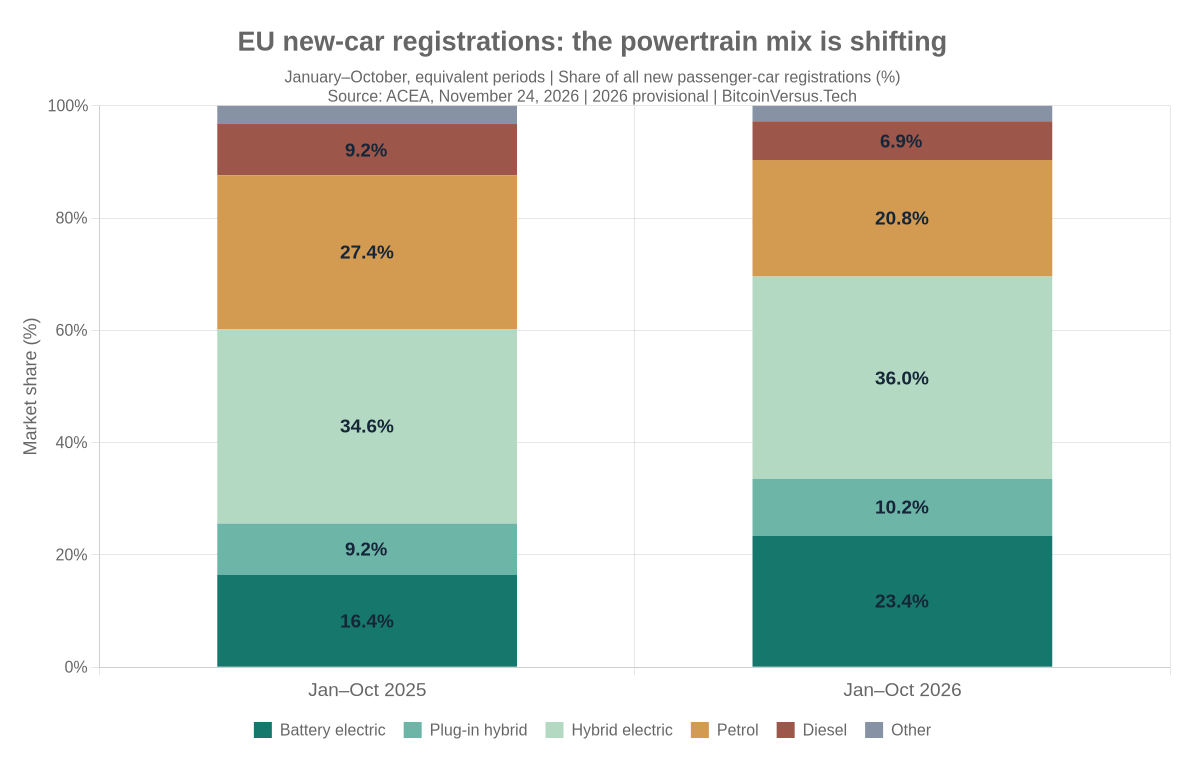
The battery-electric share gained approximately seven percentage points, while conventional petrol and diesel registrations combined fell from about 36.5% to 27.7%. Plug-in hybrids gained approximately one percentage point. Conventional hybrid-electric vehicles, including mild hybrids, retained the largest share at 36.0%. A growing hybrid market does not imply that every hybrid vehicle can travel meaningful distances using electric power alone.
Why the distinction between powertrains matters
Battery-electric vehicles store propulsion energy in rechargeable cells and drive their wheels using electric motors. Plug-in hybrids combine externally rechargeable batteries with combustion engines. Non-plug-in hybrids recover energy during braking and can use electric assistance, but obtain their external energy principally from fuel. Mild hybrids generally use smaller electrical systems that assist the engine rather than providing sustained independent electric propulsion.
Those distinctions affect infrastructure planning. A higher battery-electric share can increase demand for charging equipment, battery cells, power semiconductors and electrical distribution capacity. Actual electricity consumption depends on distance traveled, vehicle efficiency, charging losses and driver behavior, rather than registrations alone. Our earlier coverage explains AC and DC charging and BMW’s battery manufacturing infrastructure.
ACEA’s November 2024 industry discussion examines grid connections, charging infrastructure and consumer incentives.
October accelerated the transition
In October alone, battery-electric registrations reached 279,799 out of 939,447 new cars, equivalent to 29.8% of the EU market. Reuters reported that electric vehicle demand supported overall market growth. Monthly figures can fluctuate with delivery schedules and policy changes; a sustained trend requires longer observation.
The European trajectory also differs from recent U.S. retail trends. Battery supply chains face separate engineering challenges, including lithium recovery from retired cells. Registration data demonstrate changing consumer purchases, but cannot independently establish lifecycle emissions, charging adequacy or future demand. The provisional figures will be subject to revision.
We volunteer daily to ensure the credibility of the information on this platform is Verifiably True. If you would like to support to help further secure the integrity of our research initiative, please scan the QR code below.



Leave a Reply