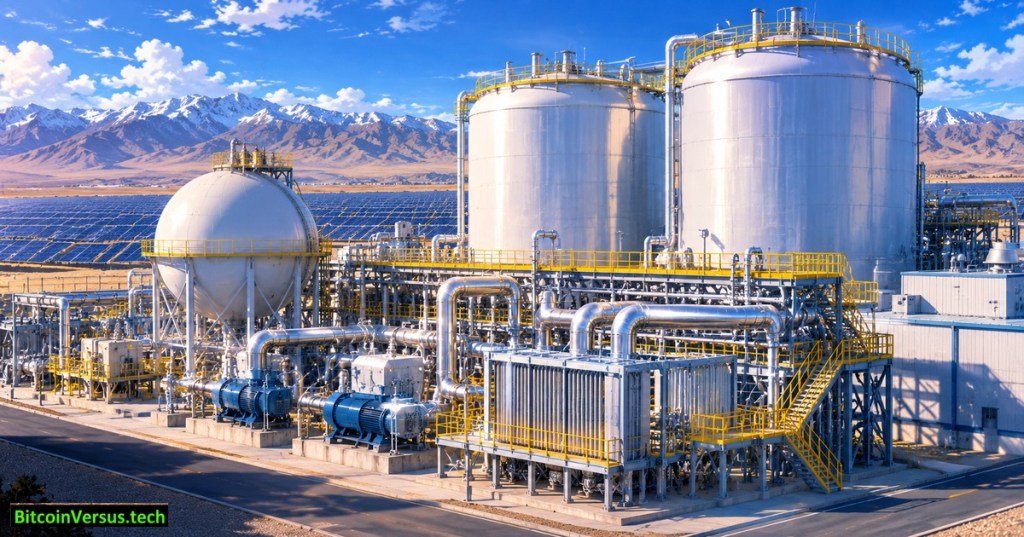
Air is cheap, abundant and ordinarily invisible. At a new facility in northwest China, it has become the working fluid for a 60-megawatt (MW), 600-megawatt-hour (MWh) power-storage system. The plant in Golmud, Qinghai Province, connected to the grid and began generating electricity on October 30, 2026, according to commissioning contractor Qingdao Huafengweiye. Developer China Green Development Investment Group calls the installation the world’s largest liquid-air energy storage demonstration by rated output and capacity.
How can air store electricity?
Liquid-air energy storage (LAES) is a thermomechanical battery. During charging, electricity drives machinery that compresses, dries and cools ambient air until a portion liquefies at roughly −194 °C. Large insulated vessels then hold the liquid near atmospheric pressure. During discharge, pumps raise its pressure; heat exchangers warm and vaporize the liquid; expanding gas drives a turbine and generator. Some designs retain compression heat and cold energy to improve efficiency. The China Energy Storage Alliance says Golmud integrates centrifugal compressors, liquid expanders, air purification and multiple coordinated control systems.
Video: Highview Power’s official 2018 animation explains the liquid-air process. Educational reference only; footage does not depict Golmud or establish its performance.
Why 60 MW and 600 MWh are different
MW measures maximum electrical output. MWh measures energy available over time. Rated discharge duration follows a simple division: 600 MWh ÷ 60 MW = 10 hours. Full-load operation for six hours would deliver 360 MWh, before accounting for operational limits. Real dispatch depends on tank state, ambient conditions, turbine controls and whether the published energy capacity represents gross or usable electricity. No public long-duration performance curve from Golmud was verified.
The developer’s scale claim should not be confused with conventional compressed-air storage in rock caverns. Cryogenic liquid occupies insulated surface tanks, potentially avoiding dependence on underground salt formations or excavated caverns. However, cryogenic insulation, industrial heat exchangers and mechanical losses introduce distinct engineering challenges.
The annual output projection needs context
A 2025 contractor announcement described a supporting 250 MW photovoltaic facility and anticipated roughly 180 million kWh (180 GWh) of electricity annually. Dividing 180,000 MWh by 600 MWh gives 300 full-output-cycle equivalents per year, or about 493 MWh of average daily generation. Those are calculations from a forecast, not a verified annual production record. Daily charging, delivered energy, availability, degradation and electricity-to-electricity efficiency cannot be established from the projected total alone.
A rigorous round-trip efficiency measurement divides exported electrical energy by electricity consumed to recharge the complete system, measured over comparable state-of-charge boundaries. For illustration, a hypothetical 55% electrical efficiency would require approximately 1,091 MWh of input to export 600 MWh. The example is a scenario, not a measured Golmud result. Annual dispatch and cost per delivered MWh remain open questions.
Video: Highview’s 2014 liquid-air pilot-site tour, a documented earlier implementation of the underlying engineering, not the Chinese 2026 project.
Grid connection is not the same as a year of operation
Huafengweiye reported grid synchronization at 11:12 a.m. on October 30, following tests of cold starts, compressor coordination and fluctuating loads. Successful first generation proves an electrical connection and initial plant functionality; it does not verify 10 consecutive hours at full load, yearly output, plant economics or a validated cycle efficiency. The installation belongs to China’s national program for first-of-a-kind energy-storage equipment.
Long-duration storage matters because solar and wind variability may extend beyond short evening peaks. Golmud adds another approach alongside the planned ten-hour non-lithium system in California, vanadium-flow battery deployments, and Utah’s 600 MWh lithium battery. Project design does not alone establish comparative cost, reliability or emissions; electricity sourcing and lifetime utilization matter.
Primary sources, photographs and verification
- Qingdao Huafengweiye, October 31, 2026: first grid connection and commissioning tests.
- China Energy Storage Alliance, November 8, 2026: engineering overview and actual project photograph.
- Commissioning contractor, May 15, 2025: solar integration and projected energy figures.
- PV Magazine, November 6, 2026: independent reporting and credited developer project photograph.
Media and evidence note: The cinematic-anime 1200 × 630 featured cover is conceptual editorial artwork, not a photograph of Golmud. The exact approved BitcoinVersus.tech watermark asset appears once at lower-left. Original project photographs are available at the linked credited sources; they are not republished without verified reuse permission. Both YouTube videos are authentic archival material from the technology company Highview, not recordings of Golmud.
We volunteer daily to ensure the credibility of the information on this platform is Verifiably True. If you would like to support to help further secure the integrity of our research initiative, please scan the QR code below.



Leave a Reply