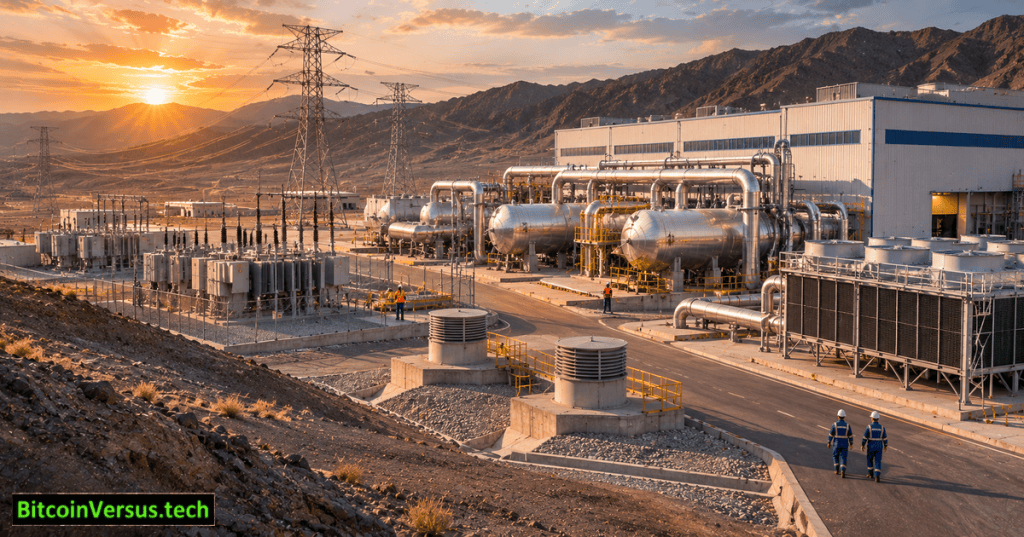
A new kind of grid-scale energy storage plant has sent electricity into China’s power network by squeezing air into human-made underground caverns. Yuanchu No. 1 in Yumen, Gansu province, achieved its first grid-connected generation on November 16, 2026, according to developer China Energy Engineering Corporation and CCTV’s contemporaneous field report. Unlike compressed-air projects that rely on naturally occurring salt caverns, the 300-megawatt facility uses four chambers excavated in hard rock. The developer describes it as the world’s first grid-connected plant of that specific artificial-cavern type, not the first compressed-air storage plant anywhere.
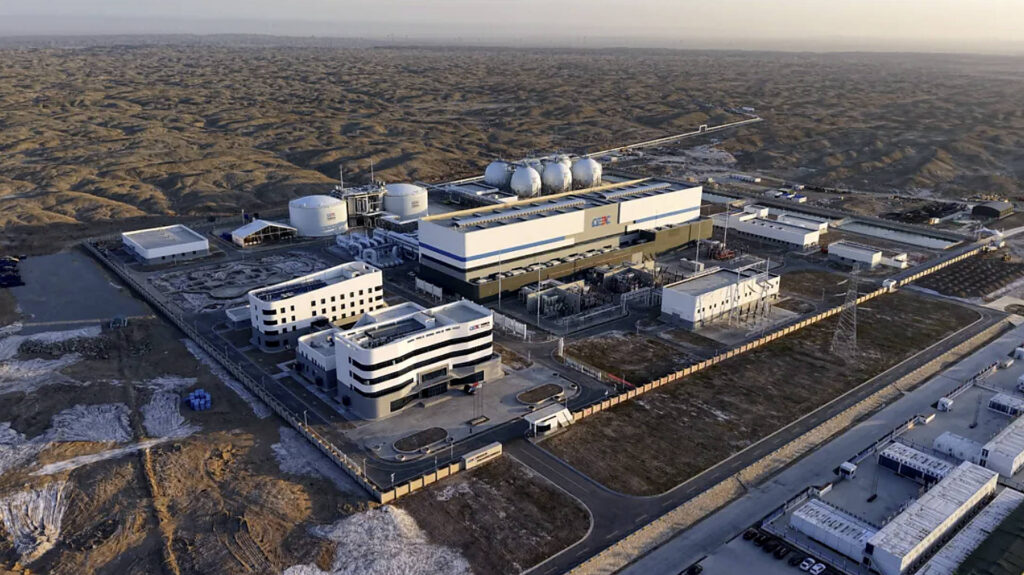
How an underground air battery works
During charging, electric motors drive compressors, forcing air into sealed rock chambers at high pressure. Compression produces heat; the plant’s thermal equipment captures part of it rather than simply releasing it to the surroundings. When electricity is needed, stored air is reheated and expanded through machinery coupled to a generator. Recovering compression heat avoids the supplementary natural-gas combustion used by some older compressed-air systems. Independent reporting from pv magazine describes hot-water and molten-salt heat-storage media used in the design.
Energy China’s official December 2025 footage of the artificial-cavern project, recorded before the November 2026 first grid connection. Watch at YouTube. Historical project footage, not proof of continuous commercial operation.
Six hours of output from four artificial caverns
The plant has 300 MW of rated electrical output and 1,800 MWh of stated energy storage. Dividing energy by power gives six hours at full rated discharge; the design specifies an eight-hour charging period. Four linked chambers sit approximately 110 meters underground, with about 200,000 cubic meters of total storage volume and a stated design pressure of 18 megapascals, roughly 180 bar. Those figures describe engineered design and commissioning claims, not independently published long-term performance tests.
The developer reports 72% electricity-to-electricity round-trip efficiency, meaning that, in principle, 100 MWh used for charging would yield about 72 MWh back under rated conditions. Its projected annual discharge is 600 GWh. Neither number should be mistaken for verified multi-year results after a single grid connection. Separate reporting on China’s 600 MWh liquid-air storage station covers a different technology: cold, liquefied air rather than a cavern of high-pressure gas.
Why digging caverns changes the economics
Conventional compressed-air plants often use natural salt formations that are geographically limited. Excavated hard-rock chambers could expand the available sites, particularly near wind and solar developments in the Hexi Corridor. Yet artificial caverns require substantial excavation, sealing, pressure containment and inspection. The apparent flexibility comes with construction expense and geological risk. Earlier pumped-hydro storage proposals and ten-hour non-lithium batteries illustrate competing long-duration approaches.
IEEE Future Directions lecture featuring Chinese Academy of Sciences researcher Changchun Liu, published March 2026. General compressed-air storage technology explanation, not a test of Yuanchu No. 1. Open the original video.
Long-duration storage can shift wind and solar output to periods when generation falls or demand rises. But a first grid synchronization is an engineering milestone, not evidence of an uninterrupted commercial operating record. Future audits should track actual dispatch, cavern leakage, maintenance, efficiency and delivered cost. For context, U.S. battery deployment statistics and repurposed EV battery systems show how other storage technologies address shorter or more modular applications.
Sources and verification
- CCTV: November 16 field report and developer statements
- pv magazine: November 20 independent technical coverage
- People’s Daily: November 17 announcement in Chinese
- China Energy Engineering: earlier grid-interconnection preparation, 2025
- Energy China: official project video, December 2025
- IEEE Future Directions: March 2026 CAES technical talk
Media note: The photorealistic featured cover is an original editorial illustration, not a photograph of Yuanchu No. 1. The original saved BitcoinVersus.tech neon-green-on-black tag appears once at bottom-left. The actual site photograph is credited separately. Video source validity and Gutenberg rendering can be checked, but successful in-player playback requires a live player test.
We volunteer daily to ensure the credibility of the information on this platform is Verifiably True. If you would like to support to help further secure the integrity of our research initiative, please scan the QR code below.



Leave a Reply