
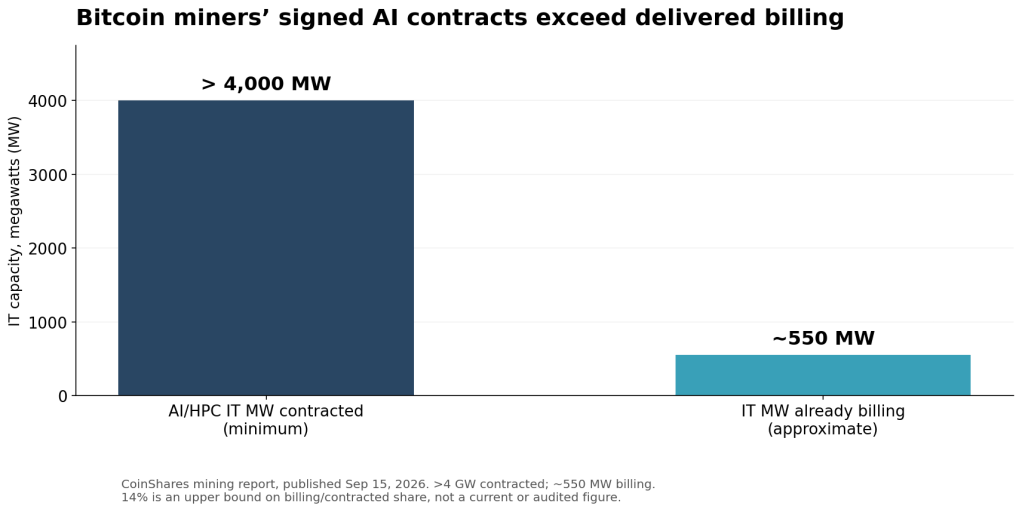
Bitcoin mining companies have signed enormous artificial-intelligence infrastructure agreements, but signed capacity is not the same as a working server hall. In its September 15, 2026 Bitcoin mining report, CoinShares estimated that publicly traded miners in its research universe held contracts for more than 4 gigawatts (GW) of AI and high-performance-computing IT capacity. Only approximately 550 megawatts (MW) were already billing customers. At the minimum 4,000 MW denominator, the billed share would be 13.75%; because contracted capacity exceeds 4,000 MW, its actual reported ratio is below approximately 13.8%. Figures describe the September research snapshot, not a November capacity census.
CoinShares investment strategist Matt Kimmell discusses mining infrastructure and the AI transition in a May 2026 Boardroom Exclusives interview. Historical industry context, not evidence of September billing status. Watch the original interview on YouTube.
The difference between contracted and billing megawatts
Contracted IT power is capacity promised under commercial agreements. Billing capacity is the part generating rent or service revenue. Neither measure automatically equals a site’s total grid connection, because cooling, pumps and electrical losses consume additional facility power. CoinShares’ figures imply that more than 3,450 MW of contracted IT capacity had not started billing at the September observation date. Deployment can require transformers, high-voltage switchgear, GPU deliveries, cooling commissioning, network integration and customer acceptance.
CoinShares also aggregated more than $100 billion in disclosed AI/HPC contract backlogs, versus approximately $1.1 billion of annualized AI/HPC revenue in its executive summary. Backlog is expected contract value over future service periods; annualized revenue is a current-period run rate. Dividing one by the other would not produce a valid profit margin or contract-completion rate. The report separately identifies under $800 million of annualized colocation revenue, a narrower category.
Why markets valued contracted miners differently
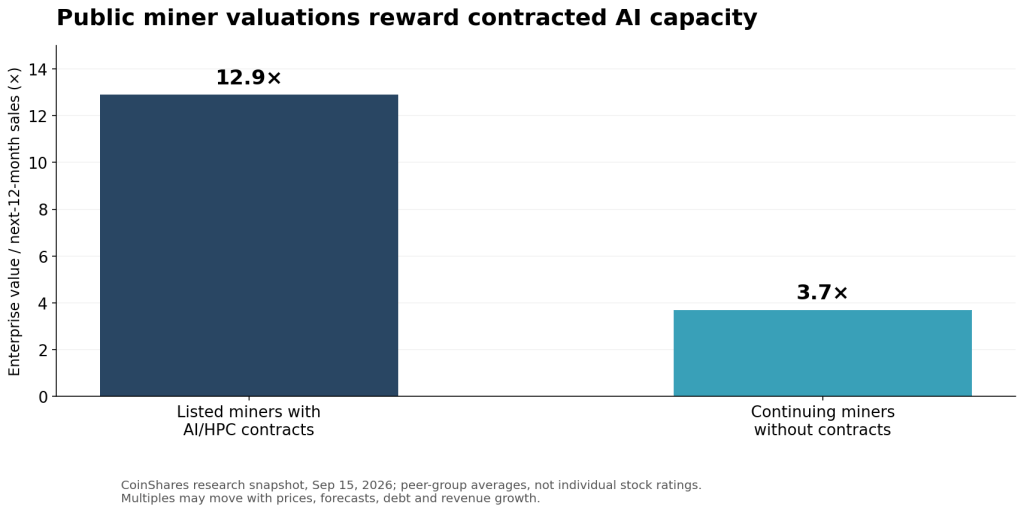
In the same snapshot, miners with signed AI/HPC contracts traded at an average 12.9 times enterprise value to next-12-month sales, compared with 3.7 times for selected continuing miners without contracts. The ratio of those peer-group averages is approximately 3.5 times. A valuation multiple is not a return forecast: stock prices, projected sales, debt and comparison-group membership all affect the calculation.
Hut 8 CEO Asher Genoot discusses converting Bitcoin mining infrastructure to AI data centers in a May 2026 interview with Anthony Pompliano. Company perspective and historical context, not a verification of CoinShares’ aggregate contracts. Watch the full interview.
November filings show the operational bottleneck
Recent disclosures illustrate why signed contracts require careful status labeling. BitcoinVersus.Tech reported Bitdeer’s 55 MW Knoxville conversion delay, where essential electrical equipment pushed a target into late 2027. Separately, HIVE’s $129 million GPU financing covers planned hardware deliveries, not necessarily operational and invoiced racks. Both are individual November updates, not adjustments to CoinShares’ older aggregate.
The broader transition also affects remaining SHA-256 capacity. BitcoinVersus.Tech documented IREN’s declining installed Bitcoin mining capacity and TeraWulf’s shift in revenue mix. The direction is clear, but contracts, installed GPUs, energized IT megawatts and recognized sales are distinct milestones.
The next statistic that matters
A reliable follow-up needs company-by-company dates for contracted IT capacity, commissioning progress, billed MW, annualized recognized revenue and capital still required. Future reports should preserve identical portfolio coverage when comparing periods. The most meaningful outcome is not a larger announced pipeline; it is a growing share of contracted megawatts safely energized and actually producing customer revenue.
Sources and methodology: CoinShares, Bitcoin Mining Report Q2 2026, published September 15; CoinShares financial and valuation analysis. Ratio and difference calculations use reported rounded numbers. All CoinShares statistics are dated to its original publication; subsequent company reports are independent context.
We volunteer daily to ensure the credibility of the information on this platform is Verifiably True. If you would like to support to help further secure the integrity of our research initiative, please scan the QR code below.



Leave a Reply