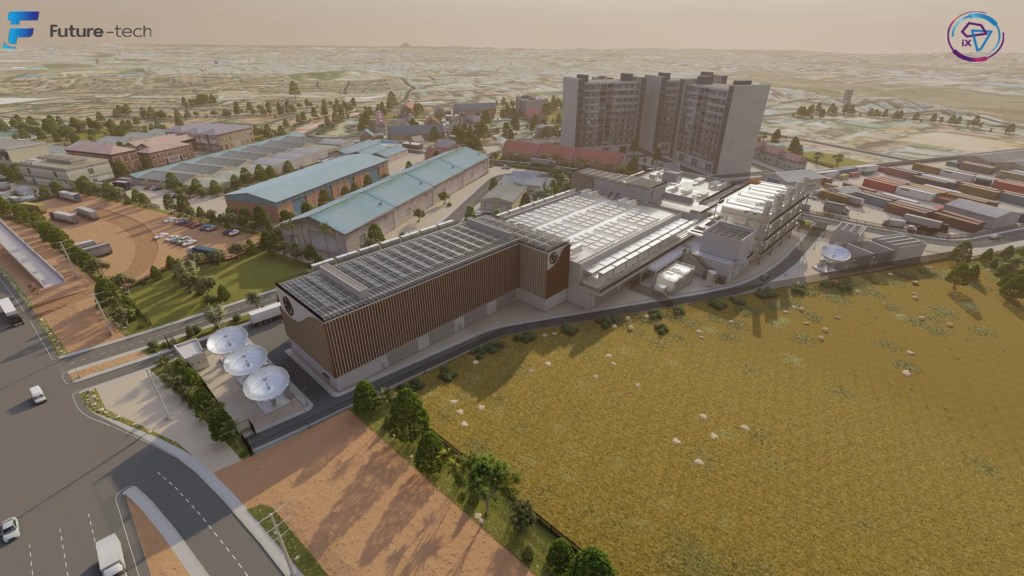
Hurricane Electric announced on November 25 that it had opened a network point of presence at iXAfrica’s NBOX1 data center in Nairobi, Kenya. The new location provides customers with access to the company’s international IPv4 and IPv6 backbone through Ethernet interfaces rated at 1, 10 or 100 gigabits per second. It is the operator’s second Nairobi location, third in Kenya and thirteenth in Africa, according to its announcement.
What a point of presence actually does
A point of presence, or PoP, is a physical location where a network operator makes connectivity services available. Inside a carrier-neutral facility, a customer may arrange a fiber cross-connect between its own equipment and a provider’s network interface. The connection can carry traffic toward other networks through an agreed transit or interconnection arrangement. A PoP is not necessarily an Internet exchange, which provides shared infrastructure through which multiple independent networks can interconnect.
At the highest advertised port rate, 100 Gb/s corresponds to 12.5 gigabytes per second before protocol overhead. A theoretical 1-terabyte transfer would require about 80 seconds at that rate. Real transfers depend on congestion, transport behavior, remote system capacity and the purchased service. A 100G port does not establish how much backbone capacity the operator has installed at the site. Our optical transceiver guide explains the distinction between physical interfaces and usable network throughput.
Routing across independent networks
The Border Gateway Protocol (BGP) allows autonomous networks to exchange reachability information. Operators apply routing policies to decide which paths to advertise and accept, rather than simply choosing the geographically shortest path. Hurricane Electric reports more than 40,000 BGP sessions, connectivity to over 10,500 networks and participation in more than 320 exchange locations globally. Those are company-wide figures, not statistics for the new Nairobi site. Its public PoP directory lists both Nairobi locations.
A second local access point can create additional routing and provisioning options, but resilience depends on independent physical fiber routes, power supplies and upstream infrastructure. Two network circuits sharing the same conduit can still fail together. Route-origin validation is another consideration, as explained in our RPKI engineering lesson.
Why Nairobi is an important interconnection location
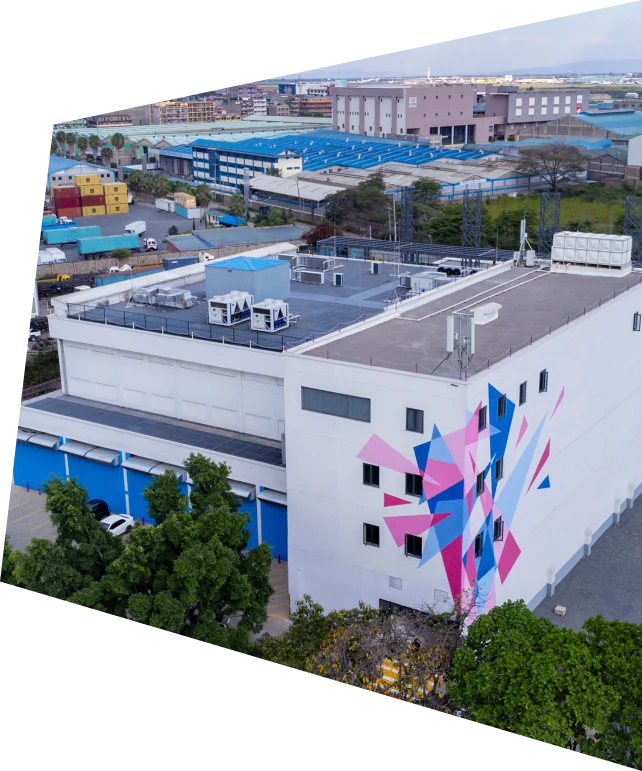
Kenya’s coastal subsea cable connections and terrestrial fiber routes create a gateway for regional and international traffic. The NBOX1 campus specifications list 4.5 MW for the first IT phase and 18 MW for the second, totaling 22.5 MW at full development. The operator’s homepage separately reports 2.25 MW ready in the first phase. These are facility power figures and must not be confused with network bandwidth.
The deployment adds a connectivity option for local cloud providers, enterprises and telecommunications companies without requiring a new hyperscale campus. Related developments include programmable dark fiber in Portugal and 800G optical interfaces for distributed computing. Hurricane Electric has not disclosed the Nairobi installation’s aggregate capacity, measured latency improvements or customer traffic volumes. Those metrics would help assess the network expansion’s practical impact.
Cover credit: iXAfrica / Future-tech, official campus design rendering. The artwork is not a photograph of the new PoP.
We volunteer daily to ensure the credibility of the information on this platform is Verifiably True. If you would like to support to help further secure the integrity of our research initiative, please scan the QR code below.



Leave a Reply