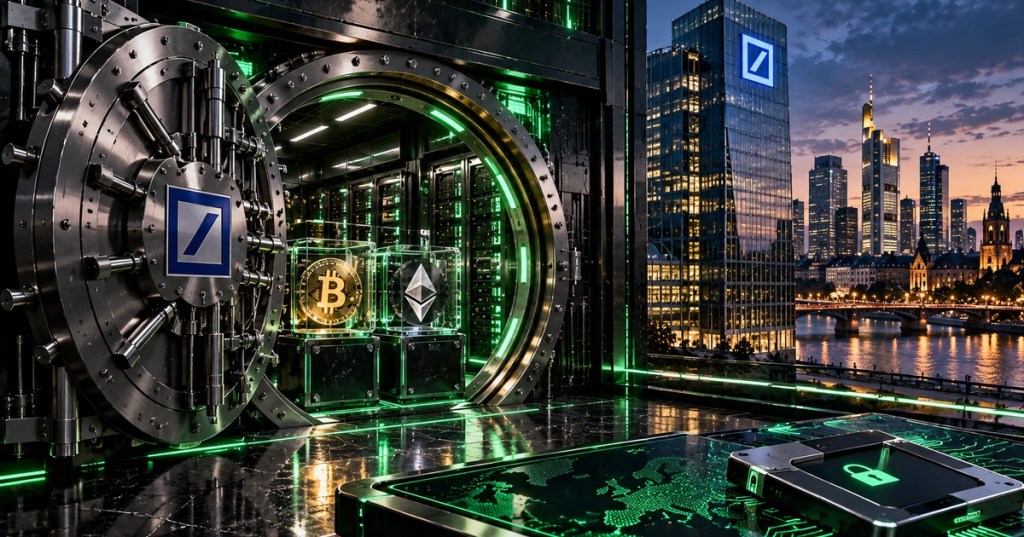
Germany’s largest bank is preparing to begin cryptocurrency custody for institutional clients within weeks. Deutsche Bank’s corporate banking co-head Gerald Podobnik told Reuters on October 16, 2026 that the offering will first open in Germany, with expansion into Asian financial centers targeted in 2027. The initial custody capabilities focus on major digital assets including Bitcoin and Ether. This is an announced near-term launch, not confirmation that the service is already operating.
The German lender first formally detailed its planned custody service in a September 16 company release. It will be aimed at eligible businesses, asset managers, hedge funds, custodians, brokers and other institutional customers—not the bank’s ordinary retail account holders. Launch timing, assets and geography remain subject to regulatory processes and product approvals.
- What: custody and third-party transfers of eligible crypto assets with bank-managed private keys.
- Who: institutional and corporate customers in Europe; retail customers are not the initial target.
- When: the bank says launch is expected within weeks, subject to approvals; Asian expansion is planned for 2027.
- Next: stablecoin-related transaction services, tokenized deposits and blockchain-issued securities are on the wider roadmap.
A Bank-Managed Wallet for Institutions
Instead of purchasing Bitcoin itself, Deutsche Bank plans to safeguard clients’ assets. Its official disclosure describes hardware-based protection for private keys, multi-person transaction approvals, segregation of duties, distinct warm and cold storage environments, and backup/recovery controls. These are measures for custody security—not a guarantee against every cyberattack or operational failure.
The bank’s September launch description included selected stablecoins and e-money tokens—USDC, EURC and EURAU—alongside Bitcoin and Ether in its prospective custody lineup. The newer Reuters interview describes a phased rollout in which additional ways to move into and out of stablecoins, tokenized deposits and digital bond issuance would follow. It is important to distinguish holding a stablecoin from offering a full payments and conversion business.
Video interview: Sibos 2026 — Deutsche Bank Enters Digital Asset Custody. In the October 8 recording, Deutsche Bank’s Paul Maley discusses the planned custody service and tokenized-asset roadmap. The interview opens in Global Custodian’s original video player.
Why Deutsche Bank Is Entering Crypto
Podobnik framed the initiative as part of a wider corporate banking strategy seeking approximately 8% annual growth through 2028. Rather than replacing the traditional financial system, the bank wants digital assets, tokenized financial instruments and established bank services to work together. In a September research article, Deutsche Bank described custody infrastructure as essential to secure institutional use of tokenized money, securities and digital assets.
Crypto services are also becoming increasingly relevant across European finance. Our earlier coverage followed Commerzbank’s Bitcoin trading plans, Zurich Cantonal Bank’s crypto trading service, and Asian banks exploring institutional crypto custody. Deutsche Bank’s move is another step toward putting digital-asset access inside familiar regulated banking systems.
Custody Does Not Mean Bitcoin Buying
A new custody service does not establish that Deutsche Bank is purchasing BTC for its own treasury, buying coins on behalf of customers today, or opening retail Bitcoin wallets. Financial institutions can transfer existing client holdings into custody without adding new demand. The bank has not provided a final go-live date, committed assets under custody, fee schedule or named launch clients.
The bank also makes clear that crypto assets are not protected by a conventional bank deposit-guarantee scheme, and market price volatility remains the customer’s exposure. Bank-managed keys reduce the operational burden on the client but introduce reliance on the custodian’s processes and controls. Self-custody advocates may prefer direct possession of their private keys; many institutions instead prioritize audited operational processes, segregation and regulated counterparties.
What to Watch Next
The next verifiable milestone is the bank’s confirmation that its first institutional clients have actually been onboarded after completion of the relevant regulatory steps. Readers should then look for live asset support, geographic scope, initial assets under custody and detailed evidence of how stablecoin transfers are implemented. The proposed Asian rollout is currently a 2027 plan, not a completed deployment.
BitcoinVersus.Tech Editor’s Note:
We volunteer daily to ensure the credibility of the information on this platform is Verifiably True. If you would like to support to help further secure the integrity of our research initiatives, please donate using the QR code provided

For best QR-code scanning results, please scan this donation code from a desktop or larger screen. Mobile screens may prevent camera recognition.


Leave a Reply