
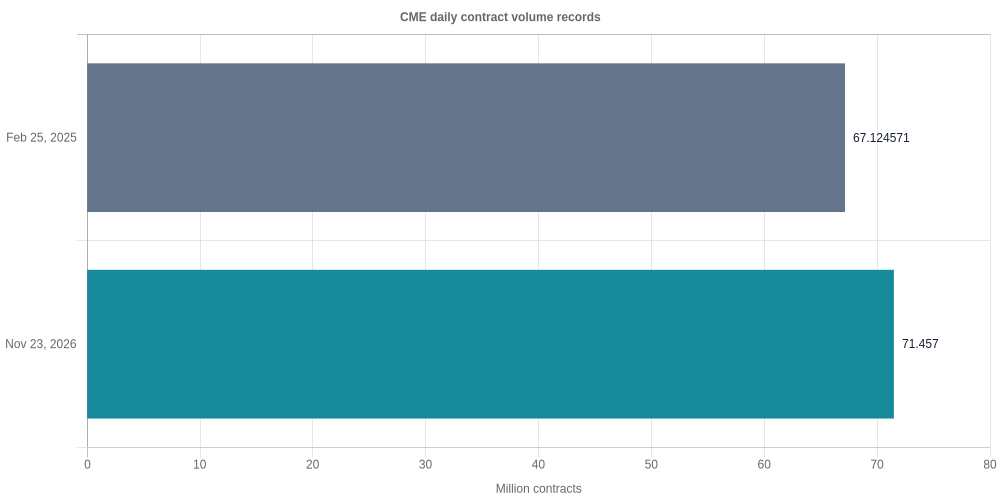
CME Group processed a record 71,457,000 derivatives contracts on November 23, 2026, according to its November 24 announcement. Activity was concentrated in interest rate products as market participants adjusted their exposures. The milestone provides a quantitative view of the infrastructure behind risk management, complementing our analysis of financing risks associated with AI investment.
A 6.45% increase over the previous record
The previous single-day peak was 67,124,571 contracts on February 25, 2025. The difference amounts to 4,332,429 contracts, or approximately 6.45% relative to the earlier record. The figures represent traded contract volume, not the dollar value of transactions or the number of unique market participants. An increase in turnover does not automatically imply rising asset prices, exchange profitability or additional open positions.
Interest rate futures and options accounted for 50,918,578 contracts, equivalent to approximately 71.26% of total activity. Treasury futures alone reached 41,379,250 contracts, a record that the exchange reports was 10% above the previous Treasury futures peak. Treasury futures form part of the interest rate category, so adding those two counts together would double-count activity. FX News Group also reported the announcement.
Why institutions use interest rate derivatives
The economic value of a fixed-rate bond generally falls when its yield rises, holding other factors constant. A portfolio manager can use Treasury futures to reduce sensitivity to interest rate movements without selling every cash security in the portfolio. Futures positions still create margin requirements, basis risk and potential losses. Our coverage of electronic corporate bond trading highlights a related shift in execution infrastructure, although cash bond trading and futures trading are distinct markets.
CME Group educational video: Yield Futures Overview. Background on Treasury benchmark derivatives; not a recording of the November 23 session.
The infrastructure behind the record
An electronic matching engine receives orders and updates outstanding quotations as transactions occur. Market data systems distribute resulting information, while clearing infrastructure calculates obligations and manages counterparty exposure. A high-volume session tests the complete chain, including network capacity, message processing, risk controls and recovery procedures. Contract counts alone do not establish peak message rates or prove that any particular latency target was met.
Our reporting on Hong Kong’s tokenized bond settlement system addresses another part of financial infrastructure: post-trade settlement. Different market structures can use different technologies while sharing the need for reliable controls and reconciliation.
The November record reinforces the importance of scalable derivatives exchanges. It also illustrates the distinction between trading activity and market access, an issue discussed in our coverage of Blockchain.com’s U.S. derivatives licensing efforts. Subsequent volume, open interest and transaction-fee disclosures will help establish whether the record represents sustained demand or a particularly active trading day.
Featured image: CME Center archival photograph, CME Group/Henry Delforn/Allan Schoenberg, 2009, cropped; CC BY-SA 3.0.
We volunteer daily to ensure the credibility of the information on this platform is Verifiably True. If you would like to support to help further secure the integrity of our research initiative, please scan the QR code below.



Leave a Reply