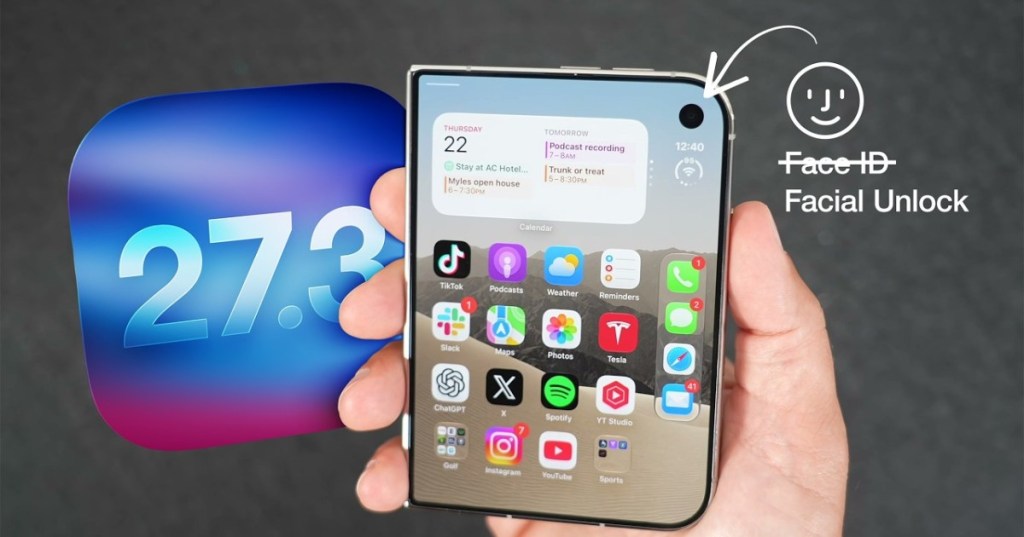
Apple is testing a new facial recognition option for its foldable iPhone Duo. Introduced in the second iOS 27.3 beta on November 16, 2026, the feature uses the outer display’s conventional front camera rather than the dedicated TrueDepth hardware found on Face ID-equipped iPhones. Hands-on testing by MacRumors establishes that the feature operates when the device is folded. It is a convenience layer, not a complete replacement for fingerprint authentication. Our earlier iPhone Duo review coverage examined the hardware compromises associated with Apple’s first folding phone.
MacRumors demonstrates the new camera-based unlocking option in iOS 27.3 beta 2, November 16, 2026. Watch directly on YouTube.
Why facial recognition is not necessarily Face ID
According to Apple’s Face ID technical explanation, TrueDepth projects invisible infrared dots onto a face, measures its geometry and captures infrared imagery. Machine-learning processing compares a mathematical representation with previously enrolled biometric data. Active illumination helps the dedicated system operate even in darkness. A standard front camera instead relies on available light to capture an image. Its recognition software must extract identifying information without equivalent dedicated depth-sensing hardware. The camera-based implementation should not be assigned Face ID’s published false-match statistics without separate validation.
Apple’s September 9 product announcement describes a fingerprint sensor integrated into the Duo’s side button. Packaging constraints are relevant because foldable phones must accommodate two display assemblies, batteries, cameras and a hinge in a compact enclosure. Competing designs, including Samsung’s Fold8 family, demonstrate the growing importance of foldable-device engineering.
A deliberately limited authentication system
The November 25 iDownloadBlog guide reports that camera unlocking is optional and initially disabled. It requires a recent stronger authentication event and expires after roughly 45 minutes of inactivity. The feature applies to the folded phone’s lock screen, not its internal camera or sensitive authorization operations.
| Capability | Duo camera unlock (beta) | TrueDepth Face ID |
|---|---|---|
| Dedicated infrared depth sensing | No | Yes |
| Operation in total darkness | Not reliable | Designed to support it |
| Apple Pay authorization | No | Yes |
| Recent stronger authentication required | Yes | Different security rules |
Payments and protected credentials still require the appropriate stronger authentication method. Our reporting on Google Wallet’s iPhone integration highlights another distinction between convenient access and authorization for financial transactions.
November 19 hands-on walkthrough of the front-camera unlock feature on iPhone Duo. Watch directly on YouTube.
Convenience without overstating security
The beta offers a useful example of tiered authentication. Device designers can permit low-friction access after recent identity verification while reserving more sensitive operations for stronger methods. Independent evaluation would require false-acceptance and false-rejection measurements under varied lighting, facial appearances and presentation-attack conditions. Published testing does not yet establish comparable security between the two systems.
As Apple’s recent smartphone market performance illustrates, software differentiation matters alongside hardware capabilities. The camera unlock feature remains beta software as of the reviewed reports. A final public release and its precise behavior should be confirmed when iOS 27.3 ships.
Featured image: MacRumors November 16 demonstration thumbnail, cropped for editorial presentation.
We volunteer daily to ensure the credibility of the information on our platform is Verifiably True. If you would like to support to help further secure the integrity of our research initiative, please scan the QR code below.



Leave a Reply