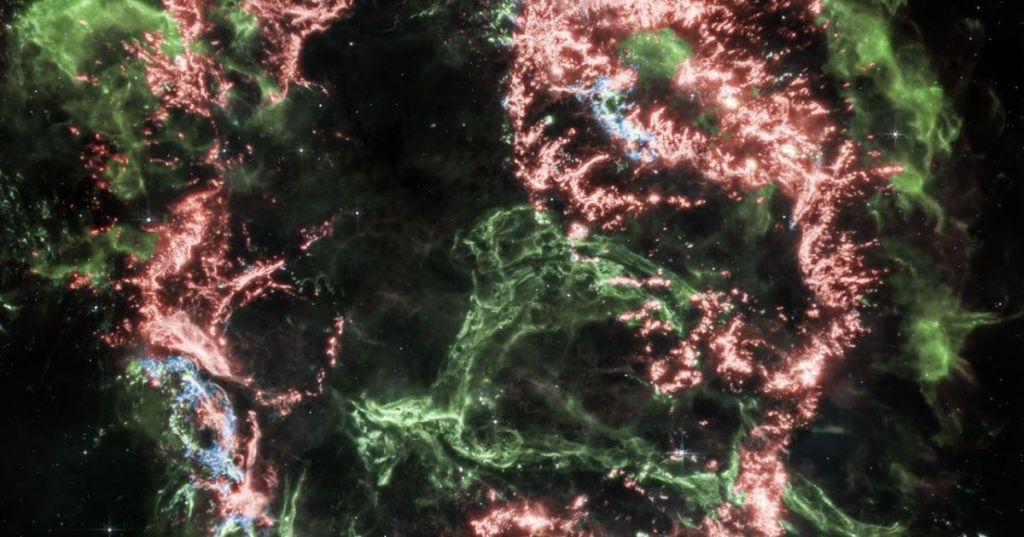
Astronomers studying the Cassiopeia A supernova remnant have found chemical evidence consistent with mixing between burning layers inside its progenitor star shortly before core collapse. The European Space Agency and Webb collaboration announced the results on November 23, 2026, alongside publication in The Astrophysical Journal Letters. The research uses infrared measurements of dust to reconstruct stellar conditions that are otherwise inaccessible. The approach complements earlier investigations, including our coverage of Webb’s observations of the Bao stellar merger.
ESA/Webb official pan across the new Cassiopeia A image, released November 23, 2026. Original source and credits.
Chemical records preserved in dust
Massive stars fuse progressively heavier nuclei as their interiors evolve. Different burning processes occupy separate regions, producing layers with different chemical abundances. Convection can circulate material within those regions; theoretical calculations indicate that neighboring shells can also mix before collapse. When a star explodes, some expelled material subsequently cools into dust grains. The composition of those grains can preserve evidence of earlier nuclear burning and mixing.
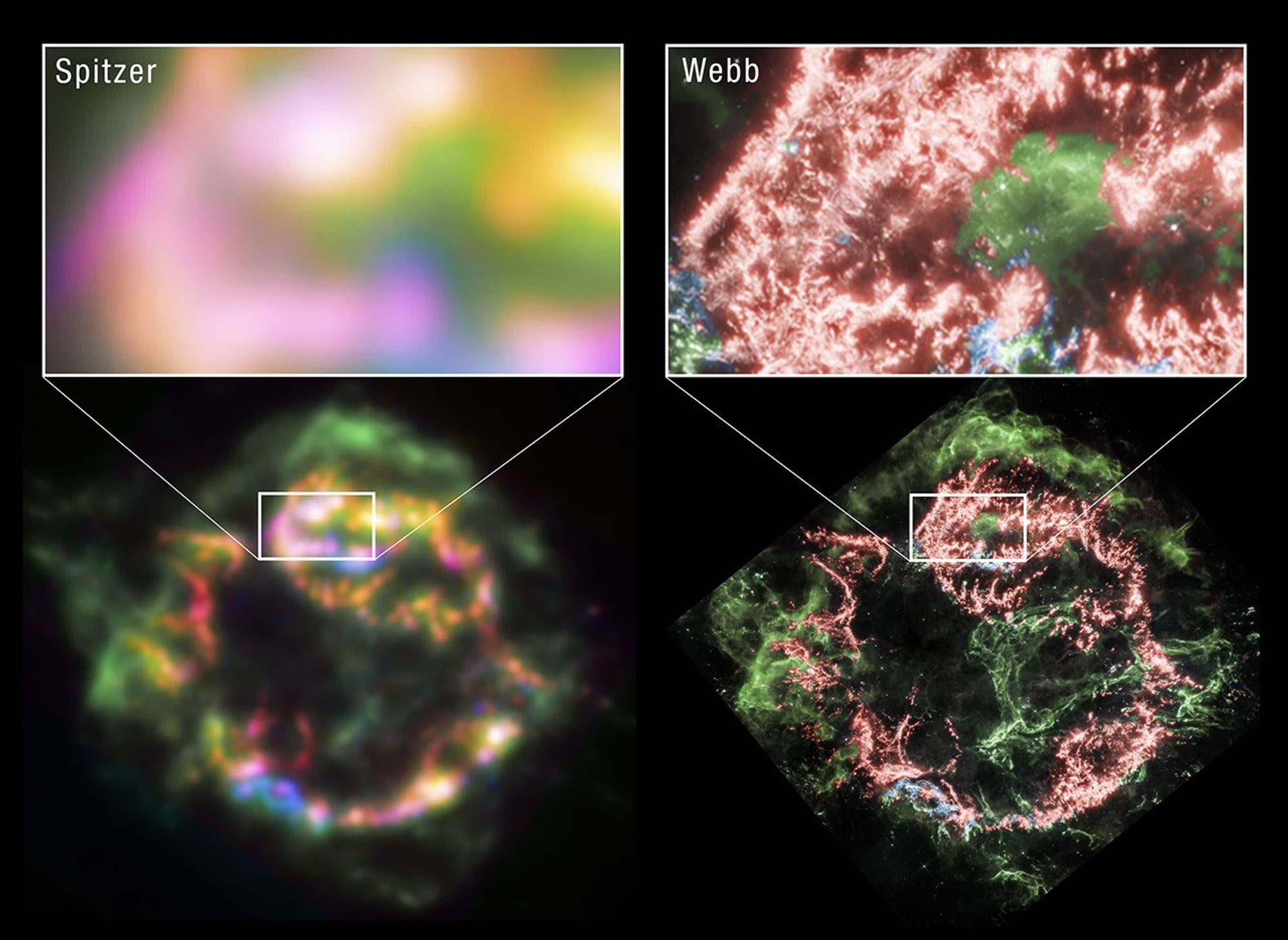
The research team examined three locations identified through earlier Spitzer observations. Two locations lie in material heated by a reverse shock, which propagates through ejecta as the expanding remnant interacts with its surroundings. One region is dominated by silica grains and another by carbonaceous grains. A third region, nicknamed the Green Monster, contains magnesium silicates and is associated with material lost before the explosion. Distinguishing that material from ejecta is essential to the interpretation.
Why the larger telescope changes the analysis
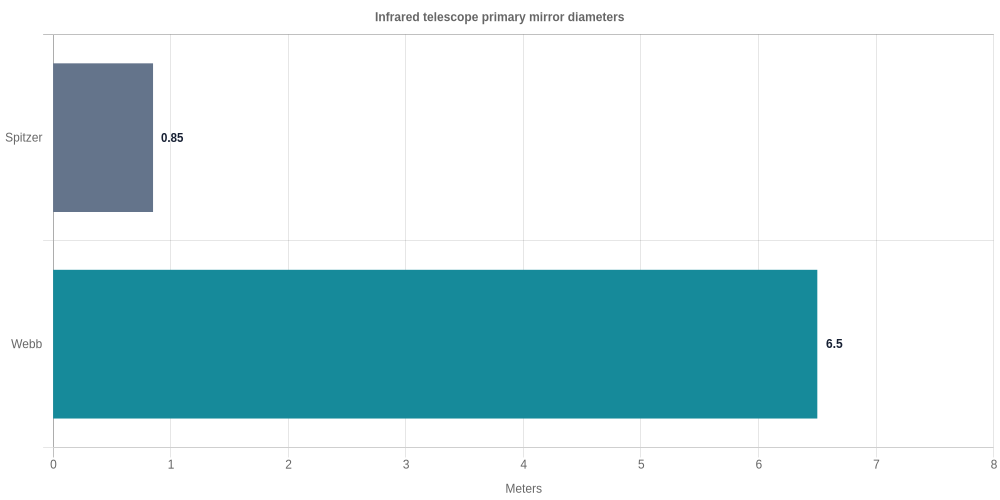
Webb’s approximately 6.5-meter primary mirror is about 7.65 times wider than Spitzer’s 0.85-meter mirror. For ideal diffraction-limited circular apertures at the same wavelength, angular resolution scales inversely with diameter. The ratio therefore describes an approximate theoretical resolution advantage, not a measured sensitivity or resolution ratio for the particular observations. Instrument sampling, wavelength and optical design also matter. Our BepiColombo optical calibration coverage illustrates why actual point-spread measurements are necessary.
Reconstructing the final hours
The infrared maps complement X-ray evidence from Chandra and XRISM. Different wavelength bands reveal different aspects of an evolving remnant: X-rays can trace shock-heated plasma, while infrared observations probe warm dust. The combined approach resembles the use of complementary observations in our Chandra stellar-outburst coverage.
The Columbia University research summary explains that the dust distribution supports a merger of burning shells potentially hours before the explosion. The timing is inferred from observations and models; Webb did not directly observe the interior during collapse. Understanding how the elements move through subsequent shocks will help estimate the amount and composition of dust that survives to enrich interstellar space. Other observatories, including the planned COSI gamma-ray mission, investigate complementary signatures of stellar explosions.
Featured infrared observation: NASA, ESA, CSA, STScI, T. Temim, R. Arendt, D. Milisavljevic; image processing J. DePasquale. Full image and original metadata.
We volunteer daily to ensure the credibility of the information on this platform is Verifiably True. If you would like to support to help further secure the integrity of our research initiative, please scan the QR code below.



Leave a Reply