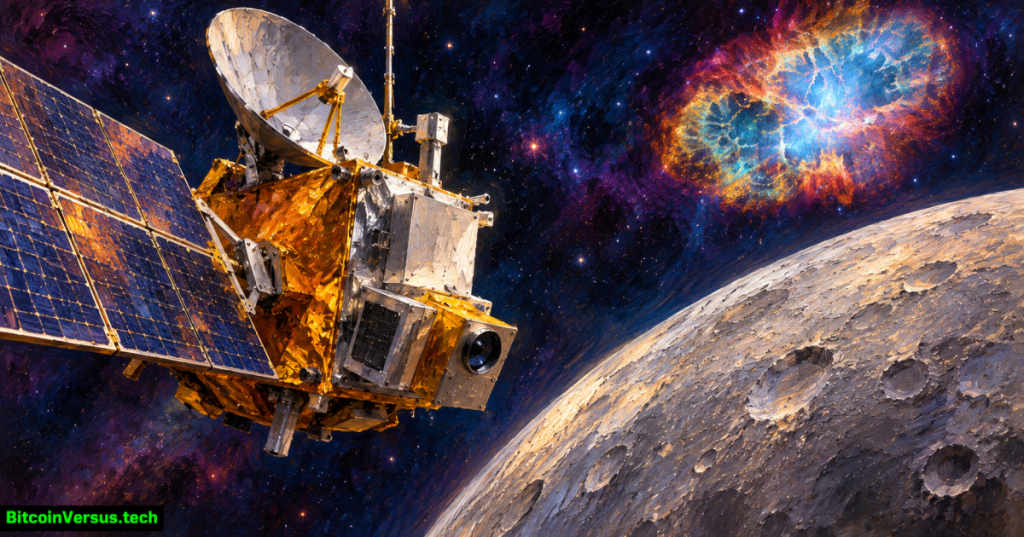
After nearly eight years in space, an X-ray telescope aboard BepiColombo has captured its first astronomical images. Instead of photographing Mercury, the UK-led Mercury Imaging X-ray Spectrometer (MIXS) aimed at the Crab Nebula, approximately 6,500 light-years away, to check whether its optics and detector still work. The University of Leicester released the results November 20, 2026, one day before the spacecraft’s planned Mercury orbit insertion.
Researchers combined 39 hours of observations from September 11–12, including 55 spacecraft pointing maneuvers. The calibration showed slightly better angular resolution than MIXS achieved during its last laboratory measurements in 2015. The work represents a successful in-space optical test, not a chemical map of Mercury or a newly discovered cosmic object.
The University of Leicester links to the MIXS video from its official November 20 first-light announcement. The footage explains the instrument and observations. Original video.
Why an instrument headed for Mercury looked at a supernova remnant
The Crab Nebula is a familiar X-ray source produced by a stellar explosion observed from Earth in 1054. Its well-studied emission lets engineers evaluate whether a telescope is sharp, correctly aligned and stable. In the MIXS test, researchers measured how widely incoming X-ray photons spread across the image sensor. The narrower the detected spread, the better the telescope can distinguish neighboring features on Mercury.
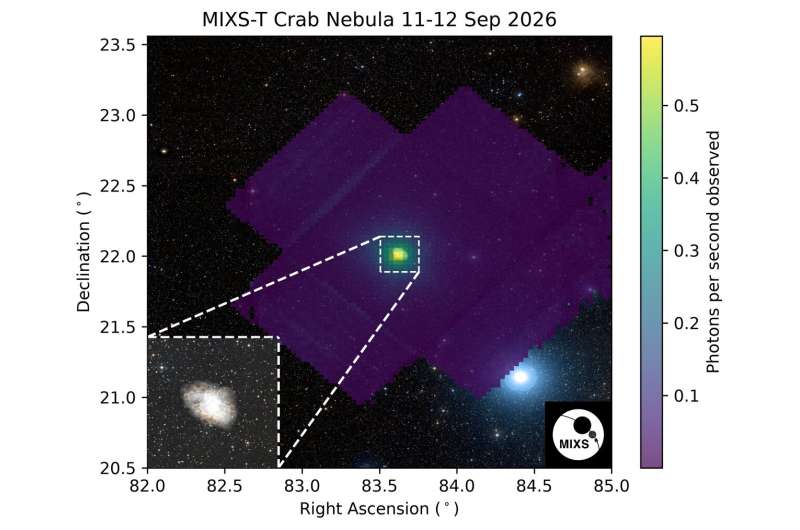
The result is particularly meaningful because MIXS spent much of the journey unable to look into open space. Following the September 3 separation of the Mercury Transfer Module, its field of view became available for calibration. According to principal investigator Emma Bunce, the instrument shows no evidence of radiation damage after eight years. Cosmic-ray signals can be filtered, while some illumination-related fluorescence still requires study and optimization.
An X-ray map of Mercury’s chemistry
MIXS is not simply another camera. When energetic solar X-rays strike Mercury’s surface, atoms in its rocks emit characteristic fluorescent X-rays. MIXS can record their energies to infer which elements are present. A companion instrument, the Solar Intensity X-ray and particle Spectrometer (SIXS), monitors the incoming radiation so scientists can interpret the surface response rather than confuse solar activity with changes in rock composition. Leicester’s instrument specifications list a mass of 10.8 kilograms and nominal power demand of 24 watts.
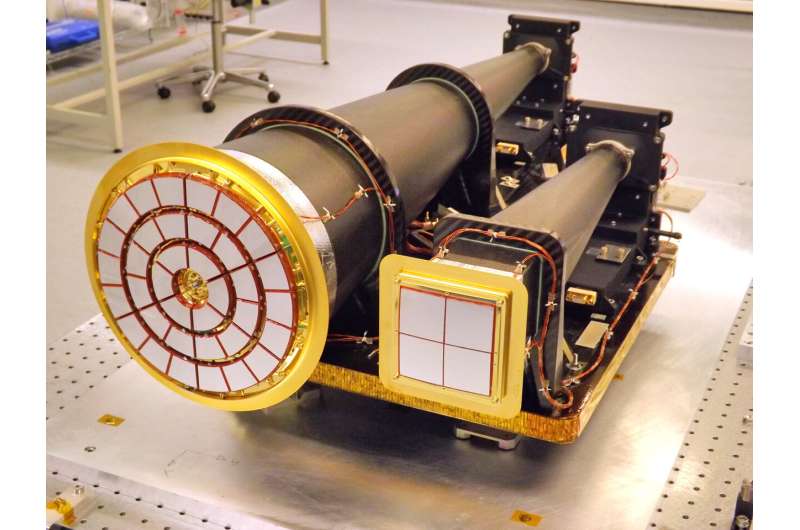
MIXS is described by its developers as the first imaging X-ray telescope flown on a planetary science mission. The technology is intended to generate a global map of elemental composition, helping researchers investigate Mercury’s formation and evolution. The significance differs from NASA’s NICER X-ray observatory, which studied distant astrophysical objects rather than using solar-triggered fluorescence to map another planet.
Official ESA footage published September 9, 2026, compiled BepiColombo monitoring-camera views from its eight-year journey. It predates the new MIXS results. Original video.
The next test is at Mercury
BepiColombo’s combined European and Japanese orbiters were scheduled to enter Mercury orbit on November 21. The mission plan calls for the Mercury Planetary Orbiter and JAXA’s Mio to separate on December 9–10, with science observations beginning in April 2027. Our earlier arrival preview details the demanding orbital maneuver; neither orbital insertion nor the full scientific campaign was completed when Leicester released the images.
The first-light image is an engineering milestone, not proof that every future surface measurement will meet mission requirements. Detector optimization, orbital operations, calibration against variable solar X-rays and interference from Mercury’s space environment remain critical. Related work, including James Webb observations of an Andromeda stellar merger and analyses of microscopic dust beyond Neptune, underscores how spacecraft sensors can turn faint radiation and tiny materials into evidence about planetary history.
Sources and editorial verification
Primary reporting: University of Leicester, November 20, 2026; Leicester MIXS technical specifications; ESA mission overview. Official video: University of Leicester release and ESA’s September 9 journey footage. The university’s instrument and observation images were preserved with credit. Quoted performance findings are reported by the instrument team, not independently reproduced by BitcoinVersus.Tech.
Visual note: The featured image is an original fine-art oil painting illustrating the spacecraft, Mercury and the Crab Nebula together. The pictured arrangement is imaginative and is not spacecraft photography or the measured X-ray observation.
Editor’s Note: We volunteer daily to ensure the credibility of the information on this platform is Verifiably True. If you would like to support to help further secure the integrity of our research initiatives, please scan the QR code below

For mobile scanning, open the article on another display. Verify the receiving Bitcoin address before sending any payment. BitcoinVersus.tech publishes independently researched technology journalism for informational purposes and offers no investment, legal or cybersecurity assurance.


Leave a Reply