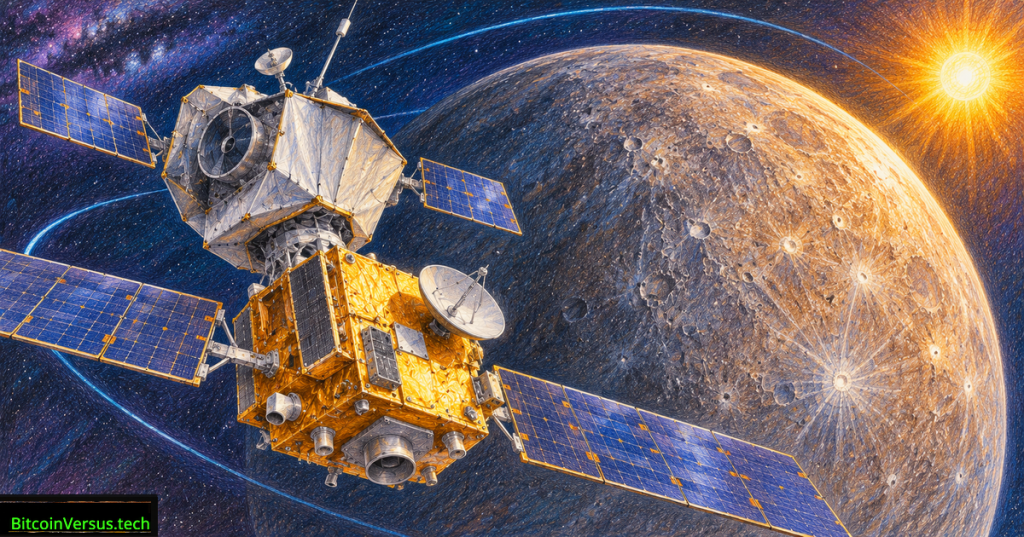
Europe and Japan are preparing a two-spacecraft mission for a critical Mercury orbit insertion on Saturday, November 21, 2026. BepiColombo, launched in October 2018, has spent eight years navigating the inner Solar System using electrical propulsion and nine planetary flybys. The European Space Agency says the connected Mercury Planetary Orbiter and Japanese Mio probe are scheduled to enter a polar orbit together before separating in December. Successful capture remains a planned maneuver, not an accomplished event.
Mercury poses a demanding navigation problem. A spacecraft approaching the planet has already fallen deep into the Sun’s gravitational field, so a direct journey would arrive with substantial excess speed. BepiColombo instead used one Earth flyby, two Venus flybys and six Mercury flybys to reshape its path while minimizing propellant requirements.
European Space Agency, September 2026: “MTM’s selfie footage of BepiColombo’s eight-year journey.” Official mission imagery and navigation context, not live video of the November 21 maneuver.
Solar-electric cruise is finished, chemical thrusters take over
BepiColombo’s Mercury Transfer Module relied on four xenon-ion thrusters powered by solar arrays. ESA says the electric propulsion system completed its final thrust arc on June 15, 2026. The module separated successfully on September 3, leaving ESA’s Mercury Planetary Orbiter, called MPO, responsible for steering the remaining spacecraft stack.
On September 24, MPO fired its axial thrusters for eight minutes and 42 seconds. The resulting velocity adjustment measured 11.4 meters per second, according to ESA mission operations updates. Engineers monitored temperatures, pressure, acceleration and radio Doppler measurements through a ground antenna in Spain. The test demonstrated steering capability after separation, but did not replace the main orbit-insertion burn.
ESA Operations’ November 16 announcement on X confirms the planned November 21 insertion and promises mission updates. The embedded post is an original agency source, not confirmation that the maneuver has succeeded.
Sixteen maneuvers and two different science orbits
The November 21 event starts a broader sequence of 16 propulsion burns extending into March 2027. According to ESA’s official arrival timeline, Mio is scheduled to separate from MPO on December 9 or 10. MPO is then expected to discard Mio’s sunshield on December 16 and continue lowering its own orbit until March 10, 2027. Science operations are scheduled to begin April 6, 2027, subject to operational readiness.
The orbiters have complementary jobs. MPO is designed to examine Mercury’s surface chemistry, geology, interior structure and magnetic environment, while JAXA’s Mio will study the planet’s magnetosphere and its interaction with the solar wind. Two coordinated vantage points could help scientists distinguish magnetic changes over time from differences across locations.
What could go wrong near Mercury?
The spacecraft must maintain accurate pointing, thermal control, communication and engine performance during capture. A missed or incomplete burn could alter the planned orbit and require contingency operations. Strong solar heating, long radio delays and the complex sequence of separation events increase operating demands. ESA completed its final arrival simulation in October, after rehearsing scenarios involving unexpected faults and coordinated decisions between European and Japanese teams.
European Space Agency, September 2026: “BepiColombo begins its final approach to Mercury.” Official mission explainer describing the arrival plan; archival footage rather than a live capture broadcast.
Why the milestone matters beyond Mercury
BepiColombo demonstrates the combination of electric cruising, gravity assists and precise chemical propulsion needed for demanding planetary missions. Related BitcoinVersus.Tech reports cover NASA’s ESCAPADE gravity-assist route, an ISRO satellite orbit-raising maneuver, iodine-electric satellite propulsion and the communications delay facing Voyager 1.
The next verification point is ESA’s confirmation of orbital capture on November 21, followed by Mio’s actual separation in December. Until those milestones occur, the story remains one of engineering preparation, not a completed two-orbiter Mercury mission.
Primary sources: ESA mission updates; ESA arrival timeline; ESA simulations report; ESA propulsion report; ESA Operations on X.


Leave a Reply