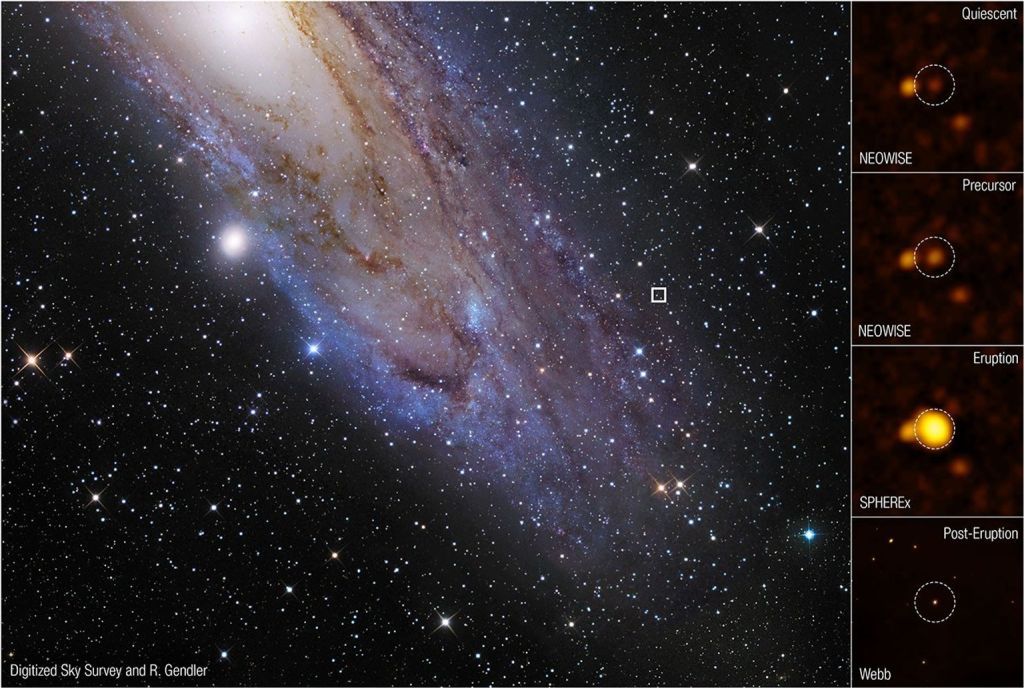
NASA announced November 18, 2026, that combined telescope observations have allowed astronomers to reconstruct a stellar merger in the Andromeda galaxy. The event, formally AT 2025abao and nicknamed Bao, involved an aging supergiant engulfing a companion smaller than the Sun. Scientists followed its brightening over years, captured its 2025 eruption, and used James Webb Space Telescope infrared observations from December 24, 2025, to test models of the aftermath. The NASA release describes a rare opportunity to connect observed brightness and dust with a simulation of how a binary star becomes one.
A seven-year spiral into a giant star
The team estimated that the primary star, called Big Bao, initially contained about seven solar masses, had a radius roughly 350 times the Sun’s, and radiated around 18,000 times as much light. Computer modeling assigned the smaller companion, Little Bao, about 0.7 solar masses. Those stellar masses and internal dimensions are model-derived estimates rather than direct measurements of a resolved stellar surface. From first contact with the giant’s extended atmosphere, the smaller star completed approximately seven orbits over seven years before being engulfed.
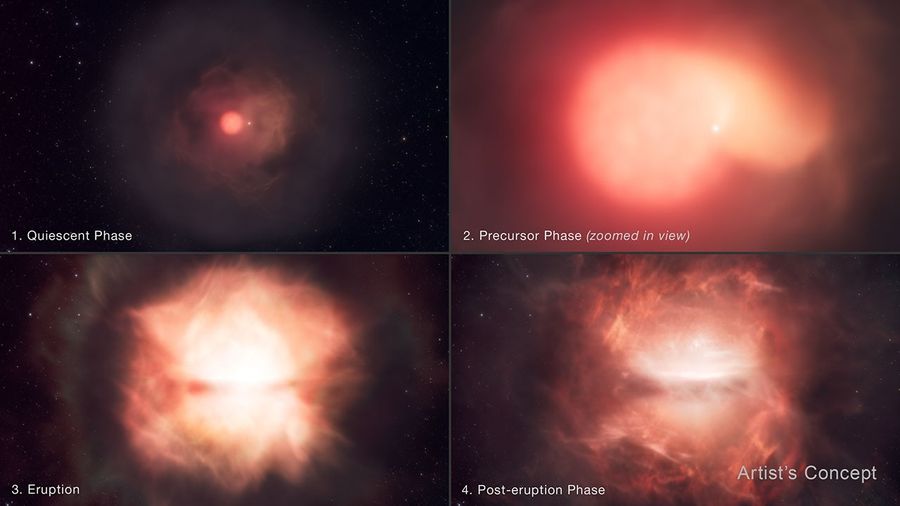
As the companion moved through outer gas, drag reduced its orbital energy, causing the pair to share an envelope. Some material escaped and cooled into dust. Such common-envelope evolution can also end with two survivors; in Bao, the data and models favor a full merger. The researchers compared scenarios, including a possible escape, before concluding that the companion continued inward. No telescope watched the stars as separate visible disks at the instant of collision.
NASA Goddard, August 13, 2025: archival video about an ultramassive white dwarf formed in a different stellar merger. Scientific context only; the video does not depict Bao.
Why Webb changed the interpretation
The sequence began with altered brightness recorded in NEOWISE data from February 2023 and follow-up observations in 2024. NASA’s SPHEREx recorded strong infrared changes in July 2025; the Zwicky Transient Facility saw the eruption on October 17, 2025. Additional observations came from Swift, Gemini North and other telescopes. Webb observed the system on December 24, only 47 days after the outburst’s peak according to the research team.
Webb’s mid-infrared measurements traced cooler dust that visible-light observations can miss. Researchers compared the measured infrared emission with simulations of how much material a massive star expelled, and how the envelope responded as the smaller star spiraled inward. The result supports a merger interpretation and constrains the efficiency with which orbital energy can eject gas. Infrared astronomy can add evidence that optical images alone cannot supply, a principle explained in BitcoinVersus.Tech’s earlier report on extracting signals from Webb data.
Space Telescope Science Institute, June 30, 2026: official archival explainer about the infrared light and spectra measured by Webb. The demonstration predates NASA’s November Bao announcement.
What the discovery establishes and what remains open
The observations constrain a rapidly unfolding merger, but scientists do not yet know how the combined star will settle or evolve. Astronomers must continue watching its luminosity, chemistry and expanding dust. A red optical eruption alone cannot establish the exact internal fate of a companion without supporting evidence. Comparisons with other interacting stars remain crucial, including Chandra’s evidence of a possible hidden companion behind periodic outbursts.
The wider implications reach binary evolution, neutron stars, black holes and gravitational-wave populations. Some common-envelope systems survive as compact pairs, while others combine. BitcoinVersus.Tech also covered NICER’s neutron-star research and Euclid’s large-scale galaxy survey, showing complementary ways of observing stellar remnants and the environments around them.
NASA expects surveys from the Nancy Grace Roman Space Telescope to find more transient events that can be followed by instruments such as Webb. The strongest finding so far is a richly documented case where infrared data and calculations support the fate of a supergiant’s companion. Independent studies and further observations will determine how broadly the new merger model applies.
Primary sources: NASA Webb mission report, November 18, 2026; STScI news release 2026-132; NASA James Webb Space Telescope mission.


Leave a Reply