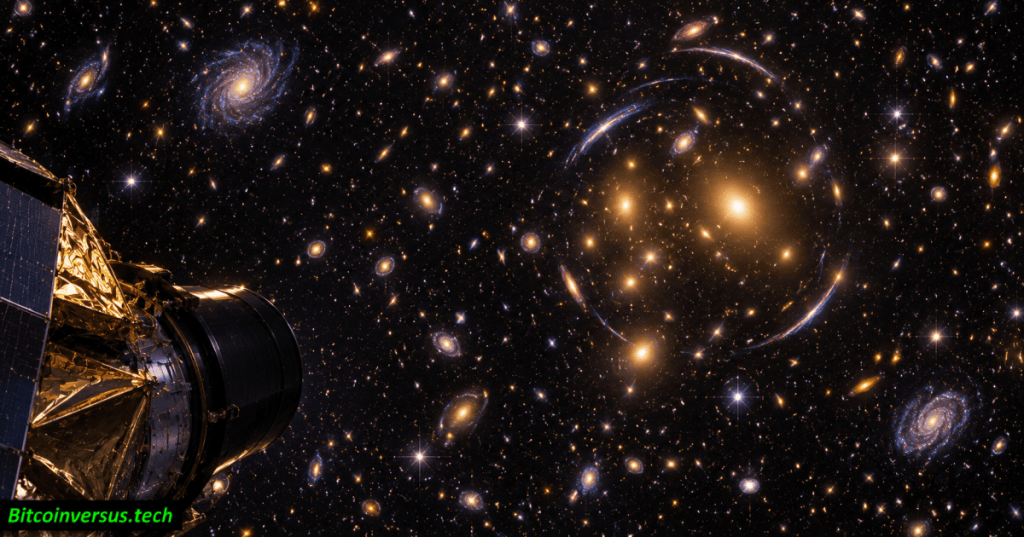
The European Space Agency released Euclid’s first major survey dataset on November 12, 2026, cataloguing more than 900 million galaxies and around 15,000 potential strong gravitational lenses. Named DR1-Foundation, the release draws on roughly 13 months of space observations and includes more than 160 million source spectra. The catalogues are a major step toward mapping dark matter and the Universe’s expansion, but neither the final 3D cosmic map nor Euclid’s full dark-energy measurements has been completed.
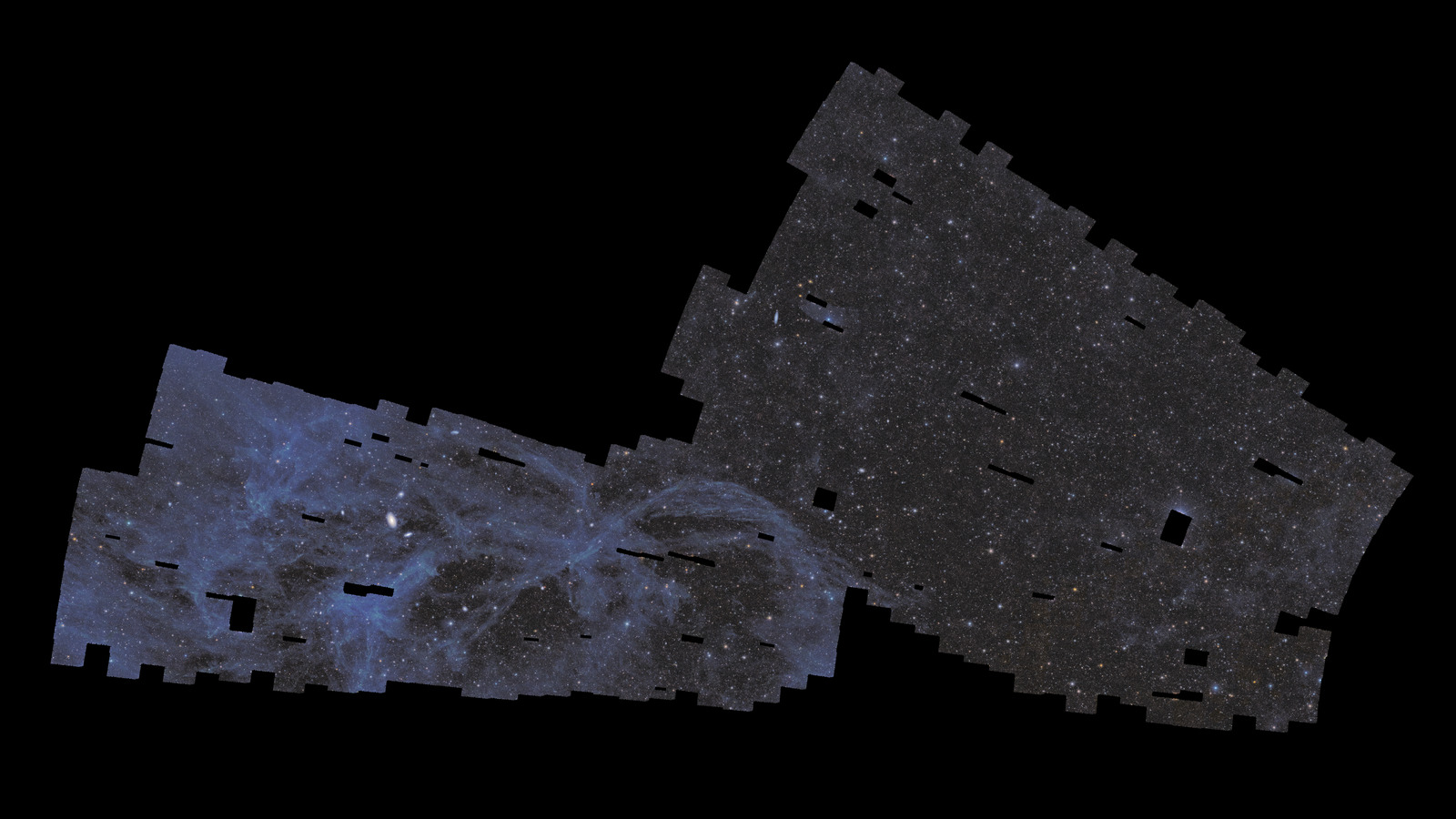
ESA/Euclid’s official November 12, 2026 video zooms into the northern-sky mosaic, nearly 500 gigapixels across. Actual survey imagery, not a computer-generated prediction of cosmic structure. Credit: ESA/Euclid/Euclid Consortium/NASA, image processing J.-C. Cuillandre and E. Bertin / YouTube.
A billion objects across an enormous sky survey
The mission’s official announcement reports observations covering about 1,900 square degrees, equivalent to the apparent area of 9,500 full Moons. The archive contains roughly 1.7 million gigabytes, or 1.7 petabytes, of survey data. Beyond galaxies, it lists more than 60 million quasar candidates, which still require further classification and confirmation.
Euclid combines its high-resolution visible-light instrument with near-infrared imaging and spectroscopy. Researchers can use the brightness, shape, colour and spectral features of distant galaxies to trace where matter accumulated across cosmic history. Separately, NASA’s Roman telescope preparations show how another upcoming observatory will complement large astronomical surveys.
Why 15,000 lens candidates matter
Gravitational lensing occurs when the gravity of foreground matter bends light from a more distant object. Strong lenses can produce arcs, multiple images and near-complete Einstein rings. Euclid’s approximately 15,000 candidates exceed previous catalogues in scale, but candidate status does not establish that every object is a verified lens. Machine-learning searches and citizen scientists helped locate the candidates among far more common galaxies and stars.
Confirmed strong lenses can reveal the mass of foreground galaxies, including the contribution of dark matter that emits no light. Hubble’s recently published nine-lens gallery illustrates the same physical phenomenon on a much smaller sample. Euclid’s value comes from broad, consistently collected measurements.
ESA Space Science Hub’s September 2024 explanation of weak gravitational lensing shows how tiny statistical distortions in galaxy shapes help trace dark matter. Background engineering and science context; not a November 2026 detection result. Credit: ESA/Euclid Consortium/Cacao Cinema / YouTube.
Spectra provide distance information
The released spectra contain information about light emitted by over 160 million sources. Astronomers identify spectral signatures, including hydrogen emission, and estimate redshift to place objects along the line of sight. Galaxy positions and redshifts together help reconstruct the cosmic web, whose filaments and clusters developed under gravity over billions of years.
Computational analysis is essential at the new scale. An earlier all-sky AI-mapping project highlights a different computational approach, while machine-learning research using Webb data demonstrates why model validation matters. Catalogue candidates and automated classifications remain distinguishable from independently measured astrophysical results.
The decisive dark-energy analyses are still ahead
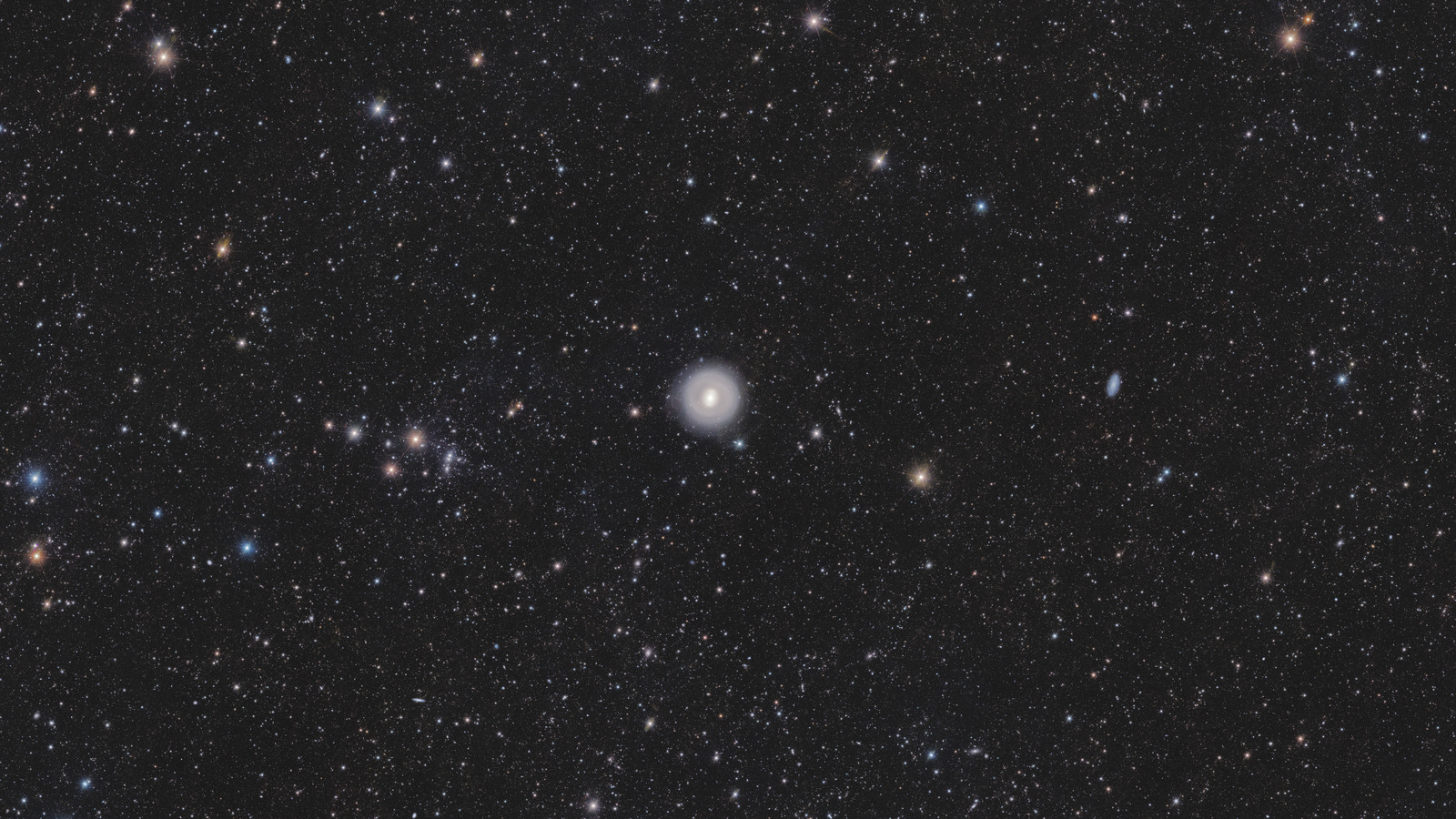
The November dataset covers roughly 14% of Euclid’s planned survey area. ESA and the Euclid Consortium say additional weak-lensing shape measurements, galaxy-clustering products and high-level cosmology analyses are expected with the completed DR1 in mid-2027. Consequently, the release does not independently establish a new value for dark energy, overturn a cosmological theory, or finish the promised 3D map.
The immediate scientific result is a publicly accessible trove of calibrated images, candidate catalogues and spectra. It provides material for studies of rare lenses, ancient galaxies and large-scale structure, while future analysis will determine which discoveries endure and what they imply about the dark Universe.
Primary sources: ESA announcement, November 12; ESA/Euclid DR1-Foundation technical documentation; Euclid Collaboration DR1 release overview; Euclid NASA Science Center archive; Reuters independent report. Reported catalogue totals are survey classifications, not individually confirmed cosmological discoveries.
Editor’s Note: All dataset counts, release dates, 2027 milestones and candidate classifications were checked against ESA and Euclid Consortium documentation. The original 1200 × 630 featured cover is conceptual photorealistic art with a neon-green Bitcoinversus.tech watermark; it is not an actual telescope exposure. Both in-story images are genuine Euclid observations credited to ESA and collaborators. The two YouTube embeds use verified official ESA source videos. WordPress rendering and actual browser playback are separate verification steps.

BitcoinVersus.Tech is volunteer-run and publishes independent scientific and technical reporting. An optional 5,000-satoshi donation supports research. Scan the original QR from a second screen with a compatible Bitcoin wallet; on the same phone, import a saved QR image if supported by the wallet. Independently verify recipient 3C9o19EH5HSiwEPyCTmEKzxhNCbo2X6TTb and 5,000 satoshis before payment. Bitcoin transfers are generally irreversible.
We volunteer daily to ensure the information on BitcoinVersus.Tech is Verifiably True. Scientific coverage is educational and informational and does not constitute certified engineering, financial or investment advice.


Leave a Reply