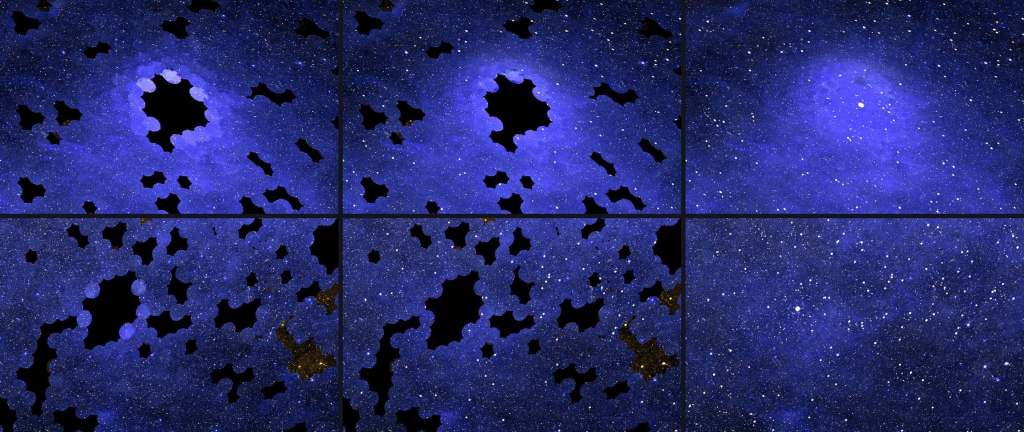
Claude Science helped astrophysicist Brice Ménard create the first complete ultraviolet map of the entire sky, combining decades of telescope observations with AI predictions for regions that had never been directly observed in UV.
The project was published by Anthropic on October 8, 2026. Ménard, an astrophysicist at Johns Hopkins University and a researcher at Anthropic, used Claude Science to assemble, calibrate, merge, and complete ultraviolet survey data collected by multiple space missions.
What Claude Actually Mapped
The map covers the entire sky in ultraviolet light, not every wavelength of the electromagnetic spectrum. That distinction matters. Ultraviolet astronomy reveals hot stars, glowing dust around young stars, stellar explosions, and other structures that look very different from the same regions in visible, infrared, radio, or X-ray light.
About One-Third Had Never Been Seen In UV
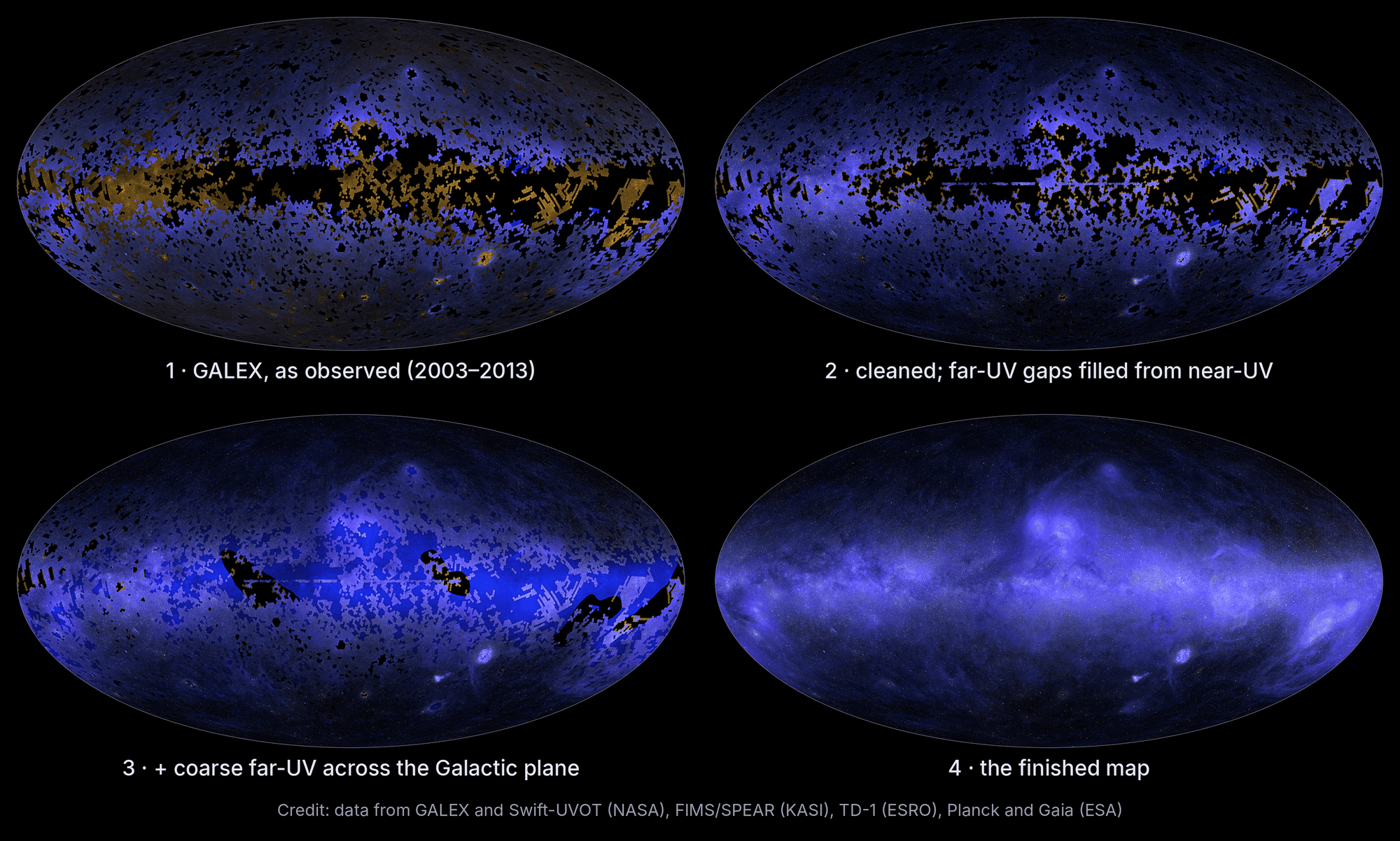
The largest source dataset came from NASA’s GALEX mission. NASA describes GALEX as a space telescope built to observe the universe in ultraviolet wavelengths and study the history of star formation. According to Anthropic, GALEX produced roughly 38,000 observations and covered about two-thirds of the sky, but it deliberately avoided many regions containing very bright stars because they could damage its detectors.
That left a major gap: roughly one-third of the sky had never been directly observed in ultraviolet. Claude combined the existing UV data with visible, infrared, and radio observations and learned relationships between those wavelengths and UV brightness. It then estimated what the missing UV regions should look like.
The Prediction Was Tested Against Real Data
To test the method, researchers hid UV measurements from areas where real observations already existed and asked the model to reconstruct them. Anthropic reports that after refinement, the predicted values came within about 10% of the real ultraviolet measurements.
Claude also added estimated ultraviolet light from more than 100 million individual stars using measurements from ESA’s Gaia mission. The result was not a single prompt producing a picture. It was a multi-stage scientific workflow involving data retrieval, calibration, cross-survey alignment, statistical prediction, review, correction, and repeated rebuilding of the map.
Why This Matters
The interesting part is not simply that an AI system made a striking astronomy image. It is that an AI research system handled a large amount of scientific “glue work” that researchers often postpone because it requires tedious calibration, file handling, repeated checks, and computation.
That fits a broader pattern already visible in Claude projects. BitcoinVersus.Tech recently covered how Claude helped identify an enzyme system with CRISPR-like DNA repeats, how Claude Code introduced mods that can rewrite agent behavior, and how Anthropic’s rapid growth is colliding with enormous compute costs. The sky map shows another side of the same trend: increasingly capable AI systems are moving beyond chat and into long-running technical workflows.
What Comes Next
Anthropic says the finished map can be used as an educational and scientific resource, with layers identifying which pixels are measured, which are predicted, and the uncertainty associated with those predictions. That transparency is important because a predicted region should not be mistaken for a direct telescope observation.
The simple headline is true with one important qualifier: Claude helped map the entire sky in ultraviolet, and part of that complete view is a scientifically tested prediction of what unobserved regions should look like.
Editor’s Note
The featured image and body image are separate. The body image comes from Anthropic’s published sky-map materials and credits the underlying astronomy datasets. The YouTube video is embedded as a responsive native Gutenberg player, and the Polymarket post is embedded directly from its twitter.com/USERNAME/status/STATUS_ID URL. No normal article text is placed in text boxes, cards, panels, or fixed-width containers.
BitcoinVersus.Tech content is provided for informational and educational purposes.


Leave a Reply