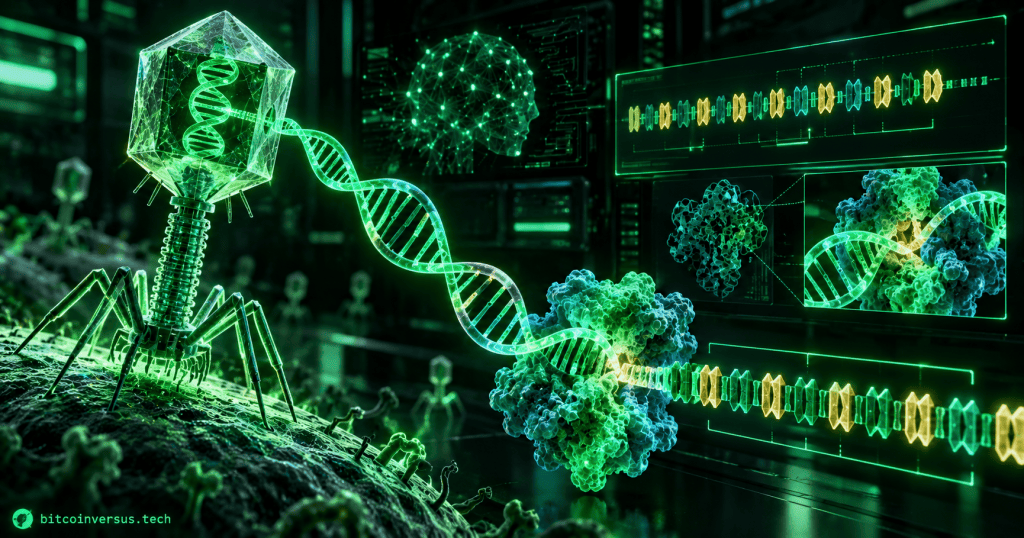
Anthropic has moved Claude out of the chatbot window and into molecular biology. The company’s new life-sciences team says Claude helped identify an unusual enzyme system hidden in bacteriophage DNA, then proposed laboratory experiments that human researchers used to begin testing whether the computational finding was real.
In Anthropic’s September 23 research announcement, the company described a family of reverse transcriptases positioned beside long arrays of repeating DNA. The arrangement resembles some features associated with CRISPR systems, but Anthropic explicitly says the system’s function and potential biotechnology uses are still unknown.
Claude Searched Genomes Instead of Waiting for a Prompt
The project used hundreds of parallel Claude agents to search genomic databases, read scientific literature, compare protein families and generate hypotheses. Anthropic says the agents converged on an unusual reverse-transcriptase system in bacteriophages—viruses that infect bacteria.
The important distinction is that this was not simply a model summarizing an existing paper. Claude was used as part of a discovery pipeline: computational search first, followed by wet-lab experiments performed by scientists.
Anthropic summarized the result in its main X announcement, while also stressing that much more work is required before anyone knows whether the system can cut, copy or otherwise manipulate DNA in a useful programmable way.
The Wet Lab Is the Reality Check
Biology forces AI research to confront something software benchmarks do not: nature gets the final vote. A model can generate thousands of plausible hypotheses, but a molecule either behaves as predicted in an experiment or it does not.
That is why Anthropic’s new laboratory matters as much as the enzyme candidate. The lab gives researchers a way to close the loop between computational hypothesis generation and physical validation instead of treating model output as a discovery by itself.
Reuters independently reported that the result is the first major public output from Anthropic’s expansion into hands-on biology research. The reporting also underscores the uncertainty: resemblance to CRISPR-like mechanisms does not establish a new gene-editing technology.
Amodei Calls It a Possible New Gene-Editing Mechanism—With Caveats
Anthropic CEO Dario Amodei described the molecular machine as something the team suspects could represent a new gene-editing mechanism, while saying its precise function, biotechnology utility and significance remain unclear.
That caution is important. CRISPR became transformative because scientists learned how to make a naturally occurring biological system programmable, precise and reproducible. Finding an intriguing enzyme-plus-repeat architecture is the beginning of that process, not the end.
AI Is Becoming an Instrument for Biology
The deeper story is the workflow. AI models are increasingly moving from analyzing completed scientific results toward choosing what scientists should investigate next.
BitcoinVersus.Tech has already tracked gene editing from a different direction, including ARIA’s gene-edited wildlife adaptation projects. Anthropic’s experiment pushes upstream, toward discovering biological machinery that could eventually become a new tool.
It also extends the long arc behind CRISPR-Cas9 and programmable genome editing. The most consequential biotechnology platforms often begin with researchers noticing strange mechanisms that evolution already built.
Discovery Throughput Could Change Before Clinical Timelines Do
Even if AI dramatically accelerates the search for enzymes, proteins and therapeutic targets, it does not erase the slow parts of medicine. Laboratory replication, toxicology, manufacturing, clinical trials and regulatory review still determine whether an idea becomes a treatment.
The immediate opportunity is throughput. If AI can search more genomic territory and propose more testable hypotheses, scientists may be able to feed more credible candidates into the experimental pipeline without pretending that every candidate is a breakthrough.
That makes this development less about replacing biologists and more about giving them a new scientific instrument—one that can read an enormous fraction of the biological record and flag patterns humans might never have chosen to inspect.
The same convergence of computation and biology is visible in BitcoinVersus.Tech’s earlier coverage of research decoding energy patterns inside cells. Better measurement and better computational search increasingly reinforce each other.
The Claim Worth Watching Is Smaller—and More Interesting
Claude has not invented a proven successor to CRISPR. Anthropic has not demonstrated a new medical treatment. The enzyme system’s function is still unresolved.
What the team has demonstrated is a credible loop in which AI searches biological data, proposes a previously uncharacterized molecular target, designs follow-up experiments and hands those experiments to human scientists for physical testing.
If that loop becomes reliable and repeatable, the breakthrough may not be any single enzyme. It may be a new way of searching biology itself.
BitcoinVersus.Tech
Advertisement
Editor’s Note:
We volunteer daily to ensure the credibility of the information on this platform is Verifiably True. If you would like to support our research initiatives, please donate here: 3C9o19EH5HSiwEPyCTmEKzxhNCbo2X6TTb
BitcoinVersus.tech is not a financial advisor. This media platform reports on financial subjects purely for informational purposes.


Leave a Reply