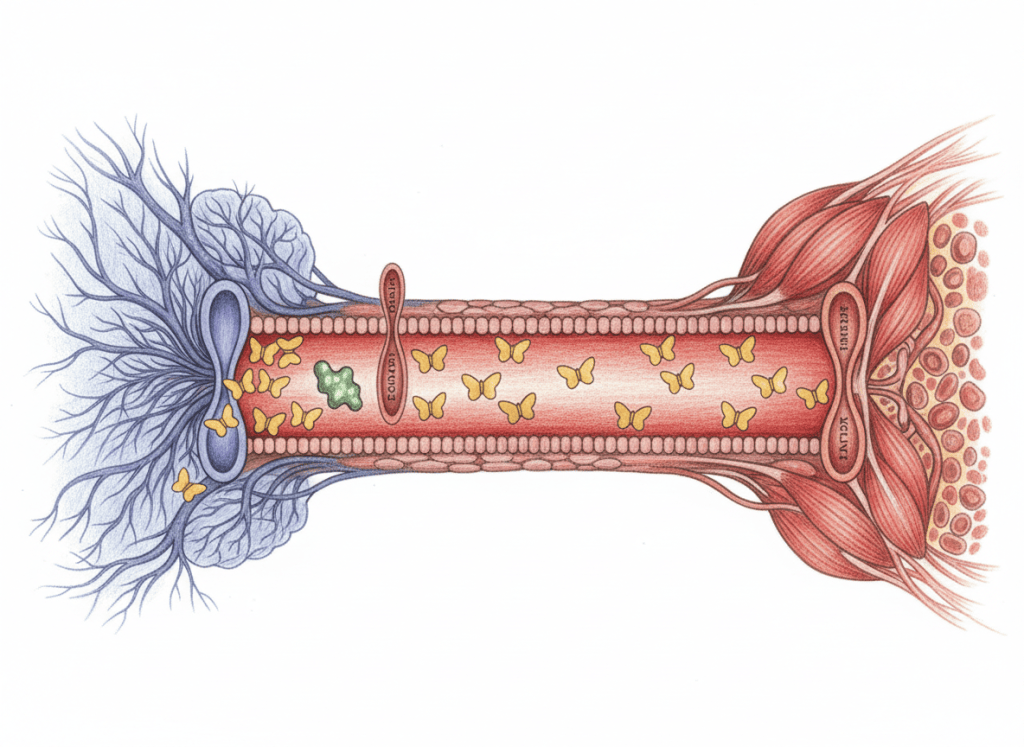
The U.S. Food and Drug Administration has approved Emcitate (tiratricol), the first FDA-approved treatment for patients with monocarboxylate transporter 8 deficiency, or MCT8 deficiency—also known as Allan-Herndon-Dudley syndrome. The September 28 decision gives adults and children with the ultra-rare X-linked disorder the first approved therapy aimed at the peripheral thyroid-hormone imbalance caused by the disease.
According to the FDA’s approval announcement, Emcitate is indicated for peripheral thyrotoxicosis in patients with MCT8 deficiency. The distinction matters: this is not a gene-editing therapy and it does not repair the underlying SLC16A2 mutation. Tiratricol is a thyroid-hormone receptor agonist that can enter cells without relying on the defective MCT8 transporter.
MCT8 deficiency creates a two-sided hormone problem
MCT8 is a transport protein that helps move thyroid hormones into cells, including across the blood-brain barrier. Pathogenic variants in the SLC16A2 gene can disrupt that transport. The result is unusual because different parts of the body can experience opposite thyroid-hormone conditions at the same time.
The central nervous system receives too little thyroid-hormone signaling, contributing to profound neurodevelopmental impairment, while peripheral tissues can be exposed to excess circulating triiodothyronine, or T3. That peripheral thyrotoxicosis can place chronic stress on the heart and metabolism and contribute to low body weight and other systemic complications.
Independent drug-reference coverage from Drugs.com describes the same mechanism: tiratricol can enter cells independently of MCT8 and restore thyroid-hormone signaling in MCT8-deficient cells. The FDA says treated patients showed reductions in excess blood thyroid hormone along with improvements in cardiovascular and metabolic measures such as systolic blood pressure and heart rate.
The treatment bypasses the transporter instead of repairing it
That is what makes Emcitate different from the gene-replacement approaches increasingly appearing across rare-disease medicine. Rather than replacing SLC16A2, the drug uses a molecule that does not depend on the broken transporter to reach its cellular target.
BitcoinVersus.Tech recently covered the first FDA-approved gene therapy for Sanfilippo syndrome type A, where an AAV vector delivers a functional gene copy. Emcitate reaches the rare-disease problem from a different direction: work around the defective transport mechanism rather than rewrite or replace the gene itself.
What the approval does—and does not—mean
The approval is important because MCT8 deficiency previously had no FDA-approved treatment option. It is also important not to overstate the result. The FDA indication is specifically for peripheral thyrotoxicosis. The approval does not claim that Emcitate reverses established neurologic injury, cures the genetic disorder, or restores the missing MCT8 transporter.
The drug is taken once daily as a liquid suspension, either orally or through a feeding tube. The FDA identified diarrhea, vomiting, rash and excessive sweating among the most common adverse reactions. The prescribing information also carries a boxed warning that thyroid hormones, including Emcitate, must not be used for obesity or weight loss.
Rare-disease biotechnology is diversifying its playbook
Emcitate is another reminder that “biotechnology” is not one therapeutic strategy. Some programs edit DNA, some deliver replacement genes, some degrade disease-driving proteins, and others—like tiratricol—use molecular design to route around a missing or malfunctioning biological component.
That wider toolkit is showing up across recent research. BitcoinVersus.Tech reported on an AI-assisted enzyme discovery with CRISPR-like repeat structures, while another recent project explored gene-edited organisms and biological interventions for wildlife adaptation. The common theme is not one technology; it is increasingly precise control over biological systems.
For MCT8 deficiency, the practical breakthrough is narrower but immediate: physicians now have an approved way to target the dangerous peripheral hormone excess created by a transporter that does not work. That is not a cure, but for a disease that previously had no approved U.S. treatment, it changes the clinical baseline.
BitcoinVersus.Tech
Advertisement
Editor’s Note
This report distinguishes treatment of peripheral thyrotoxicosis from correction of the underlying SLC16A2 mutation or reversal of established neurologic injury. The featured cover is an original editorial illustration and is not duplicated in the article body.
We volunteer daily to ensure the credibility of the information on this platform is Verifiably True. If you would like to support our research initiatives, please donate here: 3C9o19EH5HSiwEPyCTmEKzxhNCbo2X6TTb
BitcoinVersus.tech is not a financial advisor. This media platform reports on financial subjects purely for informational purposes.


Leave a Reply