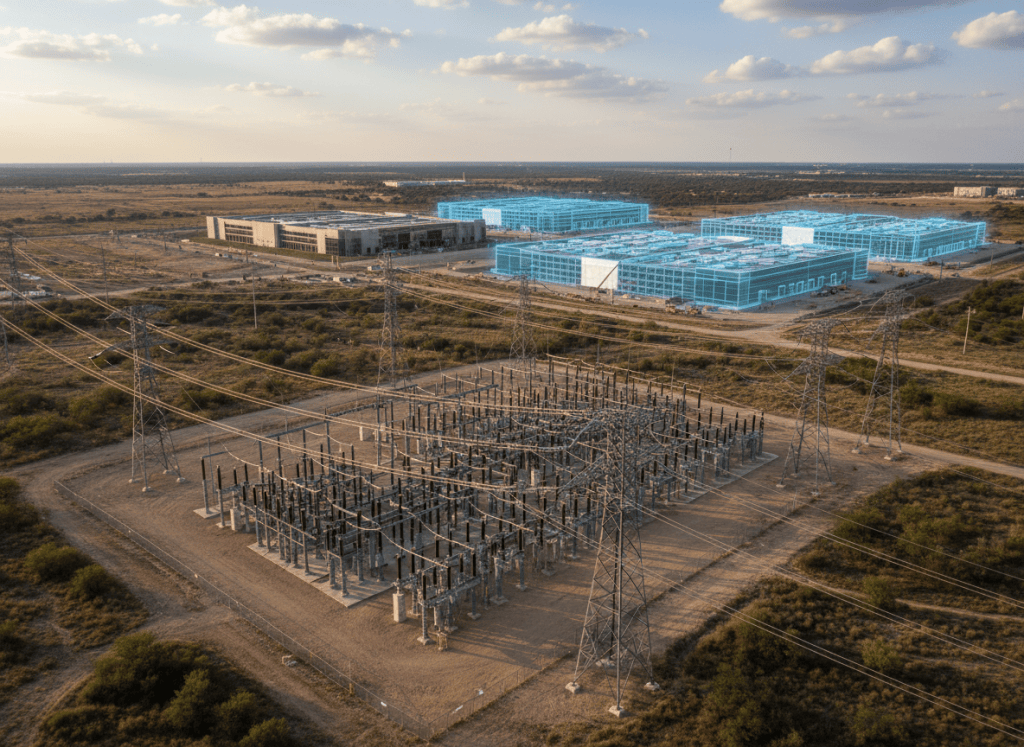
A recent YouTube explainer from Dr. Michael Litman asks a deceptively simple question about the AI data-center boom: when utilities see hundreds of gigawatts of new power requests, how much of that demand is actually real?
The video’s headline number is enormous. Across parts of the United States, large-load interconnection requests tied mostly to data centers now exceed 700 gigawatts. But many of those requests may represent the same project shopping multiple utilities, speculative site options that never get built, or developers reserving capacity long before financing, land, permits, equipment, and customers are fully secured.
Texas shows how extreme the queue has become
Texas offers the clearest example. In an official August directive, Governor Greg Abbott said ERCOT was considering more than 474 GW of requests to connect to the Texas grid. That is more than five times ERCOT’s record peak electricity demand, with data centers accounting for roughly 90% of the proposed load.
Those numbers do not mean Texas is about to add 474 GW of operating data centers. They describe requests in a connection pipeline. Utilities have to plan transmission, substations, generation, transformers, and reliability around those requests before they know which projects will survive.
BitcoinVersus has already followed the consequences from several directions. Texas paused new data-center interconnections while officials audited the queue, while Cipher Digital’s 3.2 GW ERCOT pipeline shows how existing Bitcoin-mining infrastructure is being repurposed toward AI.
Why “ghost demand” happens
Data-center developers often need power commitments before a project can attract customers and financing. Utilities, meanwhile, need credible project information before they can justify major grid investments. That creates a circular incentive: developers request capacity early because they need certainty, but the early request itself can make the project look more mature than it really is.
The problem gets worse when one developer submits multiple requests for the same eventual campus. A company evaluating several sites may ask more than one utility for similar capacity even though it will ultimately choose only one location. When each request is counted independently, the apparent demand can grow much faster than the number of projects likely to be built.
Reuters put the national figure above 700 GW
Reuters reported that requests from very large power users exceed 700 GW across parts of the Midwest, Mid-Atlantic, and Texas, while utilities increasingly question how much of that queue represents projects that will actually be completed.
The outlet shared the report in a directly relevant X post, describing Texas’ pause as part of a broader U.S. reckoning with “ghost” data-center demand.
Grid planners cannot ignore the queue just because some projects are speculative
The danger runs in both directions. If utilities assume too much of the queue is real, customers may end up paying for generation and transmission built around projects that never arrive. If utilities assume too much is fake, genuine AI infrastructure can sit for years waiting on power.
That tension is already showing up in rate design. BitcoinVersus recently covered Google’s long-term Michigan power agreement with specific ratepayer guardrails, one model for requiring giant new loads to carry more of the infrastructure risk they create.
The AI power race may need a better reservation system
The most useful way to think about ghost demand is not that AI electricity growth is imaginary. It is that the queue itself is a poor measurement tool. Actual AI data centers are being built rapidly, but the raw interconnection total mixes serious campuses with duplicate applications, early-stage concepts, optional sites, and projects that may never secure enough capital or hardware.
That suggests the grid needs stronger milestones: financial deposits, site control, equipment orders, customer commitments, phased power reservations, or other evidence that a project is moving from idea to construction. The goal is not to slow real AI infrastructure. It is to stop phantom megawatts from distorting the planning process for everyone else.
The bigger question is not 700 GW—it is how much will survive
The 700+ GW figure is useful because it shows the scale of the planning problem, not because it predicts future electricity consumption. The number that matters next is the conversion rate: how much of today’s queue becomes financed, permitted, energized data-center load.
That is why the YouTube framing is useful. AI has created a genuine power shortage in some markets, but it has also created an information problem. Utilities are being asked to build physical infrastructure around demand that can move, duplicate itself, or disappear long before the substation is finished.
BitcoinVersus.Tech
Advertisement
Editor’s Note
We volunteer daily to ensure the credibility of the information on this platform is Verifiably True.
If you would like to support to help further secure the integrity of our research initiatives, please donate here: 3C9o19EH5HSiwEPyCTmEKzxhNCbo2X6TTb
BitcoinVersus.tech is not a financial advisor. This media platform reports on financial subjects purely for informational purposes.


Leave a Reply