Michigan regulators have approved a 20-year electricity agreement for Google’s planned data center in Van Buren Township, but the deal comes with unusually explicit protections meant to keep the project’s costs off ordinary DTE Electric customers.
The Michigan Public Service Commission’s October 1 decision conditionally approves two special contracts between DTE Electric and Google: a Primary Supply Agreement for electricity service and a Clean Capacity Accelerator Agreement covering new clean generation and energy storage.
The Commission also summarized the approval in its official X post, emphasizing that the structure is intended to prevent other customers from subsidizing the new large load.
Google must pay for a large share of its contracted demand even if usage falls
The contract sets an 80% minimum billing demand. In plain English, Google must pay for at least 80% of its contracted electric demand each billing cycle even when actual usage is lower. That floor is higher than the range normally used under DTE’s large-load rate.
The agreement also stretches the service term to 20 years and requires an early-termination payment that ultimately covers at least 15 years of minimum monthly charges. Credit and collateral requirements add another layer of protection if the data center closes or scales down sooner than expected.
Those details put Michigan’s approach squarely in the wider debate BitcoinVersus.Tech recently covered around whether data center power growth should be allowed to raise household utility costs. The important shift here is contractual: the large customer is being assigned specific long-term payment obligations before the load arrives.
The power deal also triggers new renewable generation and batteries
Under the Clean Capacity Accelerator Agreement, Google will pay for DTE to develop up to 1,600 MW of renewable generation and 480 MW of battery energy storage. DTE will own and operate those resources.
That does not mean the data center will consume 2,080 MW continuously. The figures describe the maximum new renewable and storage resources contemplated under the agreement, while storage capacity and renewable generation play different roles on the grid. The Commission’s core concern is that the infrastructure needed to serve the project should not become an unpaid obligation for other customers.
Scale is increasingly the defining feature of AI infrastructure. BitcoinVersus.Tech recently covered TCS planning a 1 GW Hyderabad AI data center campus, showing how quickly single projects are moving into power-system territory once associated with entire industrial districts.
Local approval does not erase local controversy
ClickOnDetroit independently reported that the agreement is tied to the proposed “Project Cannoli” development near I-94 and Haggerty Road and has already drawn heated local debate. The utility contract answers one question—who pays for electric-service infrastructure—but it does not resolve every dispute over siting, traffic, land use, water, noise or construction impacts.
The MPSC is explicit about that boundary. Its authority in this case covers utility service, rates and financial risk; it does not decide whether or where the data center itself may be built.
That distinction also explains why community policy is becoming a separate track from grid policy. BitcoinVersus.Tech recently examined Amazon’s effort to put more resources into communities hosting data centers. Utility contracts can allocate electrical costs, but developers still have to address the local effects of construction and long-term operation.
The next checkpoint is December 2027
DTE told regulators that the Google facility is expected to begin taking electric service in December 2027 and reach maximum load by December 2028. That gives this story a measurable next phase: watch whether the promised renewable generation, battery storage and supporting grid work arrive on schedule, and whether the cost-allocation protections work as designed once the load begins ramping.
For the data center industry, the bigger lesson is that gigawatt-class development is no longer only a construction problem. It is becoming a contract-design problem, a generation-planning problem and a ratepayer-protection problem at the same time.
BitcoinVersus.Tech
Advertisement
Editor’s Note
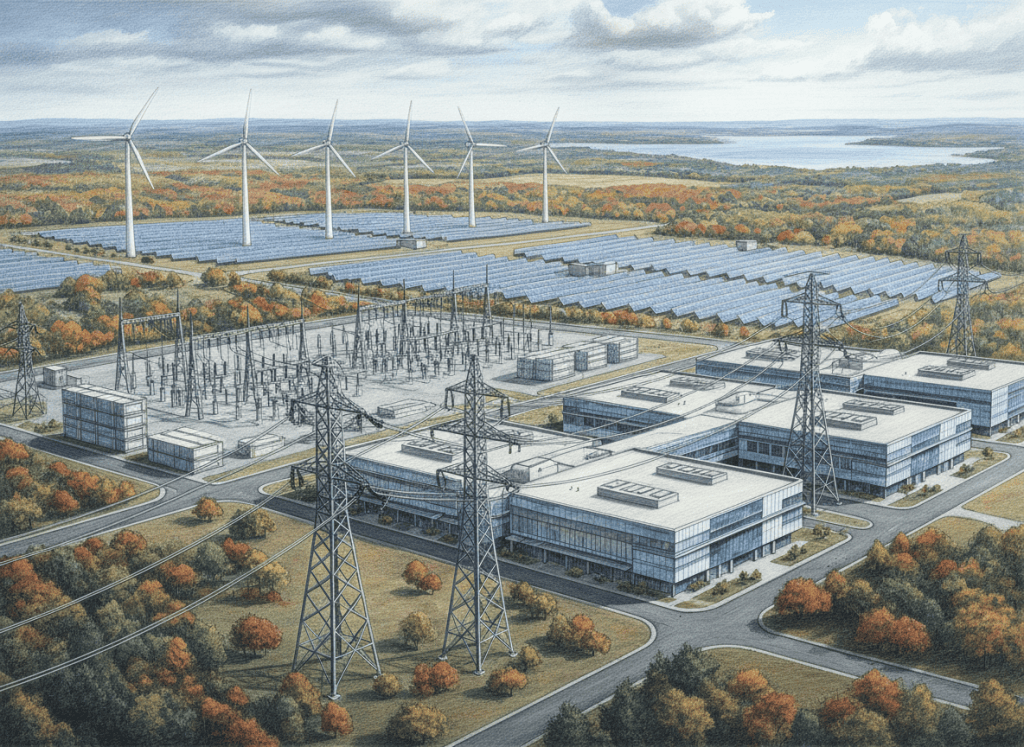
This report distinguishes the MPSC’s utility-contract approval from separate local siting and land-use decisions. The featured cover is an original editorial illustration and is not duplicated in the article body.
We volunteer daily to ensure the credibility of the information on this platform is Verifiably True. If you would like to support our research initiatives, please donate here: 3C9o19EH5HSiwEPyCTmEKzxhNCbo2X6TTb
BitcoinVersus.tech is not a financial advisor. This media platform reports on financial subjects purely for informational purposes.


Leave a Reply