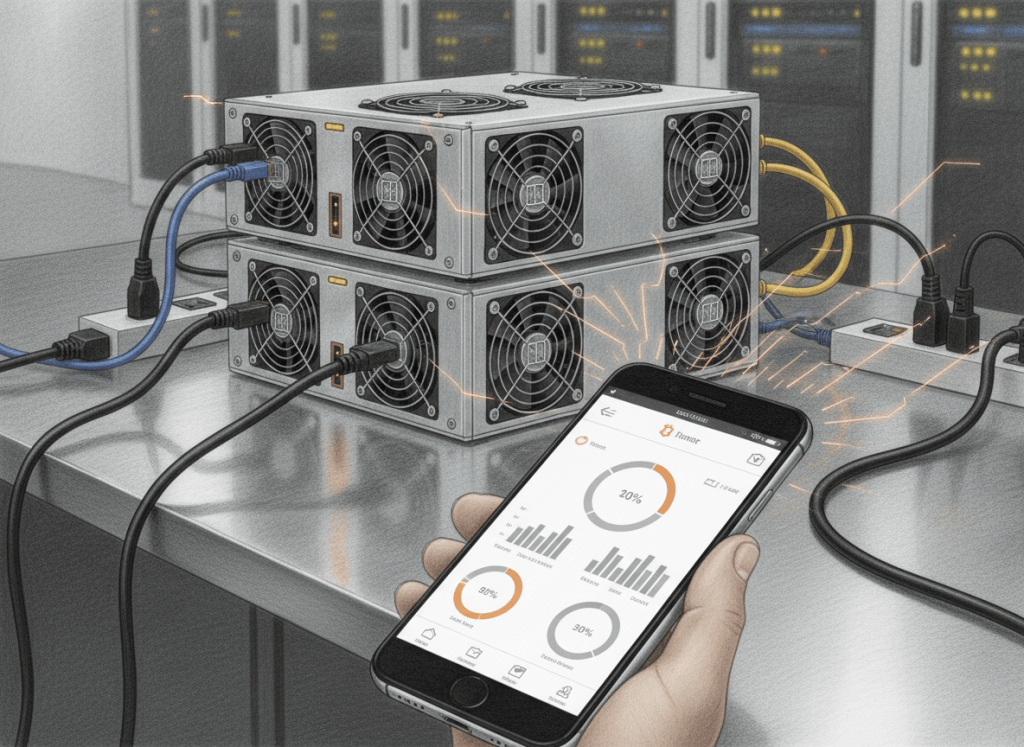
Braiins has moved a major part of the solo-Bitcoin-mining workflow onto a phone. Its newly announced Mobile Block Hunting experience lets users monitor hashrate, track their best share and rent mining hashrate from iOS or Android without sitting in front of a desktop dashboard.
The important distinction is that the phone is not doing the SHA-256 mining itself. The handset is the control plane. The actual hashes are still produced by ASIC hardware elsewhere and routed through Braiins Hashpower and Braiins Solo. In its official Mobile Block Hunting announcement, Braiins describes the phone experience around three actions: monitoring hashrate, tracking the best submitted share and renting hashrate instantly.
The phone becomes the mining control panel
That separation matters because “mobile mining” can easily sound like a smartphone is competing directly with modern Bitcoin ASICs. That is not what is happening here. A user can initiate or monitor a solo-mining session from a phone, but dedicated mining equipment is still performing the proof-of-work calculations.
Braiins Solo exposes the result that matters most to a block hunter: the best share. Mining pools use lower-difficulty shares to measure work being performed. A very strong share can get close to network difficulty, but only a hash that actually satisfies Bitcoin’s current network target becomes a valid block. A high best share does not make the next hash more likely to succeed.
BitcoinVersus.Tech recently documented block 966,351 being found through Braiins Solo. Braiins also confirmed that block find on X, showing the other half of the mobile story: the interface may be getting simpler, but the result still comes from real proof of work on Bitcoin.
Renting hashrate changes access, not probability
The app can reduce the operational friction of getting temporary mining power. Instead of buying an ASIC, arranging electrical capacity, cooling it and keeping it online, a user can rent SHA-256 hashrate and point that compute at a solo-mining destination. Braiins’ current Hashpower infrastructure handles the underlying delivery while the mobile interface makes the session easier to start and watch.
What the interface cannot remove is variance. More hashrate gives a miner more attempts per second, but it does not create a schedule for finding a block. That is why seemingly opposite outcomes can both be normal. BitcoinVersus.Tech recently covered three solo-style Bitcoin blocks landing within roughly 22 hours, while other stretches can pass with no comparable result.
An independent walkthrough shows the workflow
The new interface is also visible outside Braiins’ own announcement. Rabid Mining’s mobile Braiins walkthrough demonstrates renting hashrate from a phone and directing that compute toward a solo-mining workflow. The video reinforces the technical distinction: the mobile device is issuing instructions and displaying results, while remote mining hardware performs the hashes.
Why this matters for smaller miners
Solo mining has increasingly become both an infrastructure experiment and an educational tool. A person does not need to confuse a small miner with industrial-scale production to learn how pools, shares, Stratum connections and network difficulty fit together. BitcoinVersus.Tech previously looked at the Braiins Mini Miner as a hands-on entry point; Mobile Block Hunting pushes the same accessibility idea into software and rented compute.
The strongest part of the design may be that it exposes mining mechanics instead of pretending the phone is magically mining Bitcoin. Users can watch hashrate arrive, see shares accumulate, compare a best share with the network target and understand that each new hash is another independent attempt.
That makes Mobile Block Hunting less interesting as a “mining app” and more interesting as a portable interface to real mining infrastructure. It lowers the number of operational steps between deciding to try solo mining and actually directing ASIC hashrate at a block target. It does not lower Bitcoin’s difficulty, remove variance or make a block guaranteed—and that distinction is exactly what keeps the product grounded in how proof of work actually functions.
BitcoinVersus.Tech
Advertisement
Editor’s Note
This report distinguishes mobile control of remote ASIC hashrate from mining directly on a smartphone. The featured cover is an original editorial illustration and is not duplicated in the article body.
We volunteer daily to ensure the credibility of the information on this platform is Verifiably True. If you would like to support our research initiatives, please donate here: 3C9o19EH5HSiwEPyCTmEKzxhNCbo2X6TTb
BitcoinVersus.tech is not a financial advisor. This media platform reports on financial subjects purely for informational purposes.


Leave a Reply