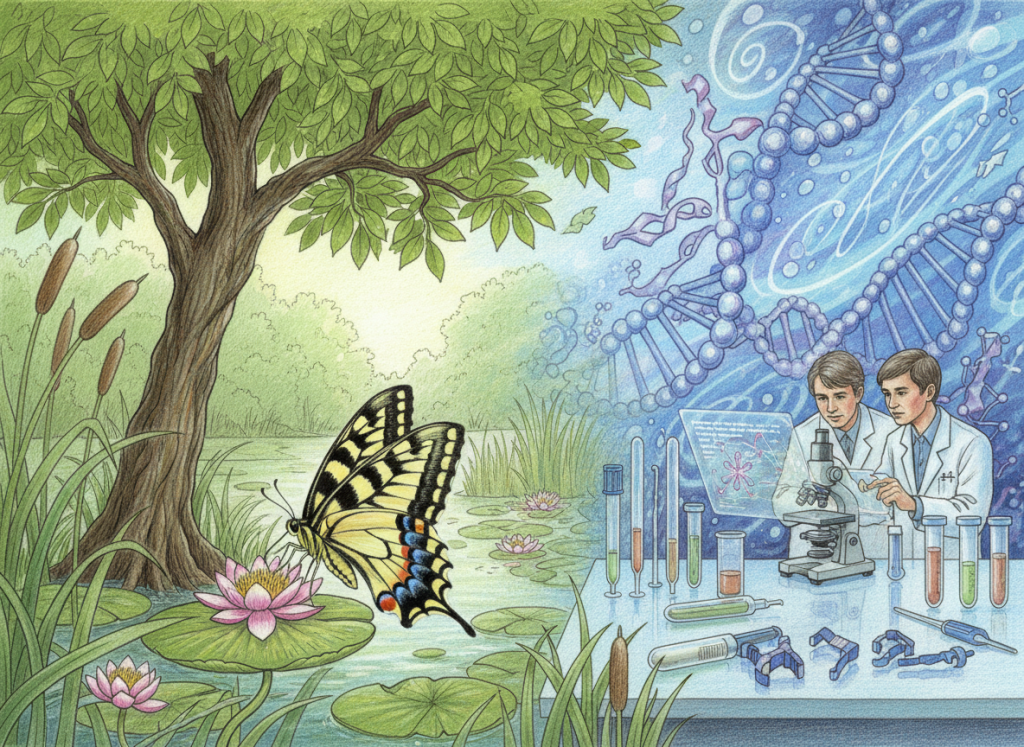
Biotechnology is moving beyond medicine and agriculture into a considerably more difficult environment: wild ecosystems.
The UK’s Advanced Research + Invention Agency, or ARIA, has announced research teams for its £54 million Accelerated Adaptation programme, an effort to determine whether modern biotechnology can help vulnerable wild species adapt to environmental pressures faster than conventional evolution alone.
ARIA describes the work as an exploration rather than a proven conservation solution. Its programme combines genomics, molecular biology, ecological modelling and artificial intelligence while also studying the ethical, social and governance questions that would accompany any future intervention in wild populations.
The research is unusually ambitious. Projects include efforts involving gene-edited swallowtail butterflies, RNA-based protection for ash trees, engineered skin bacteria intended to help amphibians resist fungal disease, and techniques for accelerating adaptation in long-lived trees. Fourteen teams announced on September 21 are expected to share an initial £30 million over two years, according to reporting on the programme.
Editing a Butterfly to Resist Insecticides
One project involving researchers at the University of Exeter plans to investigate CRISPR-Cas9 editing in swallowtail butterflies. The objective is not to redesign the species cosmetically. Researchers are investigating whether genetic changes could increase resistance to agricultural insecticides, one of the pressures affecting the endangered British population.
That distinction matters. Gene editing can make precise changes to DNA, but successfully changing an organism in a laboratory does not establish that releasing that organism into an ecosystem would be safe, effective or desirable. The ecological consequences can be substantially harder to predict because an engineered trait may affect reproduction, competition, predators, prey or other organisms across multiple generations.
Vaccines — But for Trees
Another branch of the programme is exploring biological protection for trees. Ash dieback, caused by the fungus Hymenoscyphus fraxineus, has devastated ash populations across Europe. A Cardiff University project is developing RNA-interference-based protection intended to disrupt fungal infection.
Other teams will study ways of shortening the reproductive cycle of long-lived trees such as oak. Normally, evaluating an adaptive trait across multiple tree generations can take decades. Accelerating reproduction could potentially compress that experimental cycle, allowing scientists to test evolutionary responses much faster.
Biotechnology Meets AI and Ecological Modeling
The project is not simply a collection of CRISPR experiments. ARIA says the larger programme will combine genomics, molecular biology, ecological modelling and AI to investigate whether adaptation can be measured and accelerated responsibly.
That computational component is important because biological modification and ecological deployment are different problems. Researchers first need to identify useful traits. They then need to understand inheritance, fitness and potential unintended effects. Ecological models can subsequently test how those traits might behave when organisms interact with changing environments and other species.
BitcoinVersus.tech has previously examined similar intersections between computing and biology, including CRISPR-Cas9 and human longevity research and Harvard gene therapy entering its first human clinical trial.
The new ARIA projects move that discussion from individual organisms and medicine toward entire populations and ecosystems.
Research Is Not Environmental Deployment
The distinction between an experiment and a release into nature is especially important here. ARIA describes Accelerated Adaptation as research into whether such interventions could be carried out measurably and responsibly. The programme explicitly includes ethics, social responsibility, independent data checking and governance work. The Guardian reports that none of the experimental solutions will be released during the programme, which runs to 2030.
That makes the current milestone the beginning of a technology-development and evaluation programme—not evidence that gene-edited wildlife is ready for widespread environmental deployment. Conventional conservation measures such as protecting habitat and reducing environmental pressures remain separate from these experimental technologies.
The more consequential question ARIA is asking is whether biotechnology can eventually give conservation scientists another tool when environmental change occurs faster than vulnerable species can naturally adapt. If the research succeeds, genetic engineering may eventually become not only a medical and agricultural technology, but an ecological engineering technology as well.
Sources and Visual Context
Primary source: ARIA — Accelerated Adaptation funded projects
Programme overview: ARIA — Accelerated Adaptation
University research: University of Exeter — New genetic tools could protect UK’s pollinators
Independent reporting: The Guardian — Tree vaccines and gene-edited butterflies among ARIA projects
A directly related official YouTube video was not added because no authoritative ARIA/partner video for this newly announced cohort was verified during publication. The article uses original scientific artwork and direct research links instead of inserting an unrelated generic CRISPR video.
BitcoinVersus.Tech Editor’s Note:
We volunteer daily to ensure the credibility of the information on this platform is Verifiably True. If you would like to support to help further secure the integrity of our research initiatives, please donate here: 3C9o19EH5HSiwEPyCTmEKzxhNCbo2X6TTb
https://x.com/1BitcoinVersus/status/1937006164555993338
BitcoinVersus.tech is not a financial advisor. This media platform reports on financial subjects purely for informational purposes.


Leave a Reply