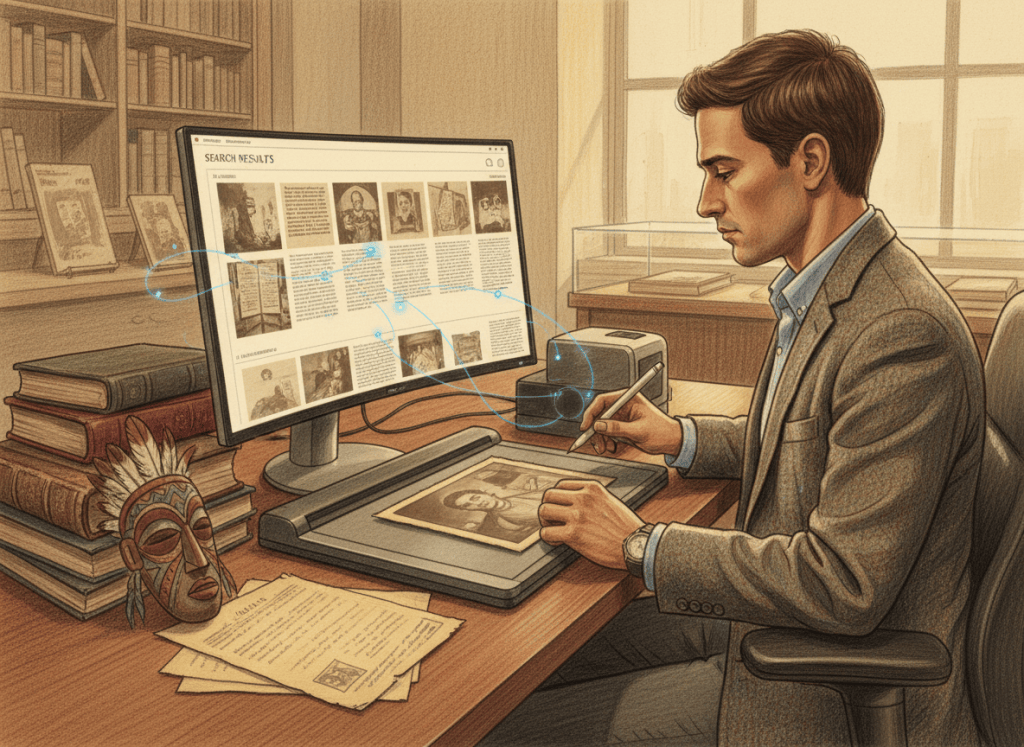
A museum collection increasingly has two forms. One is physical: paintings, documents, machines, photographs, clothing, books and artifacts stored or displayed inside a building. The other is digital.
High-resolution imaging, searchable metadata, digital asset-management systems and artificial intelligence are changing how museums preserve and expose collections to researchers and the public.
That transition is a central subject of the Digital Collections Summit, a virtual museum-technology conference focused on digitization, collection management, online curation, digital storytelling, digital asset-management systems and artificial intelligence.
An Artifact Needs More Than a Photograph
Digitizing a museum object is not simply taking a picture. A useful digital record may need high-resolution images, dates, creator information, ownership history, dimensions, conservation records, rights information and structured descriptions. Those records then need to remain searchable and usable as software platforms change.
The problem becomes significantly larger when an institution manages hundreds of thousands—or millions—of objects. One example comes from the Theodore Roosevelt Presidential Library’s Living Library research project. Researchers describe an end-to-end system developed around a collection containing roughly 300,000 records. The architecture combines digitization, OCR, metadata enrichment, human curatorial review, semantic indexing and a conversational interface.
Instead of forcing visitors to know exactly which database field or keyword to search, a conversational system can potentially let someone ask questions naturally and retrieve supporting material from the archive.
AI Does Not Eliminate the Archivist
The Living Library design also demonstrates why human verification remains important. Its workflow includes an Archivist App that allows curators to review and correct machine-generated transcriptions and metadata.
That matters because historical records are difficult data. Handwriting, faded documents, unusual typography, damaged photographs and incomplete descriptions can all create errors for automated systems. An AI-generated transcription that is almost correct may still be historically wrong.
The stronger architecture therefore uses automation to increase the amount of material humans can process while keeping expert review inside the system.
BitcoinVersus.tech recently examined the importance of maintaining a cryptographic inventory before post-quantum migration. Although museum archives and cryptographic systems solve very different problems, both demonstrate a basic information-technology rule: organizations cannot reliably protect, migrate or analyze information they have not properly cataloged.
Our coverage of Linux systems facing actively exploited kernel vulnerabilities similarly illustrates why long-lived digital systems need continuing maintenance rather than a one-time conversion.
Extended Reality Adds Another Layer
The Computer History Museum is approaching the relationship between culture and computing from another direction. Its Extended Reality: Visions of the Future exhibition brings together more than 100 headsets, smart glasses and wearable-computing artifacts spanning systems from the late 1960s through today’s AI-enabled devices.
That creates an unusual feedback loop. Museums are using new computing technologies to preserve culture while simultaneously preserving the computing technologies themselves as cultural artifacts. A virtual-reality headset can be both a tool for presenting a museum experience and an object that eventually belongs inside a museum collection.
Digital Preservation Is Infrastructure
None of this means AI automatically solves cultural preservation. Digital collections still depend on storage systems, file formats, backups, metadata standards, rights management, cybersecurity and long-term software maintenance.
The physical artifact may survive for centuries. A digital representation can disappear much faster if its storage media fails, its format becomes unreadable or its metadata is lost.
The emerging challenge for museums is therefore not simply to digitize everything. It is to build digital collections that remain searchable, verifiable, portable and understandable long after today’s software has been replaced.
That turns cultural preservation into something increasingly familiar to engineers: a long-term infrastructure problem.
Sources
Primary source: MuseumNext — Digital Collections Summit
Technical research: Living Library research paper
Museum technology: Computer History Museum
BitcoinVersus.Tech Editor’s Note:
We volunteer daily to ensure the credibility of the information on this platform is Verifiably True. If you would like to support to help further secure the integrity of our research initiatives, please donate here: 3C9o19EH5HSiwEPyCTmEKzxhNCbo2X6TTb
https://x.com/1BitcoinVersus/status/1937006164555993338
BitcoinVersus.tech is not a financial advisor. This media platform reports on financial subjects purely for informational purposes.


Leave a Reply