d-Matrix is pushing a different idea for AI hardware: move more of the work closer to memory so AI responses can arrive faster.
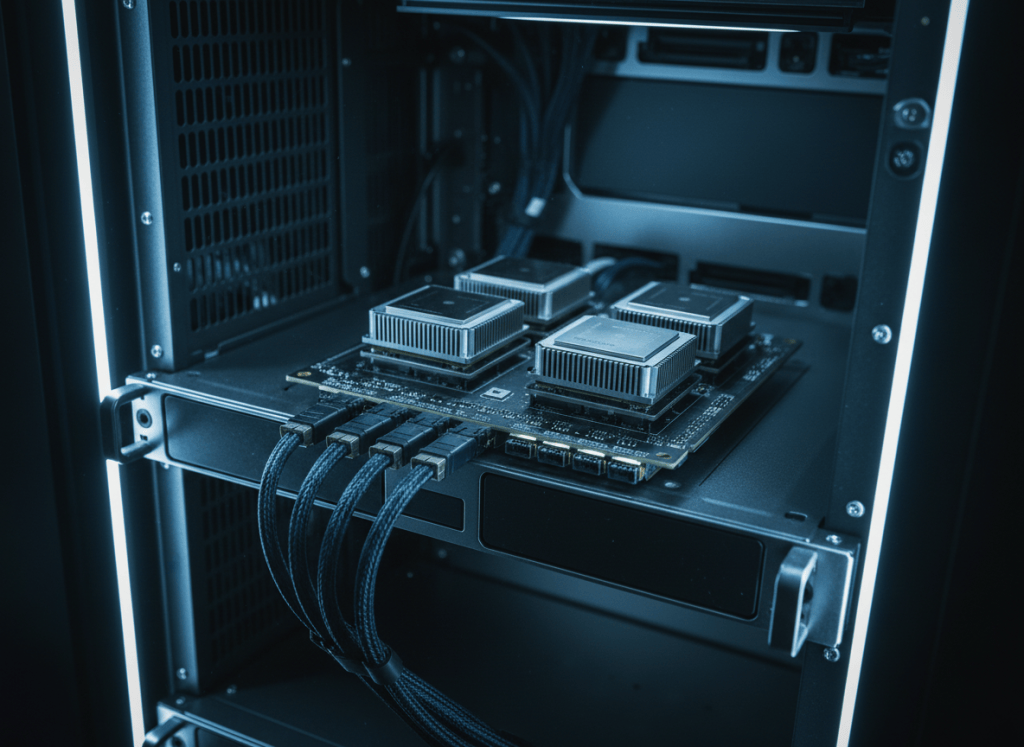
Why d-Matrix Is Building AI Chips Differently
Most people experience AI through a chatbot, coding assistant or voice tool. Behind those apps, the hardware has to repeatedly move huge amounts of model data through memory while generating each response. d-Matrix is attacking that bottleneck with a memory-centric architecture built specifically for AI inference—the part of AI computing that happens when a trained model is actually answering users.
The company’s Corsair platform combines high-bandwidth memory and compute on the same fabric and uses a PCIe form factor designed for data-center deployment. d-Matrix says this approach can reduce latency and improve efficiency by cutting down the distance data has to travel between memory and compute.
Corsair Is Now Real Production Hardware
This is no longer just a chip-development project. In June 2026, d-Matrix announced that Corsair had entered full production, with volume shipments planned for priority hyperscalers, neoclouds and frontier AI labs. The company positions Corsair both as a standalone inference accelerator and as hardware that can work alongside GPUs.
That second use may be especially important. Instead of trying to replace every GPU in an AI data center, specialized accelerators can take over parts of inference that match their architecture well. d-Matrix describes approaches including speculative decoding and attention/FFN disaggregation, where Corsair handles selected work while GPUs handle other portions of the model.
The Next Chip Is Raptor
d-Matrix is already working on its next-generation accelerator, called Raptor. In September, the company announced plans to integrate future d-Matrix XPUs with NVIDIA’s NVLink Fusion rack-scale infrastructure.
Raptor is designed around a 3D memory approach that places a DRAM memory chip and an SRAM compute chip together in a stacked package. d-Matrix says Raptor is expected to tape out before the end of 2026. If the approach works at production scale, the important story is not simply another accelerator entering the market—it is the growing effort to redesign the relationship between memory, compute and networking inside AI systems.
Why This Could Make Chatbots Faster
AI performance is not only about how much raw math a processor can perform. The system also has to keep model data moving quickly enough to feed that compute. That makes memory bandwidth, interconnects, latency, power use and software increasingly important.
d-Matrix recently introduced a Demo Cloud that lets evaluators run production-grade models on Corsair hardware through an OpenAI-compatible interface. That gives developers a way to test the architecture against real inference workloads instead of judging it only from specifications.
What to Watch Next
The key questions are how broadly Corsair gets deployed, whether customers reproduce d-Matrix’s performance and efficiency claims in their own workloads, and how quickly Raptor progresses from design to shipping hardware. The larger trend is already clear: the AI hardware race is expanding beyond the GPU itself and into memory, chip packaging, networking and specialized inference silicon.
Sources and further reading: d-Matrix · Corsair platform · Raptor and NVIDIA NVLink Fusion announcement · d-Matrix Demo Cloud
BitcoinVersus.Tech Editor’s Note:
We volunteer daily to ensure the credibility of the information on this platform is Verifiably True. If you would like to support to help further secure the integrity of our research initiatives, please donate here: 3C9o19EH5HSiwEPyCTmEKzxhNCbo2X6TTb


Leave a Reply