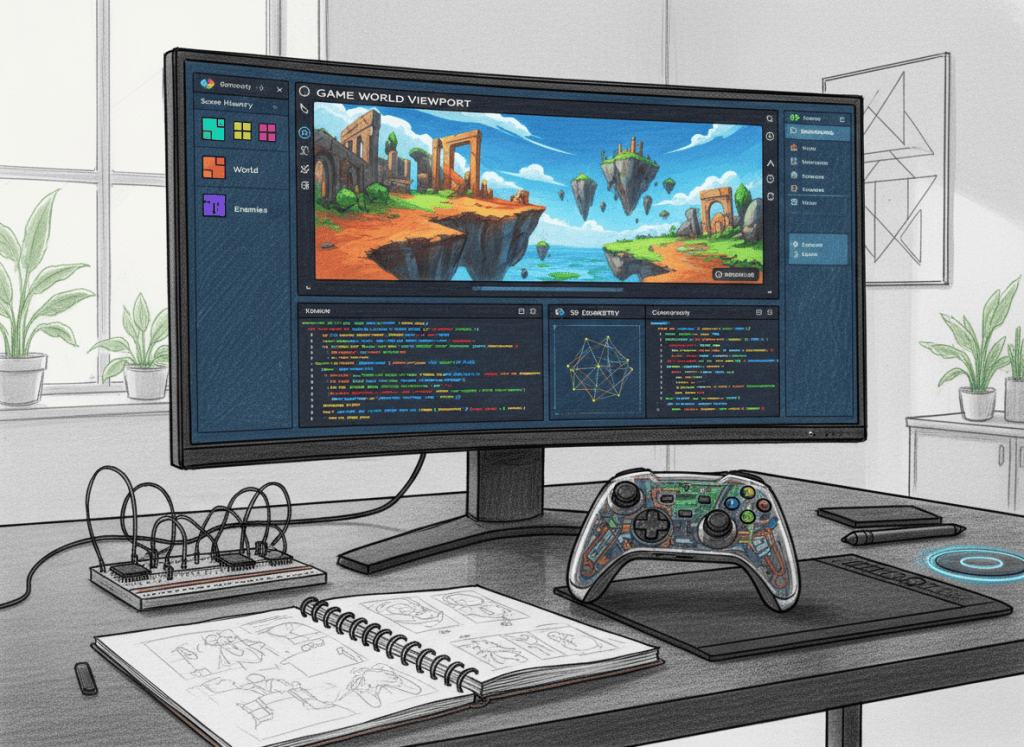
Open-source game development is gaining a larger commercial infrastructure around it.
W4 Games, a company founded by veterans and core contributors from the Godot Engine project, has raised $18 million in Series B funding and entered a multi-year strategic partnership with Tencent.
Tencent led the financing round, with participation from OSS Capital, Lux Capital, Naval Ravikant and Tobias Lütke’s family office. W4 says the new financing brings its total capital raised to $33 million. The money is intended to expand W4’s international team by roughly 50%, accelerate its enterprise products and support increased commercial use of Godot.
That matters because Godot occupies an unusual position in game development: the engine itself is open-source software distributed under the permissive MIT license, while companies such as W4 are attempting to build commercial services around that open foundation.
Tencent Partnership Targets Asia
W4 says its Tencent agreement will focus partly on expanding the Godot ecosystem in Asia through localization, market development, ecosystem support and outreach to studios and enterprise developers.
The distinction between W4 Games and Godot itself is important. W4 does not own Godot. The engine remains MIT-licensed, community-developed and stewarded by the independent nonprofit Godot Foundation. W4 employs contributors and builds commercial products and services around the ecosystem.
That separation creates an interesting open-source business model. A studio can use Godot without purchasing the engine from W4. Commercial customers can separately pay for professional services, platform expertise, console middleware and production support.
Open Source Moves Further Into Commercial Game Development
W4 reports that the number of Godot games published on Steam grew by more than 50% year over year during both 2024 and 2025. Its analysis of Gamalytic data also says the number of Godot titles generating more than $1 million in annual sales increased from two to more than 50 over three years.
Those figures come from W4’s announcement and should therefore be understood as company-reported ecosystem measurements rather than an independent audit.
Still, there are other signs that Godot is moving beyond its reputation as primarily a small-project or indie engine. W4 provides production support spanning project architecture, performance optimization, console deployment and other enterprise requirements.
Why This Matters Beyond Games
Game engines are increasingly useful as general-purpose real-time visualization platforms. Improvements driven by game development can potentially flow into engineering visualization, simulation, digital twins and interactive technical environments.
That overlap is particularly relevant to BitcoinVersus.tech’s broader coverage of open-source engineering. Projects involving data centers, semiconductor systems, electrical infrastructure and hardware simulation increasingly need interactive ways to represent complicated physical systems. A capable open-source 2D/3D engine provides another option for building those interfaces without making the application itself dependent on a proprietary engine license.
BitcoinVersus.tech has recently covered related engineering transitions, including 800 VDC moving from data-center concept to working hardware and Dnotitia’s dedicated vector-search ASIC reaching first silicon.
Godot represents a different layer of the technology stack, but the underlying theme is similar: increasingly specialized software and hardware ecosystems are being built around workloads that previously relied on more general-purpose tools.
The Tencent investment does not by itself prove that Godot will displace established commercial engines. What it does demonstrate is that a business ecosystem is continuing to form around an engine whose underlying source remains openly available.
That is a significant development for open-source gaming.
Primary source: W4 Games — $18 Million Series B and Tencent Partnership
Additional reporting: GamesBeat — W4 Games funding and Godot expansion
BitcoinVersus.Tech Editor’s Note:
We volunteer daily to ensure the credibility of the information on this platform is Verifiably True. If you would like to support to help further secure the integrity of our research initiatives, please donate here: 3C9o19EH5HSiwEPyCTmEKzxhNCbo2X6TTb
https://x.com/1BitcoinVersus/status/1937006164555993338
BitcoinVersus.tech is not a financial advisor. This media platform reports on financial subjects purely for informational purposes.


Leave a Reply