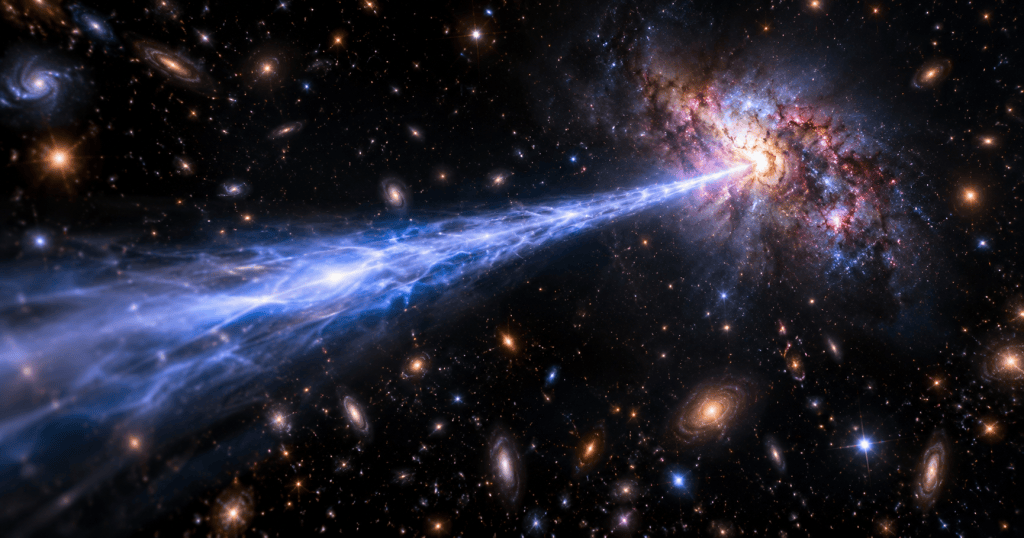
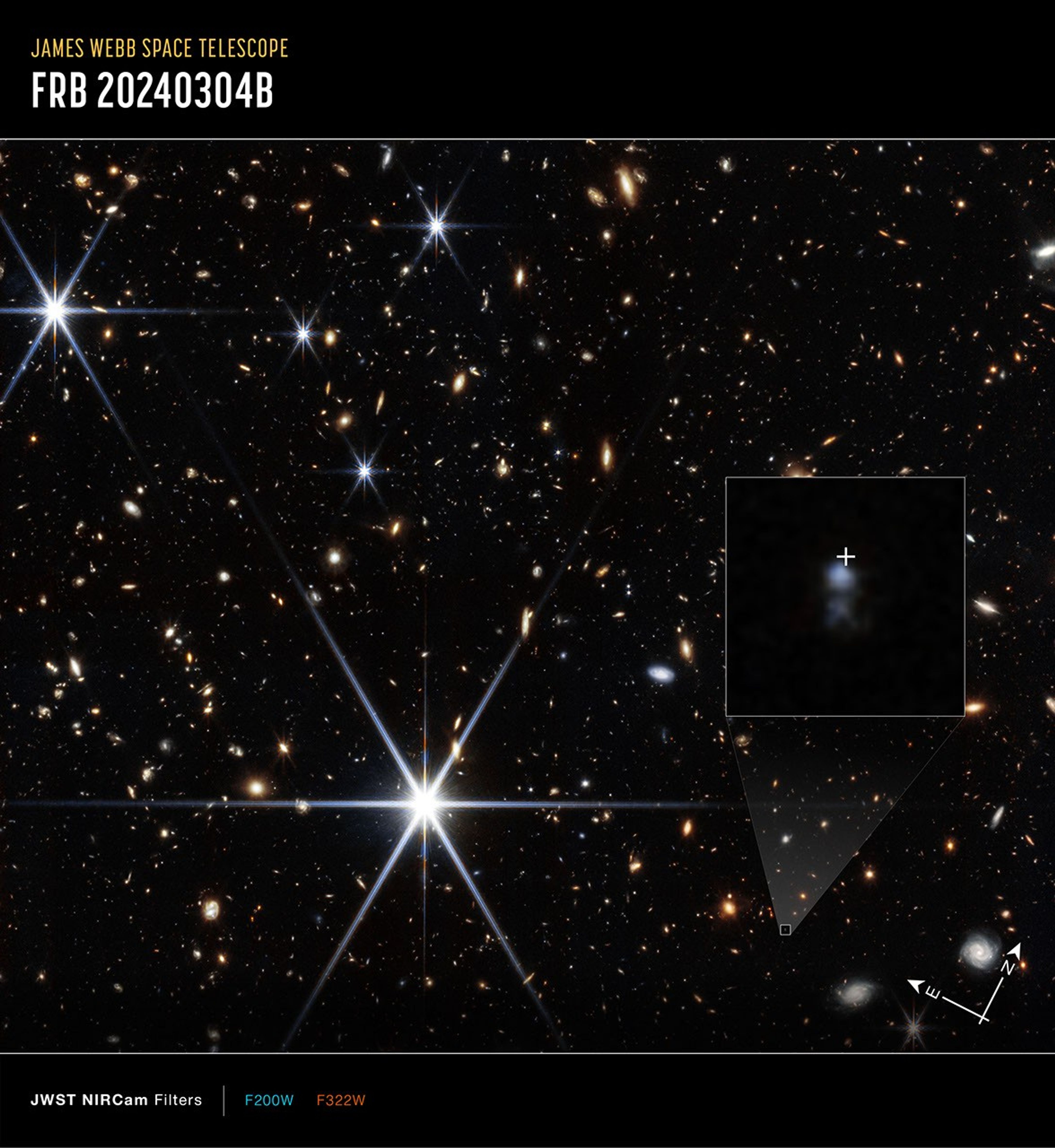
Astronomers have traced the most distant fast radio burst yet to a tiny star-forming galaxy more than 10 billion light-years away. The burst, called FRB 20240304B, was detected by South Africa’s MeerKAT radio telescope and later pinned to its host galaxy with NASA’s James Webb Space Telescope.
NASA says Webb measured the host galaxy at a redshift of 2.148, meaning the signal came from a time when the universe was only about 3 billion years old. The observation pushes precisely localized fast radio bursts much deeper into cosmic history.
The Burst Lasted Only Milliseconds
Fast radio bursts are extremely short flashes of radio energy from outside the Milky Way. They can last only a few milliseconds, yet they are bright enough to be detected across billions of light-years. Their exact origin is still unsettled, although highly magnetized neutron stars called magnetars are one of the leading explanations for at least some FRBs.
MeerKAT Found It First
The MeerTRAP team detected FRB 20240304B on March 4, 2024, with the MeerKAT radio telescope array in South Africa. The radio signal immediately suggested an extreme distance, but the team still needed a host galaxy before it could confirm how far away the event really was.
Ground-based telescopes could not see a galaxy at the burst location. Webb’s Near-Infrared Camera finally detected the source galaxy, and its Near-Infrared Spectrograph measured the redshift precisely.
The Host Galaxy Was Surprisingly Small
The host is a small, clumpy galaxy with active star formation. Researchers at UC Santa Cruz reported that it was roughly 1,000 times less massive than expected compared with the galaxies that host many previously localized FRBs.
That matters because the environment can help narrow down what produces these bursts. A very young, actively star-forming galaxy fits more naturally with objects that can form quickly after massive stars die, including magnetars, than with explanations requiring very old stellar populations.
FRBs Can Probe Matter We Cannot See Directly
Fast radio bursts are useful even before astronomers fully understand what creates them. As an FRB travels through space, electrons in intergalactic plasma delay different radio frequencies by slightly different amounts. Measuring that dispersion can reveal how much ionized matter the signal crossed.
The research team’s paper, “A fast radio burst from the first 3 billion years of the Universe”, says this event probes ionized baryonic matter across roughly 80% of cosmic history. That makes distant FRBs potential tools for mapping the otherwise difficult-to-see gas between galaxies.
Webb And Radio Telescopes Are Becoming A Powerful Pair
Radio arrays can detect the burst itself, while Webb can identify faint host galaxies that optical telescopes cannot see. That combination gives astronomers both the transient radio signal and the physical environment that produced it.
BitcoinVersus.Tech recently covered how a new ultraviolet map filled in missing regions of the sky and how NASA selected PRIMA to study the cold universe beyond Webb’s reach. FRB 20240304B shows another way modern observatories are extending astronomy: one instrument catches a fleeting signal, while another finds the tiny galaxy that explains where it came from.
What Comes Next
The next step is finding more FRBs at similar distances. One record-breaking burst can show that the phenomenon existed early in cosmic history, but a larger sample could reveal whether young galaxies commonly produce them, how their environments change over time, and how much ordinary matter sits between galaxies across the universe.
Editor’s Note
The featured image is original artwork created specifically for this story in a photorealistic editorial style and is not reused in the body. The body image is an official James Webb Space Telescope observation from NASA, ESA, CSA, and STScI. The YouTube video is embedded as a responsive native Gutenberg player, and the Reddit discussion is embedded directly in the article. No normal story text is placed inside cards, panels, callouts, or text boxes.
BitcoinVersus.Tech content is provided for informational and educational purposes.


Leave a Reply