NASA’s Chandra X-ray Observatory has detected a dramatic high-energy outburst from AT 2016blu, a massive star in the galaxy NGC 4559 roughly 30 million light-years away. Announced November 9, 2026, the result offers strong evidence that an unseen compact companion periodically captures material from the star. The proposed partner is either a neutron star or a stellar-mass black hole; astronomers have not established which.
Official NASA Chandra X-ray Center tour, November 9, 2026 (2:40). Chandra’s narrated explanation of AT 2016blu, its repeating flares and the compact-companion hypothesis. Credit: NASA/CXC/A. Hobart; directly linked from the mission’s official media page.
A star that repeatedly resembles a supernova
AT 2016blu is a luminous blue variable, an unstable, very massive star. Its repeated optical brightenings can rival a supernova’s apparent luminosity, earning the nickname “supernova impostor.” A genuine terminal supernova would destroy the star; AT 2016blu has survived repeated episodes. Researchers counted at least 27 optical outbursts from 2012 through June 2026, recurring approximately every 113 days, rather than occurring with perfect clockwork regularity.
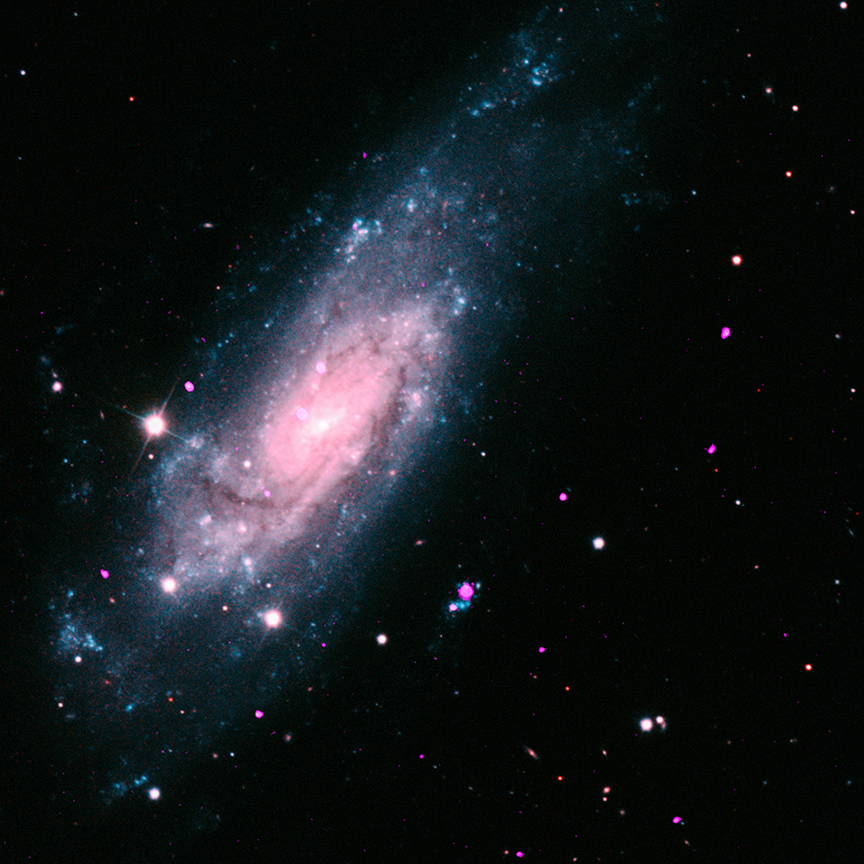
A team led by Mojgan Aghakhanloo of the University of Virginia used ground-based optical monitoring to predict a bright phase, then requested five Chandra observations during March 2026. Chandra’s angular resolution was essential because another, brighter X-ray source appears nearby in the image. The project combined observations from professional facilities and more than 30 amateur astronomers. Earlier reporting on the retired Swift observatory shows how decades of X-ray monitoring inform time-variable cosmic events.
What changed in the X-ray measurements
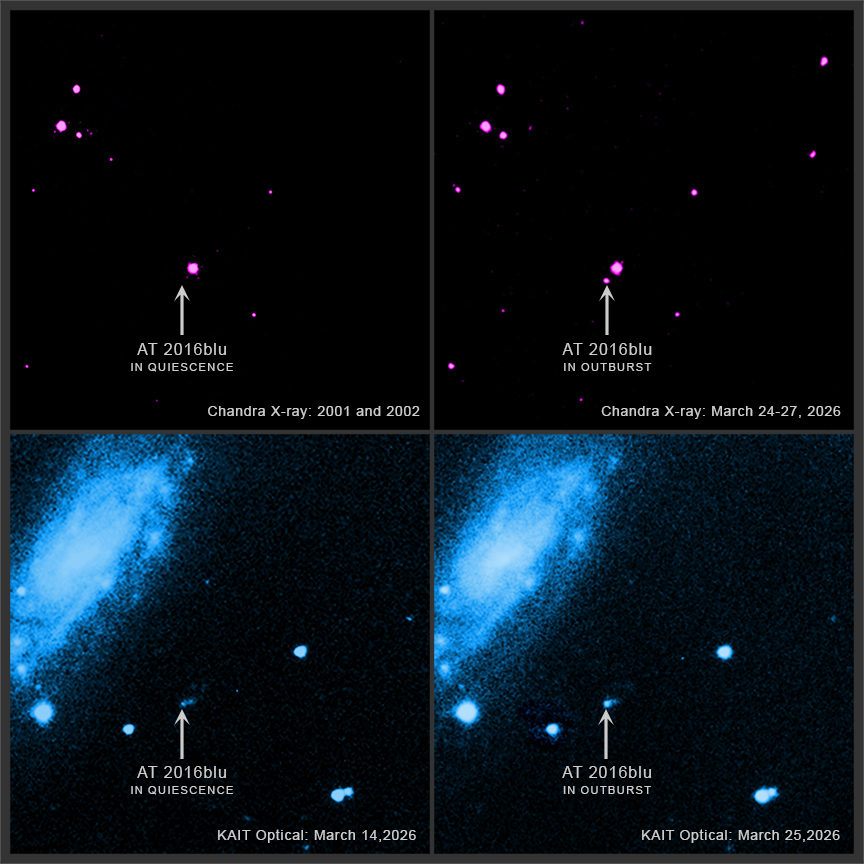
During the March flare, AT 2016blu was at least 100 times brighter in X-rays than in archival Chandra observations from 2001–2002, before its documented optical outbursts began. The team reports an X-ray luminosity near 1038.64 erg per second, consistent with accretion onto a dense compact object. A rapidly orbiting pair in an elongated orbit could generate bursts whenever the stars approach and the companion captures expelled gas.
Researchers estimate the giant star has a mass of at least 33 solar masses. Their peer-reviewed study, published in The Astrophysical Journal, classifies the system as a high-mass X-ray binary candidate with a luminous blue variable donor. A candidate ultraluminous X-ray source classification reflects extreme energy output, not confirmation of a black hole.
Why the distinction matters
The working model explains how gas capture can heat plasma sufficiently to emit powerful X-rays, which may subsequently heat surrounding gas and produce the visible flare. However, current observations do not separately resolve the hidden companion or prove its identity. Orbital measurements, spectra and additional well-timed X-ray monitoring are needed to test the neutron-star-versus-black-hole possibilities.
Other instruments probe complementary questions. NASA’s COSI gamma-ray telescope targets energetic remnants and antimatter signatures, while the Roman telescope’s instrument-alignment work supports precision optical surveys. Advanced signal-processing methods, including new analyses of faint Webb signals, demonstrate the broader value of extracting reliable information from challenging astronomical observations.
The discovery may clarify how some massive stars behave before their eventual collapse, but it does not establish that AT 2016blu is about to explode. Its significance lies in a new, observationally supported mechanism for recurring stellar eruptions—and in the ability of targeted X-ray observations to distinguish competing explanations.
Sources checked November 15, 2026: NASA/CXC press release, November 9; Chandra image documentation and observing log; Aghakhanloo et al., The Astrophysical Journal (2026); and official Chandra video listing. The hidden object’s physical classification is an evidence-based inference, not a directly resolved photograph.
Editor’s Note: Chandra detected high-energy emission associated with AT 2016blu and researchers interpret the repeating activity as intermittent accretion onto a compact companion. The companion has not been independently resolved or definitively identified as a black hole versus neutron star. The 1200 × 630 original oil-painted cover is conceptual, not a telescope photograph. Both embedded scientific images are authentic NASA/CXC data products with observation periods and credits; the official Chandra YouTube video is near the opening. HTML embed presence does not independently prove playback or mobile responsiveness. Numerical findings are attributed to the research paper and mission release.

BitcoinVersus.Tech is a volunteer-run publication. Optional support of 5,000 satoshis helps fund independent technology and science reporting. Scan the original QR with a compatible Bitcoin wallet using another screen; on the same phone, use an import-from-image function where supported. Independently verify the recipient 3C9o19EH5HSiwEPyCTmEKzxhNCbo2X6TTb and amount. Bitcoin payments are generally irreversible.
We volunteer daily to ensure the information on BitcoinVersus.Tech is Verifiably True. Reporting is for independent education, not individualized investment or scientific safety guidance. Reader support is entirely voluntary.


Leave a Reply