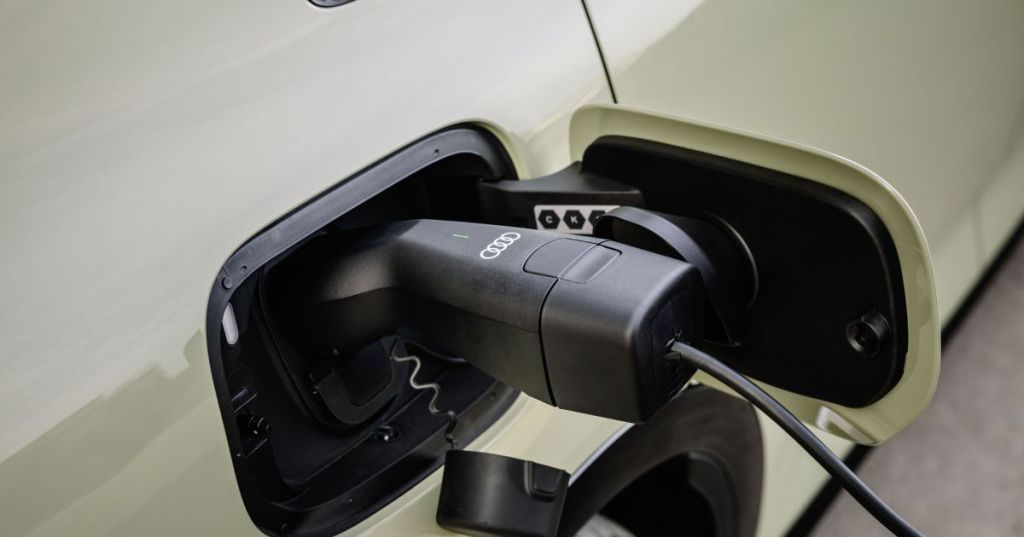
Audi detailed the bidirectional charging architecture of its A2 e-tron on November 12, 2026. The compact electric vehicle can supply suitable external equipment and, with compatible residential hardware, discharge stored electricity into a home. The manufacturer’s technical announcement describes three battery capacities and a future grid-export function. The approach differs from the vehicle-side inverter architecture planned for Ford’s Fathom electric pickup.
A2 e-tron technical animation and vehicle features, published around the September launch. For the November engineering update, see Audi’s official battery and charging animation.
Three battery configurations
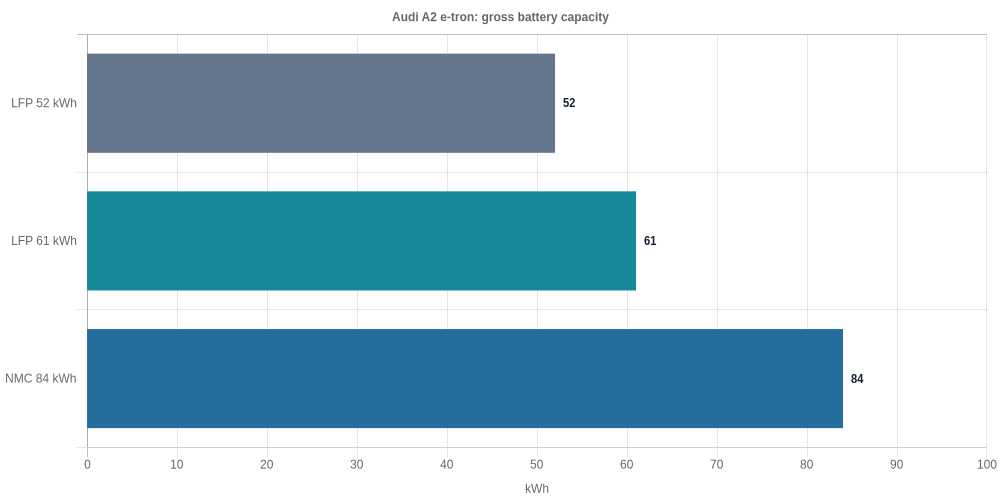
Audi lists gross battery capacities of 52 and 61 kWh for lithium iron phosphate (LFP) versions and 84 kWh for the nickel-manganese-cobalt (NMC) version. The largest pack has approximately 61.5% more gross energy capacity than the smallest. Gross capacity includes energy that the battery management system may reserve to protect the cells; usable energy will be lower. LFP packs integrate cells directly into the enclosure, eliminating conventional intermediate modules. Our reporting on Ford’s domestic LFP cell manufacturing explores the material and packaging choices behind similar systems.
Charging electronics and temperature
The revised OCDC 2.0 integrates onboard AC charging and DC-to-DC voltage conversion. Semiconductor switching devices and software coordinate electrical conversion while the battery controller monitors temperature, current and state of charge. LFP cells have a relatively flat open-circuit voltage curve across part of their operating range, so terminal voltage alone cannot reliably establish how much energy remains. Audi adapted its estimation algorithm accordingly. Reliable pack-level measurement is also central to BMW’s battery communication experiments.
The November release reports DC charging from 10% to 80% in 24 minutes for the smallest battery, 26 minutes for the middle option and 29 minutes for the largest. Those figures are manufacturer test-condition results rather than guaranteed public-charger outcomes. Temperature, charging equipment and initial battery conditions affect the charging curve. The EV Report corroborated the announced specifications.
From portable electricity to grid services
Vehicle-to-load supplies appropriate appliances or portable equipment. Vehicle-to-home requires a compatible bidirectional DC wallbox and suitable installation. Neither gross capacity nor fast-charging input power establishes the maximum household discharge power, and outage backup capability should not be assumed without confirmation of isolation equipment and regional support.
Vehicle-to-grid goes further by delivering electricity into the public network. Audi treats that function as a future offering subject to local infrastructure, tariffs and regulatory conditions. As our coverage of Germany’s emerging V2G rules explains, the car, charger, meter and utility must operate as a coordinated system. The engineering opportunity is real, but customers should distinguish an announced capability from a functioning installation and a commercially available grid-service contract.
Featured photograph: Audi, November 12, 2026.
We volunteer daily to ensure the credibility of the information on this platform is Verifiably True. If you would like to support to help further secure the integrity of our research initiative, please scan the QR code below.



Leave a Reply