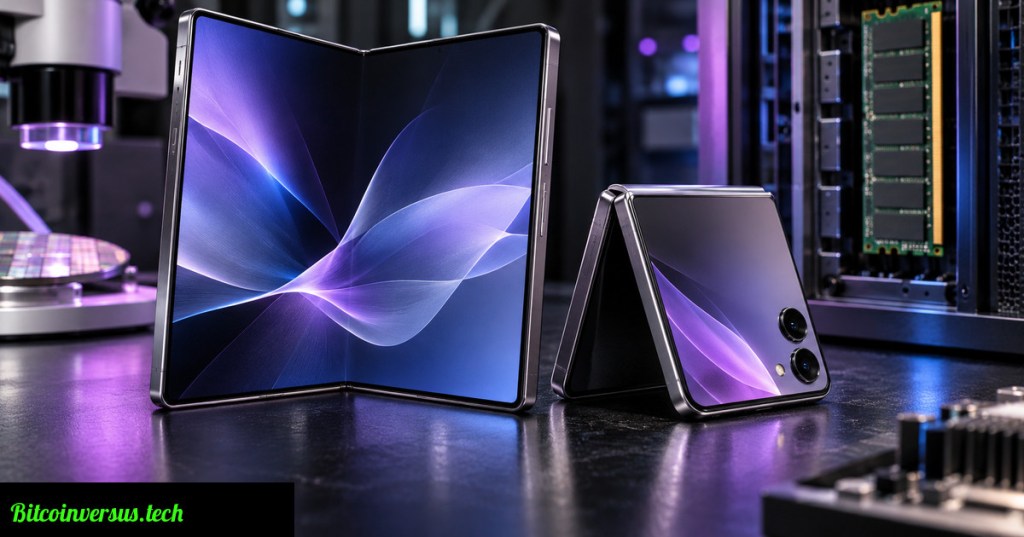
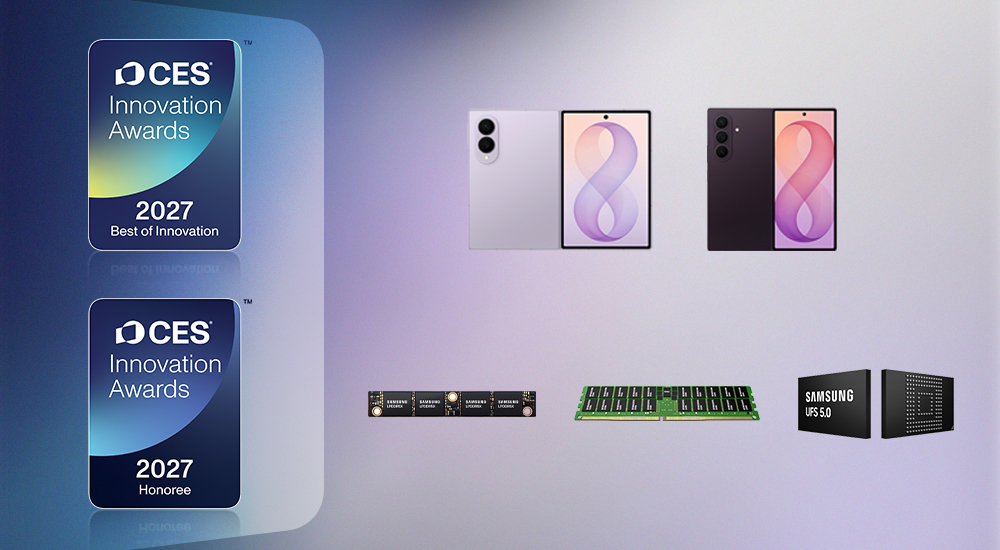
Samsung’s Galaxy Z Fold8 Ultra and Z Fold8 have received CES 2027 Best of Innovation honors in the mobile-device category, while three of the company’s memory and storage designs earned Innovation Award recognition. Samsung published the global announcement on November 15, 2026, ahead of the January trade show. The development recognizes existing devices and announced component designs; it does not mark a new phone launch or independently certify their performance.
The Consumer Technology Association’s annual program evaluates product design and engineering. Samsung’s semiconductor honorees are a 512GB DDR5 registered memory module, LPDDR5X SOCAMM2 and UFS 5.0 storage. Together they connect two engineering problems: packing more capability into thin consumer devices and moving data efficiently through AI servers.
Official Samsung Galaxy Z Fold8 Ultra and Fold8 introduction, July 22, 2026. Original product demonstration, not footage of the CES 2027 awards.
Two award-winning foldables, two different designs
The Z Fold8 Ultra has an 8-inch internal display, measures 4.1 mm thick when unfolded and weighs 215 g, according to Samsung. Its 5,000 mAh battery is the largest in the company’s Fold series. A dual-layer titanium-based display construction reportedly trims the display module’s thickness by 10%, allowing more space for internal hardware. The device also combines a 200-megapixel wide camera and a 50-megapixel ultrawide camera.
The regular Z Fold8 uses a different shape: a 5.5-inch cover display and a 7.6-inch, 4:3 inner screen. Samsung positions the wider opened screen for entertainment and side-by-side content. Engineering trade-offs remain important. Thin hinges, battery volume, crease visibility and repeated folding all affect usability, while an innovation award is no substitute for published long-duration durability data. Readers comparing form factors can revisit BitcoinVersus.Tech’s hands-on coverage of Apple’s folding iPhone.
Why the memory honorees matter beyond smartphones
Samsung’s 512GB DDR5 RDIMM uses 32-gigabit DRAM with a four-layer stacked arrangement, rather than eight layers in the referenced 16-gigabit approach. In a supported server offering 16 memory channels populated with one 512GB module per channel, the advertised capacity reaches 8TB: 16 × 512GB. Samsung claims up to 15% lower module power than its specified conventional 512GB comparator, not a 15% reduction in total rack consumption.
Capacity alone cannot resolve every data bottleneck. BitcoinVersus.Tech previously examined Micron’s 512GB DDR5 demonstration and Penguin Solutions’ 1TB CXL memory-expansion card, two distinct approaches with their own platform requirements.
The LPDDR5X SOCAMM2 module targets AI servers using low-power DRAM. Samsung advertises up to 153.6GB/s of bandwidth and more than 70% better energy efficiency against its cited DDR5 RDIMM reference. Those are vendor comparison figures, not independent measurements of complete AI servers. The removable, horizontal module could also simplify serviceability and chassis airflow, provided compatible systems are available. Related design questions appear in earlier SOCAMM2 server-platform coverage.
Samsung’s official September 9, 2026 foldables showcase presents the Fold8 lineup. Archival manufacturer footage; CES recognition and third-party benchmark results are not shown.
UFS 5.0 and the gap between awards and benchmarks
Samsung also describes UFS 5.0 mobile storage with up to 10.8GB/s of bandwidth, twice the sequential performance and 40% better power efficiency than the company’s UFS 4.1 comparison. Faster local storage could reduce the wait for on-device AI model loading, although application speed depends on processors, memory, thermal limits and software. The surrounding phone market is under pressure: recent smartphone-revenue reporting highlights how pricing and shipment trends can diverge.
Samsung says its complete list of recognized products will be published January 4, 2027, ahead of CES in Las Vegas on January 6–9. The next useful evidence will be independently repeated battery, folding, memory-power and storage tests. For now, the awards document design recognition; availability, component qualification and real-world performance must be judged separately.
Sources and methodology
Primary sources: Samsung Electronics Global Newsroom, November 15, 2026; CTA 512GB DDR5 RDIMM award entry; CTA LPDDR5X SOCAMM2 award entry; and Samsung U.S. Newsroom, November 14, 2026. Product figures are attributed to Samsung and CTA material; no independent hardware testing was conducted by BitcoinVersus.Tech.
Editor’s Note: Best of Innovation recognition should not be read as independent proof of durability, speed or battery life. The two verified official Samsung recordings show previously released foldables rather than the November award announcement. The in-story image is authentic Samsung newsroom material. The original 1200 × 630 photorealistic cover depicts an illustrative electronics scene, not an actual Samsung test facility, and uses the green-on-black publication watermark. Playback and mobile appearance require live-page checks.
Support BitcoinVersus.Tech
BitcoinVersus.Tech is a volunteer-run independent technology publication. Optional support of 5,000 satoshis helps fund technical research and reporting. Scan the original QR using a compatible Bitcoin wallet on another device; on the same phone, save the QR image and import it using a wallet that supports saved-image QR scanning. Confirm recipient 3C9o19EH5HSiwEPyCTmEKzxhNCbo2X6TTb and the exact amount before sending. Bitcoin payments are generally irreversible.

All donations are voluntary. Our reporting aims to be verifiably accurate, independent and educational. No article constitutes personalized financial advice, engineering certification, or a guarantee of product performance.


Leave a Reply