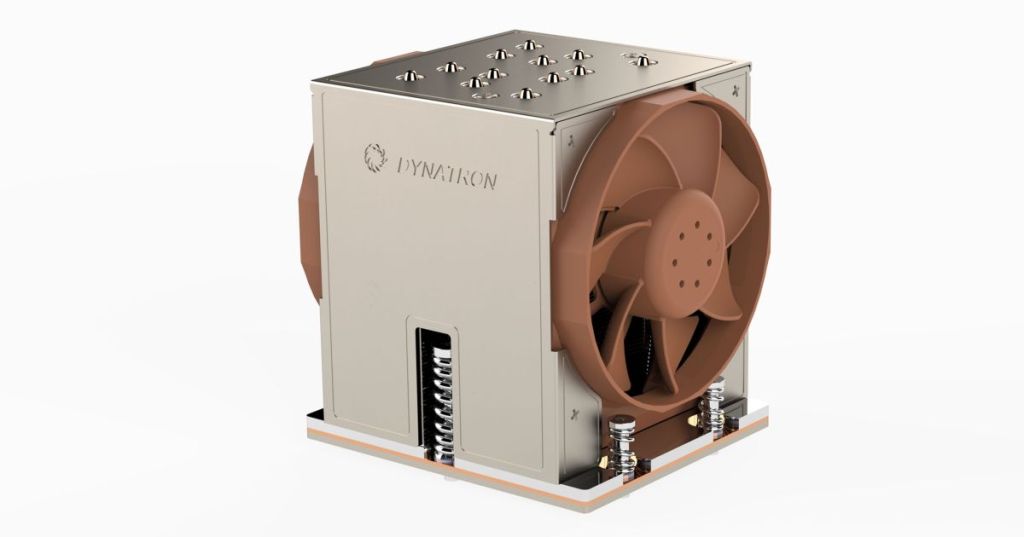
AMD’s upcoming EPYC “Verano” AI-host processor appears to be getting a dedicated server socket called SB1. The clue does not come from AMD’s launch materials. It comes from server-cooling specialist Dynatron, which has published a live product page for an SB1-4U-ACTIVE cooler and explicitly lists support for “AMD EPYC Verano on Socket SB1.”
That matters because Verano is not shaping up like a normal general-purpose EPYC part. AMD has already said the 2027 chip will be an optimized host CPU for future AMD Instinct GPU generations and will use LPDDR5X SOCAMM2 memory to improve performance per system watt in rack-scale AI infrastructure. A dedicated socket would fit that specialization—but AMD has not formally announced the SB1 name, so the socket detail should still be treated as early ecosystem evidence rather than final platform confirmation.
Dynatron Is Already Listing the SB1 Socket
Dynatron’s current SB1-4U-ACTIVE product page lists AMD as the CPU vendor and identifies the supported platform as AMD EPYC Verano on Socket SB1. The product name itself still includes “TBD,” and the maximum CPU power rating is also listed as TBD, which is a strong sign that the platform is still preliminary.
The cooler nevertheless gives the first concrete mechanical clue about Verano’s platform. Dynatron lists a 4U active design measuring 128.05 × 106.6 × 130.7 mm, with an aluminum fin stack, vapor chamber, heat pipes, and a double-ball-bearing fan that can reach 6,000 RPM and 91.7 CFM.
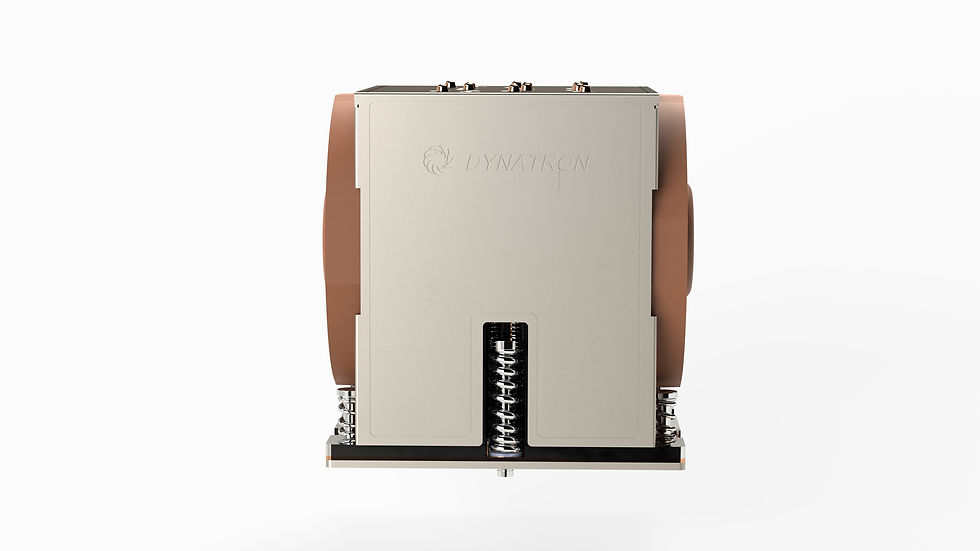
The fact that a cooling vendor is already building around SB1 matters for system integrators. A socket change affects far more than the processor package: motherboard layout, mounting hardware, thermal solution, airflow, service procedures, rack design, and qualification all have to line up before volume systems can ship.
Verano Is Being Built for AI Host Duty, Not Just More CPU Cores
AMD has already defined Verano’s role more clearly than its final socket. In an April engineering post, AMD said Verano will be the first 6th-generation EPYC server CPU family to support LPDDR5X SOCAMM2 and will serve as the optimized host CPU for future generations of AMD Instinct GPUs. AMD’s official Verano memory roadmap places availability in 2027.
That puts Verano in a different lane from the broad server role already being filled by EPYC Venice. Venice is designed to span general-purpose server, cloud, HPC, and AI-host workloads. Verano appears much more tightly optimized around feeding accelerator-heavy racks efficiently.
LPDDR5X SOCAMM2 Is the Bigger Architectural Change
The most important Verano feature AMD has confirmed is not the socket—it is the memory subsystem. Traditional servers rely heavily on DDR5 RDIMMs and MRDIMMs. Verano instead adds support for LPDDR5X in the SOCAMM2 form factor.
LPDDR5X comes from a low-power memory lineage commonly associated with mobile hardware, but SOCAMM2 makes that memory modular and serviceable enough for server designs. AMD says the smaller horizontal module can reduce memory power, improve physical density, and create more flexibility for airflow or cold-plate design.
That directly connects to the power-density problem BitcoinVersus.Tech has been tracking across AI infrastructure. AMD’s 2027 CPU and GPU ramp is happening while rack power, cooling, memory bandwidth, and accelerator interconnects are all becoming system-level bottlenecks rather than isolated component specifications.
Why a Dedicated Socket Makes Sense
A specialized host CPU can benefit from a specialized platform. If Verano is engineered around high-bandwidth LPDDR5X SOCAMM2, future Instinct GPU racks, and a narrower set of AI-host workloads, AMD does not necessarily need to preserve every mechanical and electrical compromise required by a general-purpose EPYC socket.
A smaller or otherwise purpose-built socket could allow motherboard designers to place memory closer to the CPU, optimize trace lengths, reserve board area for accelerator connectivity, improve airflow, or simplify power delivery around a known deployment model. Those are architectural possibilities—not confirmed SB1 features—but they explain why a dedicated platform would be plausible.
Early Reports Point to 72 Cores and a Huge Memory Interface
Current hardware reporting says Verano is expected to top out around 72 Zen 6 CPU cores and use a 24-channel LPDDR5X memory subsystem. Those figures are consistent with the chip’s host-CPU positioning: fewer cores than AMD’s highest-density general-purpose EPYC parts, but an unusually aggressive memory architecture intended to keep large accelerator systems fed.
Those detailed core-count and channel-count figures should still be treated as pre-launch specifications until AMD publishes the final product table. What AMD has officially confirmed is that Verano is a 2027 EPYC product using LPDDR5X SOCAMM2 and optimized for future Instinct-based rack-scale AI systems.
Cooling Hardware Is Often Where New Platforms Leak First
Server-platform details often appear in the ecosystem before the CPU vendor is ready to launch. Cooler vendors, motherboard makers, chassis builders, memory suppliers, and system integrators need mechanical drawings and interface information months ahead of release so complete systems can be validated.
That makes Dynatron’s listing more meaningful than a random product-name rumor. The company is publishing a real thermal product page with a socket field, installation torque, fan characteristics, dimensions, and material stack. At the same time, the “TBD” fields are a reminder that preproduction documentation can change.
BitcoinVersus.Tech has covered the same system-integration reality from the opposite direction with CPU thermal throttling: the processor specification is only useful when the cooling system can actually hold the silicon inside its intended operating envelope.
Verano Is AMD’s Answer to the AI Host-CPU Problem
Accelerator racks increasingly need a CPU that does more than boot the operating system. The host has to coordinate accelerators, feed networking, manage memory movement, handle control-plane work, run agents and supporting services, and keep enough CPU-side bandwidth available that expensive GPUs are not waiting unnecessarily.
That is why AMD has been positioning its CPU portfolio more explicitly around AI infrastructure. BitcoinVersus.Tech previously covered AMD’s claim that EPYC Venice can outperform NVIDIA Vera in selected server tests. Verano pushes the competition further by becoming a more specialized host design rather than simply another general-purpose CPU option.
SB1 Would Also Mean a New Service and Spares Strategy
For data-center operators, a new socket is not an abstract specification. It changes what has to be stocked and documented. Motherboards, heatsinks, mounting kits, torque procedures, firmware qualification, spare parts, and potentially rack-level airflow plans become platform-specific.
If Verano ends up tightly paired with AMD’s next Instinct generation, operators may increasingly buy the CPU as part of a rack architecture rather than treating it as an interchangeable server component. That is already the direction of travel with rack-scale systems such as AMD Helios deployments.
What Is Confirmed and What Is Still Early
- Confirmed by AMD: Verano is a 2027 6th-generation EPYC CPU optimized as a host for future Instinct GPU systems.
- Confirmed by AMD: Verano will support LPDDR5X SOCAMM2 for improved performance per system watt.
- Published by Dynatron: a preliminary 4U cooler explicitly lists “AMD EPYC Verano on Socket SB1.”
- Still pre-launch: AMD has not formally announced the SB1 socket name in its own product launch materials.
- Reported, not final: current hardware reporting points to up to 72 Zen 6 cores and 24 LPDDR5X channels.
- Unknown: final Verano SKU count, TDP range, exact package dimensions, socket electrical details, and final cooling requirements.
The Bigger Hardware Story
The SB1 clue reinforces a broader shift in server hardware: AI is forcing vendors to optimize the whole node instead of treating the CPU, memory, GPU, cooling, and rack as independent products.
If the final Verano platform looks anything like the early ecosystem evidence suggests, AMD is preparing a host CPU whose memory system, socket, cooling, and accelerator role are all designed around one goal: keep future AI racks fed while spending fewer watts on the CPU-and-memory side of the system.
Editor’s Note
The 1200×630 featured image is the actual Dynatron SB1-4U-ACTIVE cooler that Dynatron lists for AMD EPYC Verano on Socket SB1. The separate body image is a different view of that same preliminary SB1 thermal solution. No generic CPU or data-center stock photography is used. AMD’s own LPDDR5X SOCAMM2 roadmap provides the confirmed Verano platform context; socket and detailed pre-launch specifications are clearly identified as preliminary where appropriate.
Support and donation options are available through BitcoinVersus.Tech.
BitcoinVersus.Tech is not a financial advisor. Content is provided for informational and educational purposes.


Leave a comment