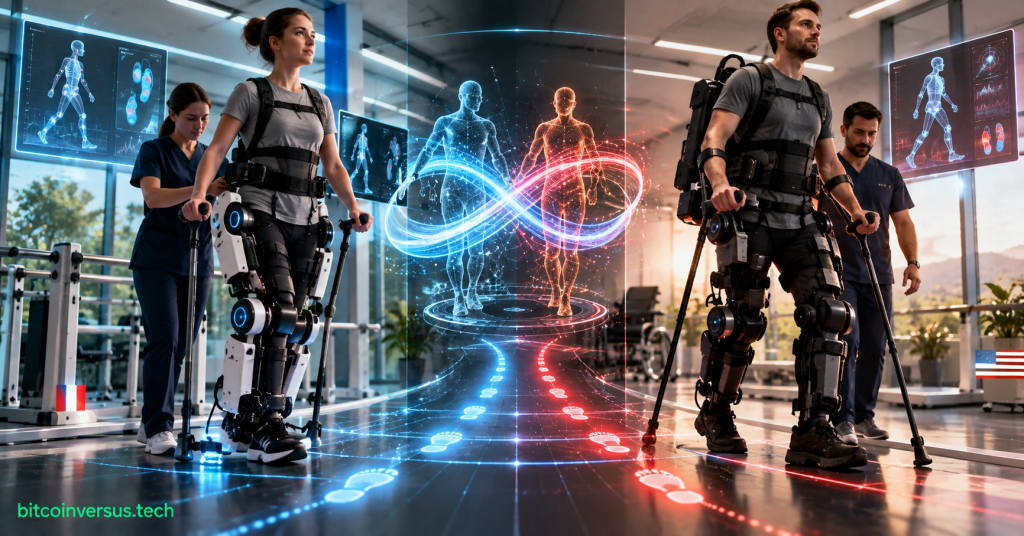
Wandercraft has acquired Ekso Bionics, bringing two of the best-known exoskeleton robotics companies under one organization and creating a broader platform spanning clinical rehabilitation, personal mobility and physical AI.
In its October 1 announcement, Wandercraft said the deal combines its self-balancing robotics and physical-AI platform with Ekso Bionics’ U.S. clinical footprint and commercial reach. Financial terms were not disclosed.
The combined portfolio now spans hospital rehab and home mobility
Wandercraft says Atalante X and EksoNR are now used across more than 700 rehabilitation centers worldwide. The combined company also plans to continue supporting Wandercraft’s Eve personal exoskeleton and Ekso’s Indego Personal system.
The important part is not just scale. The acquisition joins two different design philosophies: Wandercraft has focused heavily on self-balancing gait and physical AI, while Ekso built one of the longest-running clinical exoskeleton businesses in the United States.
Dealroom’s independent coverage confirms that Wandercraft acquired Ekso Bionics from a ChronoScale subsidiary and that the transaction is aimed at building an end-to-end robotic-mobility portfolio from rehabilitation through personal use.
Exoskeletons are becoming a physical-AI platform
Modern exoskeletons are not just powered braces. They combine sensors, motors, balance control, gait estimation, embedded computing and increasingly adaptive software that must react to a person’s movement in real time.
BitcoinVersus has covered that progression before through KAIST’s WalkOn Suit F1 self-installing exoskeleton, which showed how mobility robotics is moving toward systems that can do more of the setup and balancing work themselves.
The same trend is attracting broader capital into physical AI. BitcoinVersus recently covered MISUMI’s robotics and physical-AI fund, another sign that investors increasingly view intelligent machines as a hardware-software platform rather than a single product category.
Ekso brings two decades of wearable-robot experience
Ekso Bionics traces its wearable-robot work back roughly two decades and has built systems for clinical rehabilitation, personal mobility and industrial support. Its current medical portfolio includes EksoNR and Indego Personal.
The following official Ekso Bionics video is not about the acquisition itself, but it shows the company’s core technology category: wearable robotic systems designed to assist standing, walking and mobility.
The acquisition also expands Wandercraft’s U.S. footprint
Wandercraft has historically been strongest in Europe, while Ekso brings a deeper U.S. clinical network and commercial presence. The combination gives Wandercraft a faster route into American rehabilitation markets without having to build that installed base from scratch.
That matters because hardware distribution, clinician training, service and reimbursement can be just as important as the robot itself. A sophisticated exoskeleton that works in a lab still has to be supported across hospitals, rehabilitation centers and eventually homes.
BitcoinVersus has also followed the broader evolution of assistive robotics through Open Bionics’ 3D-printed robotic arms, another example of robotic assistance becoming more personalized, manufacturable and accessible.
A bigger exoskeleton company could accelerate the category
The acquisition does not automatically solve the hard problems in robotic mobility. Battery life, cost, weight, fit, training, reimbursement and long-term reliability still determine how widely these systems can be used.
But combining Wandercraft’s self-balancing physical-AI stack with Ekso’s clinical footprint gives the merged organization a larger base of users, therapists, field data and engineering experience. That could shorten the loop between rehabilitation robotics research and practical everyday deployment.
The deal also shows where physical AI is heading: away from isolated demonstrations and toward companies that own the full stack from sensing and control software to hardware manufacturing, service and real-world deployment.
BitcoinVersus.Tech
Advertisement
Editor’s Note:
We volunteer daily to ensure the credibility of the information on this platform is Verifiably True. If you would like to support to help further secure the integrity of our research initiatives, please donate here: 3C9o19EH5HSiwEPyCTmEKzxhNCbo2X6TTb
BitcoinVersus.tech is not a financial advisor. This media platform reports on financial subjects purely for informational purposes.


Leave a Reply