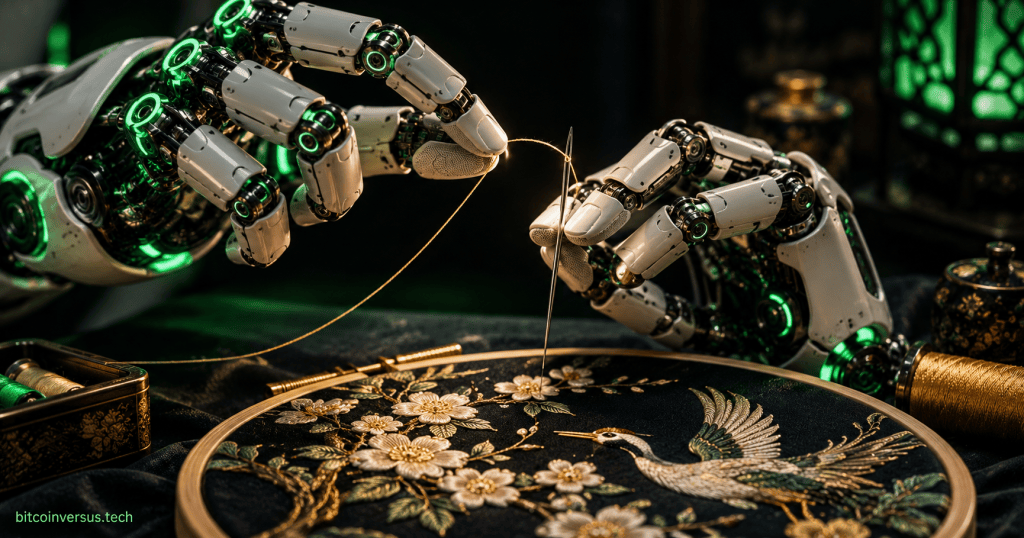
A robotic hand has taken on a task that can frustrate even patient humans: separating silk fibers, threading a needle and learning traditional embroidery. Chinese robotics company AGILINK demonstrated its OmniHand 3 Ultra working with Suzhou embroidery master Fu Xianghong, bringing centuries-old craftsmanship into a modern robotics laboratory. The demonstration was announced September 30, 2026, and circulated widely in technology coverage this week.
A Robot Apprentices With an Embroidery Master
The demonstration included separating a silk thread into finer strands, threading a needle, securing fabric in a hoop and making early stitches. These are basic moves for a skilled embroiderer, but surprisingly demanding for a robotic gripper. Silk slips, bends and twists with tiny changes in force. AGILINK described the exercise as a test of dexterous manipulation, not evidence that its hand can independently create an entire finished embroidered artwork. The company worked with Fu Xianghong, a practitioner of the traditional Suzhou technique. Read the company announcement.
Why Silk Is Such a Difficult Robotics Test
Picking up a solid block is comparatively straightforward: the object maintains its shape while the gripper closes. Silk is a deformable material, so its shape and tension change as soon as the fingers touch it. Splitting a thread requires different fingers to apply different forces while maintaining control of the remaining strands. Threading a needle adds a small target and demands precise alignment. Those same challenges appear when robots manipulate wires, soft packaging, garments and other flexible components.
How the Hand Senses Contact
The OmniHand family uses multiple articulated fingers and tactile sensing to help estimate contact forces. According to company materials and independent coverage, the Ultra series includes vision-based sensing in the fingertips to detect subtle deformation and contact. This is important because a camera watching from a distance cannot always tell whether a strand is slipping between fingers. Combining visual information with local touch feedback is one route toward more useful robotic hands. For additional context, see our software platform primer and industrial sensor communication explainer.
A Craft Demonstration With Practical Implications
The spectacle is charming: an advanced robot learning needlework from a human craft expert. Its engineering value is more serious. Factories already automate repetitive movement, but delicate tasks involving variable materials remain difficult. Demonstrations like this offer measurable challenges for fingertip force control, object handling and hand-eye coordination. Whether AGILINK can translate a carefully staged embroidery exercise into reliable everyday deployment will depend on repeatability, cost, safety and performance across different environments.
Watch and Read More
The demonstration and reporting appear in New Atlas’s October 6 report, which includes video, and in the October 7 Reddit discussion. The company says it has shipped more than 15,000 dexterous hand units, a company-reported figure rather than an independently audited count. For a lighter way to appreciate the milestone, remember that this robotic hand’s newest assignment is learning a craft that human artisans have refined for generations.


Leave a comment