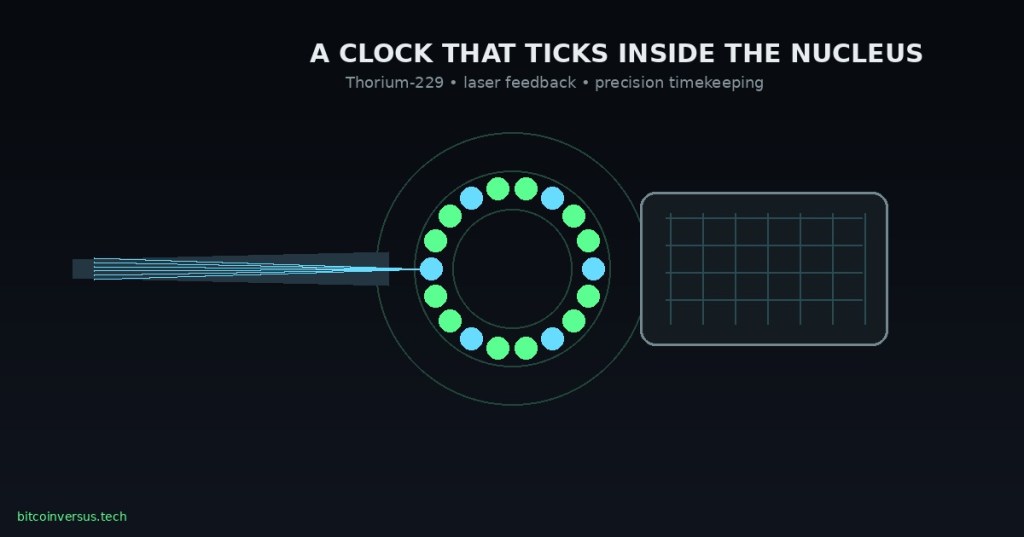
Scientists have built clocks that do something wonderfully strange: instead of keeping time with the motion of a pendulum, a quartz crystal, or even electrons inside an atom, they use a transition inside the atomic nucleus itself.
Research teams in Vienna and Beijing have independently demonstrated operational nuclear clocks based on thorium-229. The Vienna system, developed at TU Wien, locks a laser to a nuclear transition near 148 nanometers and continuously corrects the laser through a feedback loop. TU Wien says the result is the first stand-alone prototype of the technology, while Reuters reports that the Vienna and Beijing teams independently produced the first operational nuclear clocks.
Why put a clock inside a nucleus?
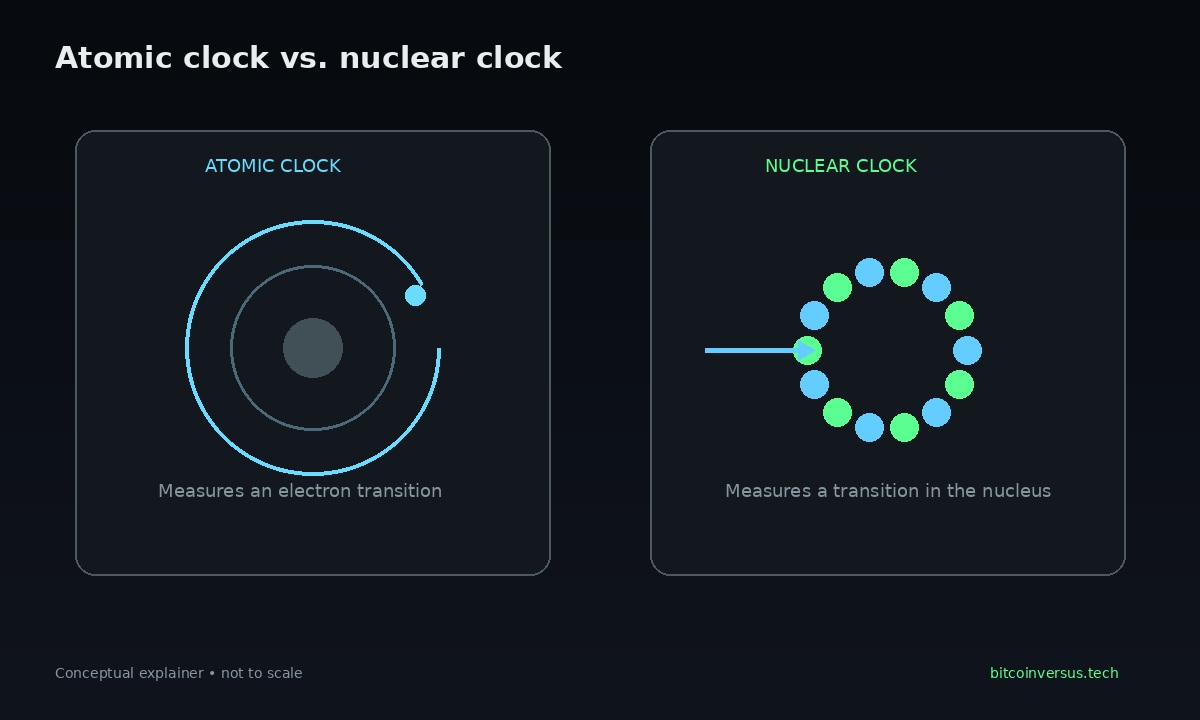
Today’s best atomic clocks already sound futuristic. They measure extremely stable transitions involving electrons around atoms. Those clocks underpin precision timing, navigation and the kind of synchronization problems discussed in our explainer on how computers keep their clocks synchronized.
A nuclear clock moves the reference point inward. The nucleus is tiny compared with the surrounding electron cloud and is comparatively well shielded from many outside electric and magnetic disturbances. In principle, that could make a nuclear reference exceptionally stable and useful for precision measurements.
Thorium-229 is the weird ingredient that makes it possible
Most nuclear transitions require energies far beyond what ordinary lasers can conveniently reach. Thorium-229 is unusual because one of its nuclear excited states sits at an extraordinarily low energy. That lets researchers address the transition with laser light instead of much higher-energy radiation.
In the Vienna clock, thorium-229 nuclei are embedded inside a small calcium-fluoride crystal at room temperature. The laser is tuned to the nuclear resonance and a feedback system continually corrects its frequency. That feedback loop is what turns a spectroscopy experiment into an actual clock: the nucleus becomes the reference that tells the laser when it is drifting.
The fun part: this is also a physics detector
The clock is not simply about knowing whether it is 3:17:00.000000000 p.m. Researchers can compare nuclear and atomic clocks and watch for tiny differences that might reveal physics we do not yet understand. Nuclear clocks have been discussed as tools for testing whether fundamental constants truly stay constant and for searching for effects associated with dark matter.
It is impressive — but it is not replacing your phone clock
The new systems are prototypes, not tiny wristwatch components. The Vienna clock currently approaches fractional-frequency instabilities around 10−15 over roughly a day of operation, while the best optical atomic clocks still outperform it in important measures. The significance is that the nuclear-clock idea has crossed a major line: researchers now have functioning feedback-controlled devices they can improve rather than only a transition they hope to someday use.
The next steps are better crystals, better lasers, greater stability and more direct comparisons with conventional optical clocks. If those pieces improve together, the strangest clock in the lab could eventually become one of the most precise scientific instruments ever built.
Editor’s Note: BitcoinVersus.Tech covers technology, engineering and science for general informational purposes.
Disclaimer: This article is informational and is not scientific, engineering, financial or investment advice.


Leave a comment