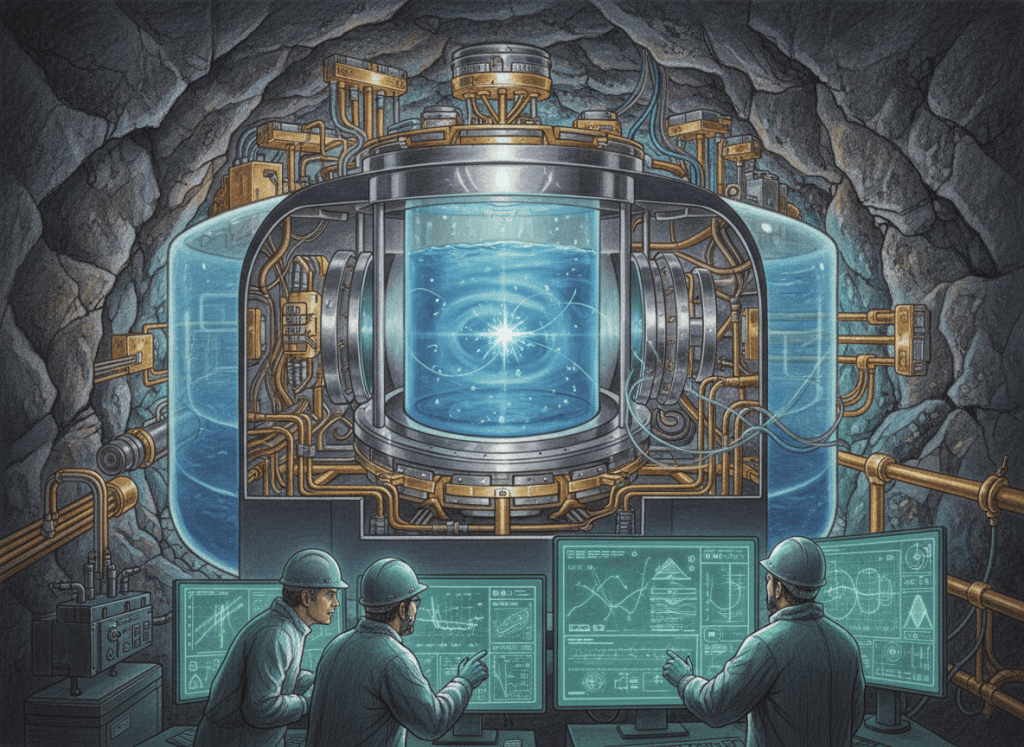
A recent YouTube explainer on the LUX-ZEPLIN experiment centers on a result that is simultaneously tiny and potentially enormous: one particle interaction deep underground in South Dakota that researchers cannot comfortably explain with their known background model.
One event is not a dark-matter discovery. But when an experiment is built specifically to eliminate ordinary explanations, a single stubborn event can be enough to make physicists look much more closely.
LUX-ZEPLIN is designed to make ordinary events disappear
LUX-ZEPLIN, usually shortened to LZ, sits nearly a mile underground at the Sanford Underground Research Facility in South Dakota. The detector uses tonnes of ultrapure liquid xenon and watches for tiny flashes of light and electrical signals created when particles interact with xenon nuclei.
The underground location, shielding, material selection, and background modeling are all there for the same reason: most particle interactions are not dark matter. Cosmic rays, radioactive materials, neutrons, detector effects, and other known sources have to be measured or rejected before an event becomes interesting.
According to NERSC’s report on the new LZ analysis, the collaboration recorded a single interaction that remains difficult to explain with its background model. The reported significance is 2.6 sigma, corresponding to roughly a 0.5% probability that the event came from the modeled ordinary backgrounds.
The collaboration itself is being careful
LZ described the result in a directly relevant X post, saying it observed a single nuclear recoil that is difficult to explain with the background model and asking whether it could be a hint of dark matter.
That caution is exactly right. Particle physics normally demands much stronger statistical evidence before claiming a discovery. A 2.6-sigma result is enough to motivate follow-up work, not enough to rewrite textbooks.
Why one nuclear recoil can still matter
Many leading dark-matter models predict that a dark-matter particle could occasionally strike an atomic nucleus and make it recoil. LZ is designed to search for that kind of interaction while suppressing other processes that can mimic it.
Northwestern University’s coverage of the collaboration emphasizes the same point: this is the most intriguing event of its kind seen by the experiment so far, but researchers still need more data and more scrutiny before deciding whether it represents new physics.
The difficulty is that an unknown background process can look exciting before anyone understands it. The history of particle physics is full of anomalies that disappeared with more data, better calibration, or a newly identified source of noise.
The next event would matter more than the first
If future LZ exposure produces more events with similar characteristics, confidence could rise rapidly. If nothing comparable appears, the current event may become an unusual statistical fluctuation or an unmodeled background.
That is why the most important next step is not a more dramatic interpretation. It is more detector time. Dark-matter experiments win by accumulating exposure while keeping backgrounds extremely low.
A broader pattern: computation is changing how hard science moves
BitcoinVersus has been following several places where modern computation is accelerating difficult scientific questions. AI-assisted work on the Navier–Stokes problem is forcing mathematicians to think about machine-generated proofs and human understanding.
In plasma physics, AI helped uncover explicit counterexamples to Grad’s 59-year fusion conjecture. And in quantum computing, D-Wave is exposing error-aware quantum simulation to developers.
LUX-ZEPLIN is a different kind of story. The breakthrough, if there eventually is one, will come from instrumentation, background modeling, statistics, and repeated observation rather than from an AI model generating the answer. But the common theme is the same: the frontier increasingly depends on extracting meaning from extremely difficult signals.
“Could be dark matter” is the beginning of the story, not the conclusion
The scientifically interesting part of this result is not that one unexplained event proves dark matter exists. Astronomical evidence already strongly indicates that dark matter exists in some form. The unresolved question is what it is made of and whether a terrestrial detector can catch one of its particles interacting directly with ordinary matter.
LZ now has one event that refuses to fit neatly into the expected background. That is enough to watch closely. It is not enough to celebrate a detection.
BitcoinVersus.Tech
Advertisement
Editor’s Note
We volunteer daily to ensure the credibility of the information on this platform is Verifiably True.
If you would like to support to help further secure the integrity of our research initiatives, please donate here: 3C9o19EH5HSiwEPyCTmEKzxhNCbo2X6TTb
BitcoinVersus.tech is not a financial advisor. This media platform reports on financial subjects purely for informational purposes.


Leave a Reply