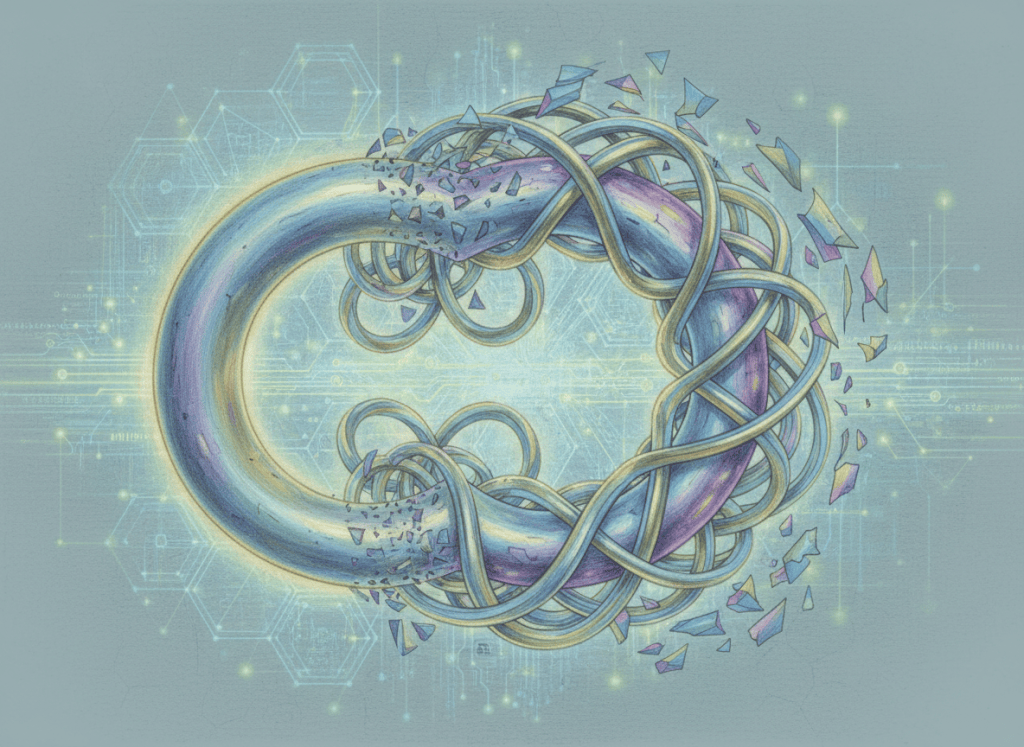
A recent YouTube deep dive into Grad’s Conjecture tells one of the more interesting AI-for-science stories of 2026: a mathematical idea that shaped plasma physics for nearly six decades has been overturned by explicit three-dimensional counterexamples, and two of those solution families were discovered with help from GPT-6 Astra.
The important caveat is immediate. AI did not “solve fusion.” It helped a plasma physicist discover exact mathematical equilibria showing that a long-standing restriction on three-dimensional magnetohydrodynamic, or MHD, equilibria was too strong.
What Grad thought three-dimensional plasma could not do
Fusion devices such as tokamaks and stellarators use magnetic fields to confine plasma hot enough for fusion reactions. Before engineers can ask whether a reactor will produce net energy, physicists need mathematical descriptions of states in which plasma pressure and magnetic forces balance.
Harold Grad argued in 1967 that smooth, fully three-dimensional MHD equilibria with nested toroidal surfaces should be severely constrained unless the configuration had strong symmetry or trivial pressure structure. That intuition became known as Grad’s Conjecture.
The conjecture mattered especially for stellarators because stellarators deliberately use complex, non-axisymmetric magnetic geometry. If exact smooth equilibria fundamentally required much more symmetry than stellarators possess, that would be a deep mathematical limitation on how plasma equilibrium could be understood.
September produced three counterexample families
Two independent papers appeared within about a day of one another. One group led by Javier Gómez-Serrano constructed a family of smooth equilibria with only discrete rotational symmetry. Plasma physicist Matt Landreman then presented two additional families of explicit analytic solutions.
Landreman’s paper on analytic toroidal 3D MHD equilibria gives non-axisymmetric solutions with exact nested toroidal flux surfaces. The field, current density, and pressure remain smooth throughout the toroidal domain, directly providing the kind of counterexamples the conjecture had suggested should not exist.
The result was summarized in a widely shared X post as three families of counterexamples from two independent papers, with two of the families found using GPT-6 Astra.
What the AI actually contributed
According to Landreman’s public explanation of the work, GPT-6 Astra helped discover the two explicit families in his paper. That is different from asking a chatbot for an answer and trusting the output. The useful contribution was candidate mathematical structure: forms that a human physicist could then derive, simplify, and verify equation by equation.
Independent coverage from The Neuron describes the same distinction. The model helped identify new equilibria, while the mathematical burden remained proving that those fields and pressures really satisfy the MHD equations and the geometric conditions the conjecture was about.
This is the same boundary BitcoinVersus examined in the debate over AI and the Navier–Stokes Millennium Problem: discovery can be accelerated by machines, but scientific value still depends on verification, interpretation, and whether researchers understand why the result works.
Why this matters for stellarator fusion
Stellarators are intentionally three-dimensional. Their magnetic coils twist around the plasma to create confinement without relying on the same large plasma current used by tokamaks. The geometry is harder to design and analyze, but it can offer operational advantages if engineers can control transport, stability, and construction complexity.
The new counterexamples do not hand engineers a commercially optimal stellarator. What they do provide is mathematical breathing room: fully three-dimensional smooth equilibria with nested magnetic surfaces can exist without the strong continuous symmetries Grad’s conjecture was often interpreted to require.
That complements the experimental side of fusion research. BitcoinVersus previously covered France’s WEST tokamak sustaining plasma for 1,337 seconds. Experiments like WEST test how long real machines can maintain hot plasma, while results like these counterexamples improve the mathematical framework researchers use to understand possible equilibrium states.
The result is useful even before a reactor changes
Exact solutions are valuable because they can serve as benchmarks for numerical codes. Fusion design relies heavily on software that approximates complicated fields and plasma states. If researchers have exact three-dimensional equilibria with known answers, they can test whether simulation tools reproduce them correctly.
That may sound less dramatic than “AI solves fusion,” but it is scientifically more useful. Better reference solutions can expose errors, improve numerical methods, and help researchers distinguish limitations of a simulation from limitations of the underlying physics.
AI is becoming a search engine for equations
The broader pattern is increasingly visible across research. AI is not only summarizing published science. It is being used to search huge spaces of equations, candidate structures, proofs, molecules, and experimental strategies for configurations humans may not think to try first.
That is also what makes Stanford’s 37,000-agent Virtual Biotech interesting. In one case the search space is plasma equilibria; in the other it is drug development. Both treat AI less like a conversational assistant and more like a massively parallel discovery system whose outputs still have to survive human scientific validation.
Grad’s Conjecture fell; fusion still has plenty left to solve
The strongest version of this story is not that one AI model ended a 59-year debate by itself. Two independent research efforts produced counterexamples, and one of them used AI to help discover explicit solution families that a physicist then verified.
That is still a significant milestone. It shows that AI can contribute at the level of mathematical structure in a field where better theory ultimately feeds into the design and validation of real fusion systems. The conjecture is gone. The engineering challenge remains.
BitcoinVersus.Tech
Advertisement
Editor’s Note
We volunteer daily to ensure the credibility of the information on this platform is Verifiably True.
If you would like to support to help further secure the integrity of our research initiatives, please donate here: 3C9o19EH5HSiwEPyCTmEKzxhNCbo2X6TTb
BitcoinVersus.tech is not a financial advisor. This media platform reports on financial subjects purely for informational purposes.


Leave a Reply