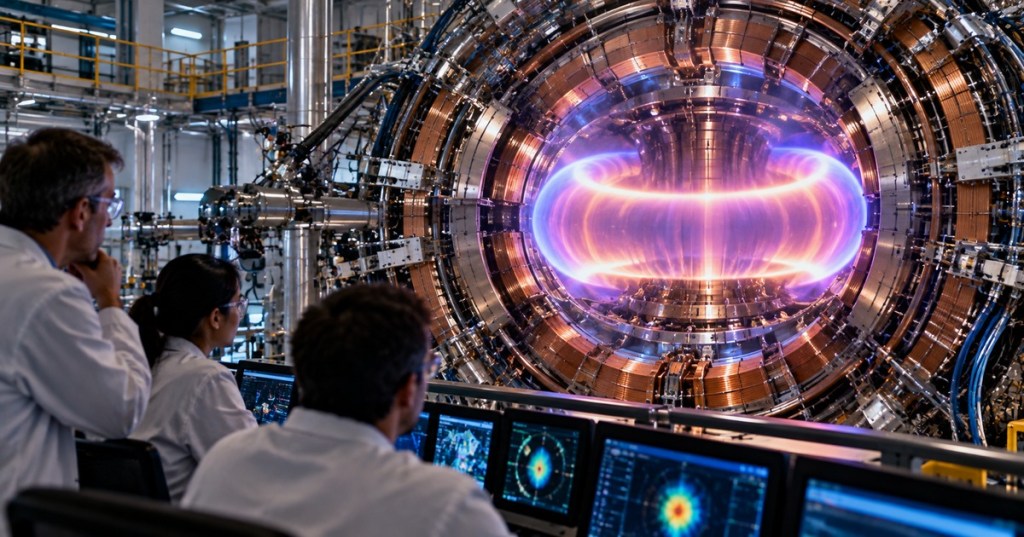
Researchers at Princeton Plasma Physics Laboratory say they have mapped a potentially less demanding route to fusion ignition: heat the plasma first, then raise its density.
The idea comes from a new framework developed by PPPL physicists Luis Delgado-Aparicio, Masayuki Ono, and Jonathan Menard. In an official PPPL explanation, the team argues that many fusion concepts effectively try to push density upward early and then add more heating. Their calculations suggest a lower-energy route may exist if the plasma is heated first and fueled more heavily afterward.
That sounds simple, but the result is really about navigating the physics of ignition more intelligently. Fusion ignition is the point where reactions inside the plasma provide enough heat to keep the burn going without continued external heating.
The Lawson criterion tells you the finish line, not the route
Fusion researchers have relied on the Lawson criterion for decades. It connects plasma temperature, density, and confinement time to determine whether a system can produce enough fusion power to become self-sustaining.
The Princeton team’s contribution is to treat ignition less like a single threshold and more like a path through a difficult landscape. Their peer-reviewed Physical Review Letters paper combines Lawson power balance with several additional conditions involving accessibility, stability, and thermal runaway.
The key is a low point called the Cordey saddle
In the team’s energy landscape, the least demanding route passes through a point called the Cordey saddle. Think of it as the lowest mountain pass between a plasma that still needs outside heating and one that can sustain its own burn.
For an ideal deuterium-tritium plasma with no impurities, the calculations place that saddle near a fusion gain of roughly Q = 5. Q is the ratio of fusion power produced to external heating power supplied. A Q of 5 means the plasma produces about five units of fusion power for every one unit of heating power being injected.
This does not mean Q = 5 automatically equals a commercial power plant. Reactor electricity output also has to pay for magnets, cooling, pumps, fuel systems, conversion losses, maintenance, and all the other equipment around the plasma.
Real reactors make the path harder
The idealized route becomes tougher once the model includes effects that real machines cannot ignore. One of the biggest is tungsten contamination. Tungsten is useful as a plasma-facing material because it tolerates extreme heat, but even tiny amounts entering the plasma can radiate energy away and make ignition harder.
Very strong magnetic fields can also raise the pressure requirements in parts of the operating space. The team found that real-world radiation losses shift the ignition ridge toward higher temperatures and densities, forcing the reactor to work harder than a simplified Lawson calculation would suggest.
This connects with an issue BitcoinVersus has covered before: fusion progress depends on far more than one headline number. France’s WEST tokamak held plasma for 1,337 seconds at roughly 50 million °C, a major confinement milestone, but duration alone does not equal ignition or net electric power.
Some of the same losses may help stabilize the burn
One of the more interesting results is that the physics making ignition harder may also help prevent thermal runaway. If fusion heating rises too quickly, more fusion can create more heat, which then creates still more fusion. The new model suggests transport losses, radiation, impurities, and synchrotron effects can push back against that feedback and help a burning plasma settle into a steadier operating state.
That is important because practical fusion is not just about crossing an ignition threshold once. A power plant has to enter the right operating regime, stay there, and do it repeatedly without damaging its walls, magnets, or fuel-handling systems.
Lithium walls and spin-polarized fuel could widen the window
The researchers also point to techniques that may make the route easier. Liquid-lithium plasma-facing surfaces could reduce tungsten contamination while improving confinement. Spin-polarized fuel could increase the probability of fusion reactions by aligning the nuclei before they collide.
Fusion researchers are already combining unconventional materials, stronger magnets, AI control, and new reactor geometries. BitcoinVersus recently covered Pacific Fusion’s $1 billion machine aimed at net facility gain, showing how much engineering sits between plasma physics and a grid-connected plant.
AI is also entering the theoretical side of fusion research. Earlier this month, BitcoinVersus covered how AI helped crack a 59-year fusion-physics conjecture, another sign that better modeling may become as important as bigger hardware.
This is still a theoretical result
The biggest limitation is straightforward: no experiment has demonstrated this heat-first route at the temperatures associated with the predicted Cordey saddle. The work is based on calculations, not a reactor reaching ignition in the lab.
The PPPL team plans to test the idea through digital experiments and additional modeling. If the route holds up, it could influence how future fusion machines sequence heating and fueling rather than simply pushing harder along the traditional path.
The significance is therefore not that Princeton “solved fusion.” It is that researchers may have found a smarter way to approach one of fusion’s hardest milestones—and a better framework for identifying where real machines will struggle before billions of dollars are committed to hardware.
Editor’s Note: This research is theoretical. No fusion reactor has experimentally demonstrated the proposed heat-first ignition pathway at the predicted operating point.
Support independent technology reporting: Bitcoin donations help fund BitcoinVersus.Tech research and publishing.
Disclaimer: BitcoinVersus.Tech provides technology news and analysis for informational purposes only.


Leave a Reply