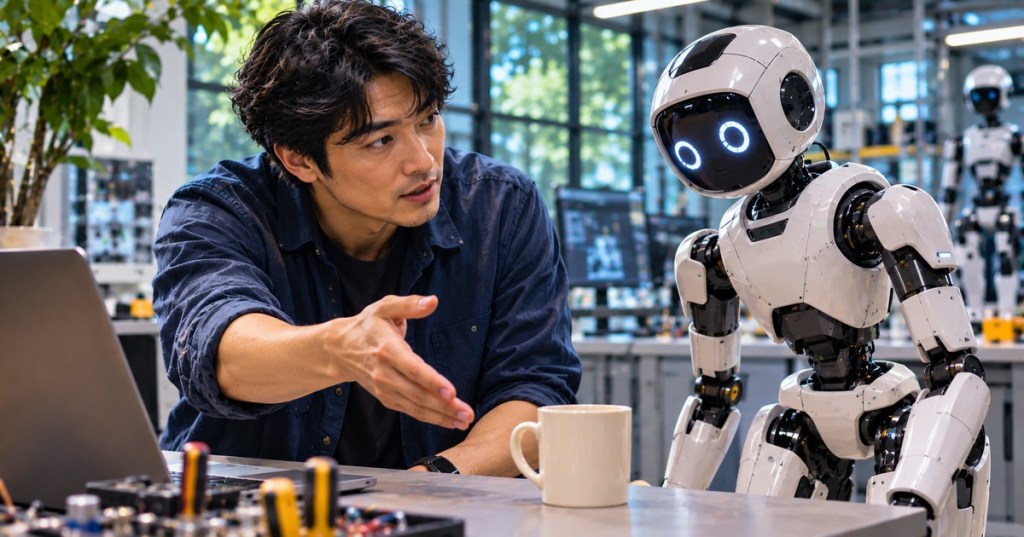
PALO ALTO, Calif. — Krafton subsidiary Ludo Robotics presented Ludi 0.2, an experimental artificial-intelligence system designed to help robots interpret human intent, gestures and changing instructions, at UC Berkeley’s Bay Area Robotics Symposium on October 30, 2026. The company behind PUBG: Battlegrounds wants to transfer its experience with responsive game characters into physical human-robot collaboration.
According to Krafton’s announcement, Ludi 0.2 advances conversational memory, social-cue recognition, coordination of navigation and manipulation, gesture interpretation and adaptable movement. These are company-reported improvements, not independently benchmarked gains.
Official Ludo Robotics handover demonstration of the earlier Ludi 0.1 system, published on the company’s research page. Not Ludi 0.2 footage.
From Game AI to Physical Robots
Krafton has built interactive game characters and, with Nvidia, AI teammates capable of responding to players. Ludo applies similar dialogue and decision-making ideas to robots that must act safely when someone interrupts, corrects a request or points toward an object.
The previous Ludi 0.1 architecture combined a fine-tuned vision-language model with specialized speech, navigation and manipulation tools. Its August technical report described a 28-scenario simulated household benchmark: successful outcomes rose from 10 before fine-tuning to 17 afterward. A separately prompt-optimized frontier model completed 26 scenarios.
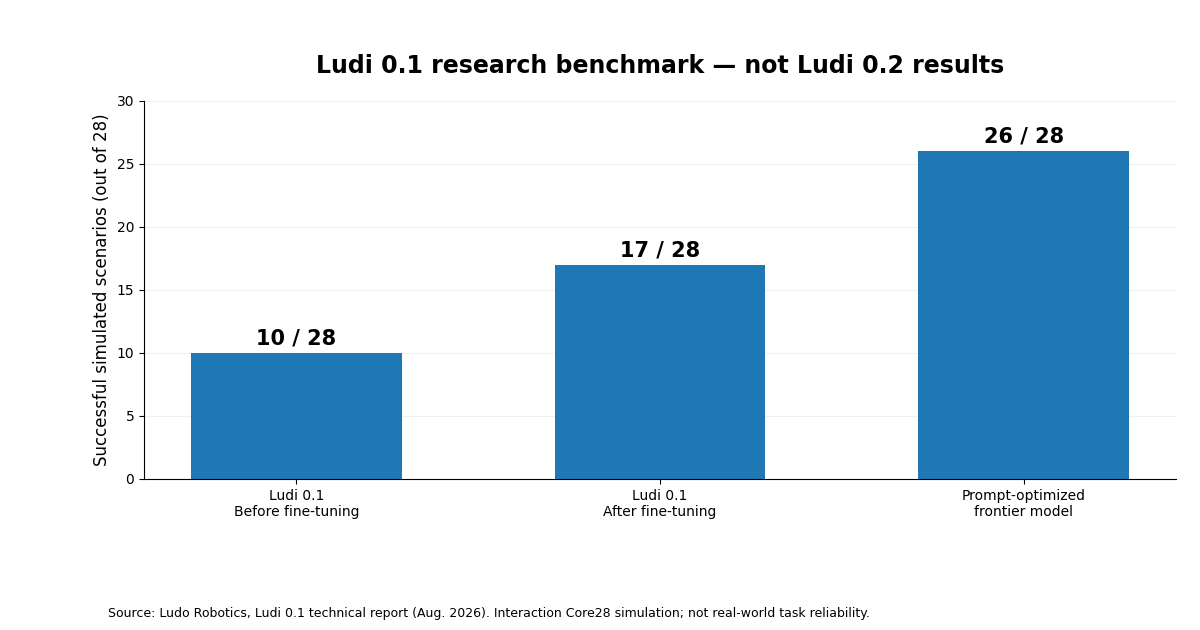
Source: Ludo Robotics’ Ludi 0.1 research. These are simulated results from August, not real-world success rates or Ludi 0.2 measurements.
A Research Demonstration, Not a Household Product
In an interview with Fast Company, Krafton chief executive CH Kim acknowledged that Ludi remains a research demonstration rather than a system reliable enough for everyday use. Ludi 0.2 retains separate reasoning and action components; its planned successor, Ludi 1.0, aims to integrate them more tightly.
Official Ludo Robotics demonstration of the earlier system checking a home environment, shown for technical context rather than as a new Ludi 0.2 test.
BitcoinVersus.Tech has covered Meta’s motion-data research, robot training with human motion and touch, Meta’s reported humanoid prototype and robots doing commercial work.
The next test is measurable reliability around people: how often a robot understands corrections, avoids unsafe actions and completes tasks outside scripted demonstrations. Ludo has not disclosed reproducible Ludi 0.2 benchmark results or a commercial launch date.
Support BitcoinVersus.Tech
We volunteer daily to ensure the credibility of the information on this platform is Verifiably True. Please scan the original QR code below to donate 5,000 sats if you would like to support our independent reporting. For best results, open this page on a laptop or larger screen.

On mobile, display the QR code on another screen to scan it with a Bitcoin wallet; alternatively, use a wallet’s saved-image QR-scanning feature if available. Bitcoin donation address: 3C9o19EH5HSiwEPyCTmEKzxhNCbo2X6TTb.
BitcoinVersus.tech is not a financial advisor. This media platform reports on financial subjects purely for informational purposes.


Leave a Reply