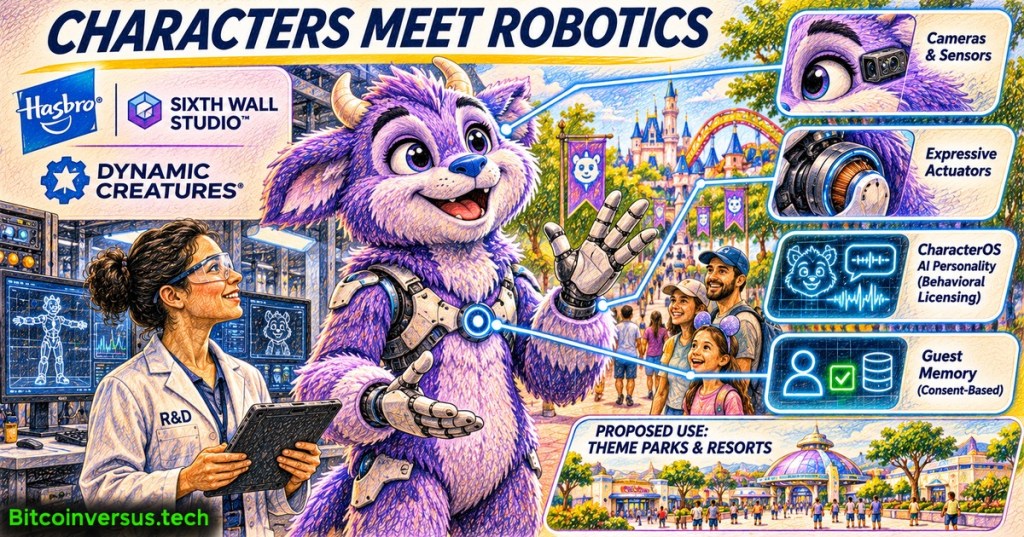
Hasbro is moving its fictional characters toward physical robotics. On November 10, 2026, Hasbro’s Sixth Wall Studio and Dynamic Creatures announced a partnership to develop expressive robotic characters for theme parks, resorts and entertainment destinations. The proposed systems would pair authorized voices and personalities with mobile hardware capable of moving, gesturing and responding to guests. No venue, specific licensed character or commercial opening date was announced.
Official October 2026 demonstration of Hugo, a Dynamic Creatures mobile character-robot prototype. The video predates the Hasbro deal; the displayed interactions were remotely controlled by a human, not demonstrations of fully autonomous Hasbro characters. Credit: Dynamic Creatures / YouTube.
CharacterOS and SnowJay provide different pieces
Sixth Wall Studio, which Hasbro launched in June, supplies CharacterOS and its Behavioral Licensing framework. The goal is to let rights holders authorize a fictional character’s voice, conversational conduct and personality rules while preserving licensing controls. Unlike an unrestricted character chatbot, an approved experience would need behavior boundaries that follow the character’s established identity.
Dynamic Creatures contributes the physical layer. Its SnowJay robotics platform coordinates movement, real-time control, perception, gesture execution and operational safety functions. The partners propose encounters in which a character greets a resort guest, assigns a story-related adventure and refers to the encounter during a later visit. Such continuity remains a planned capability rather than a documented customer installation.
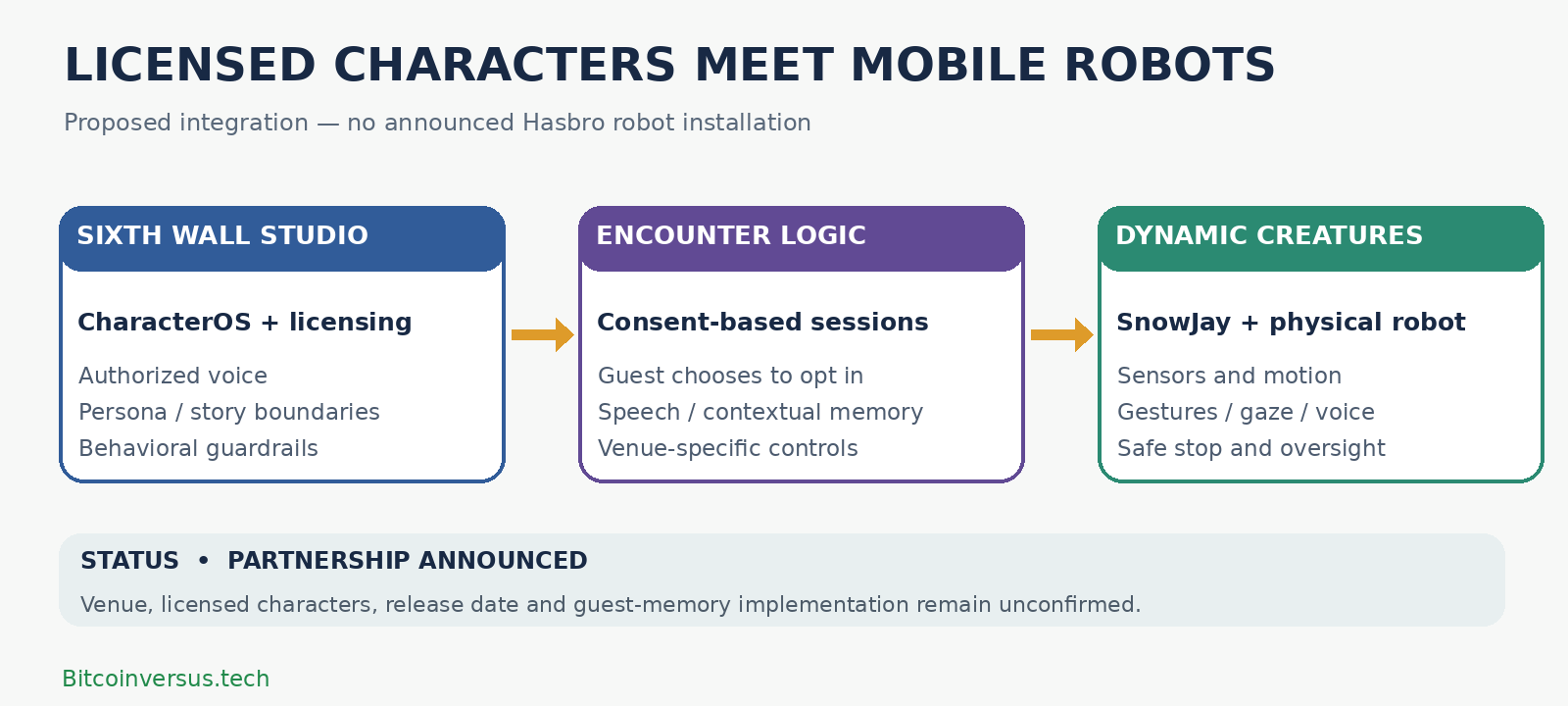
A mobile robot could turn toward visitors, match speech to body movement and react to changing surroundings. Delivering those behaviors reliably requires much more than a language model: sensors, actuation, control loops, animation timing, navigation, remote supervision and recovery from unexpected physical contact all matter.
Hugo is real, but its autonomy remains unfinished
Dynamic Creatures revealed Hugo, a furry bipedal character prototype, in October. The company identifies 43 actuators, while contemporary reporting cites 57 joints. The Boston Globe reported that Hugo’s filmed interactions were teleoperated and that independent physical interaction was still under development. A carefully staged demonstration does not establish unsupervised operation among visitors.

The startup was founded by former Boston Dynamics and robotics-research leaders and serves as Boston Dynamics’ official entertainment and hospitality partner. It remains a separate business. The companies have not identified the precise underlying robot platform for any future Hasbro installation.
Remembering visitors raises privacy and safety questions
Hasbro says proposed memory features would depend on guest choice and permissions, with controls determined for each location. Its initial Sixth Wall applications target audiences aged 13 and older. Neither partner has established public specifications for visitor identification, memory retention, consent withdrawal or autonomous operation at a named park.
Physical safety will also shape deployment. Actuated robots moving near guests need reliable stopping, collision management, navigation and tested human oversight. An expressive prototype that dances, hugs or waves under remote control cannot alone demonstrate safe behavior in crowded venues.
BitcoinVersus.Tech has previously covered robotic interpretation of human intent, robotics development and simulation, entertainment intellectual property expanding into attractions and AI-generated interactive worlds. Hasbro’s approach would link licensed digital personalities to a machine sharing physical space with guests.
Bottom line: The Hasbro–Dynamic Creatures partnership is confirmed, and Hugo demonstrates existing expressive robot hardware. Named deployments, autonomous guest-facing safety, implementation of visitor memory and commercial launch schedules remain unverified.
Primary sources: Hasbro partnership announcement (November 10; posted November 12); Sixth Wall Studio launch; SnowJay technical overview; Boston Dynamics partner announcement; original Hugo video; and Boston Globe independent reporting on teleoperation. Statements about future capabilities are identified as proposals.
Editor’s Note: Hasbro and Dynamic Creatures announced a development agreement, not an operational robotic attraction. Hugo is a Dynamic Creatures prototype rather than a named Hasbro character, and its demonstration involved human remote operation. No venue, opening date, licensing character or detailed visitor-memory policy has been announced. The original 1200 × 630 colored-pencil cover and CharacterOS–SnowJay explanatory diagram are conceptual artwork, not documentary photographs. The Hugo thumbnail and original October demonstration are genuine company media. Rendering of the YouTube player is checked in WordPress; independent playback and mobile appearance are not presumed.

BitcoinVersus.Tech is volunteer-run and publishes independent educational technology reporting. An optional 5,000-satoshi donation supports ongoing research. Scan the original QR from a second screen with a compatible Bitcoin wallet; on mobile, use a wallet that supports scanning a saved image. Independently verify the recipient address 3C9o19EH5HSiwEPyCTmEKzxhNCbo2X6TTb and the payment amount before sending. Bitcoin transfers are generally irreversible.
We volunteer daily to ensure information on the BitcoinVersus.Tech platform is Verifiably True. Coverage is educational and informational and does not constitute financial or investment advice.


Leave a Reply