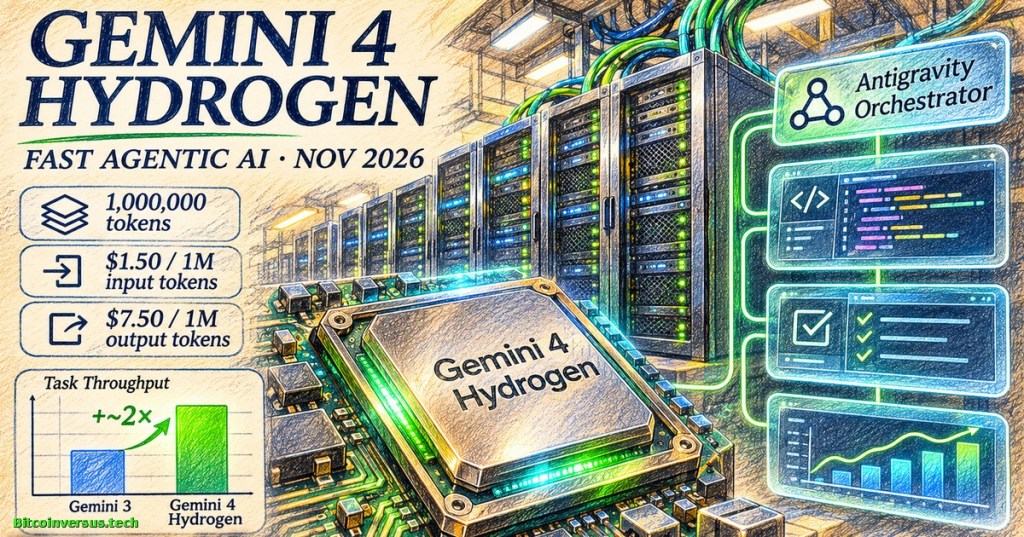
Google released Gemini 4 Hydrogen on November 12, 2026, positioning the model as a faster, lower-cost engine for coding assistants and multi-agent automation. The launch extends the Gemini 4 family across Google Search, the Gemini app, Google AI Studio and enterprise developer services. Hydrogen is adapted from the more compute-intensive Gemini 4 Carbon model, with a one-million-token context window and API pricing of $1.50 per million input tokens and $7.50 per million output tokens.
Google’s November 12 announcement, updated November 13, and its separate model card establish availability and documented specifications. Benchmark and efficiency results remain company-reported unless separately attributed. The release is an operating AI model, not a proposed processor, benchmark simulation or preproduction silicon.
A faster executor for multi-model teams
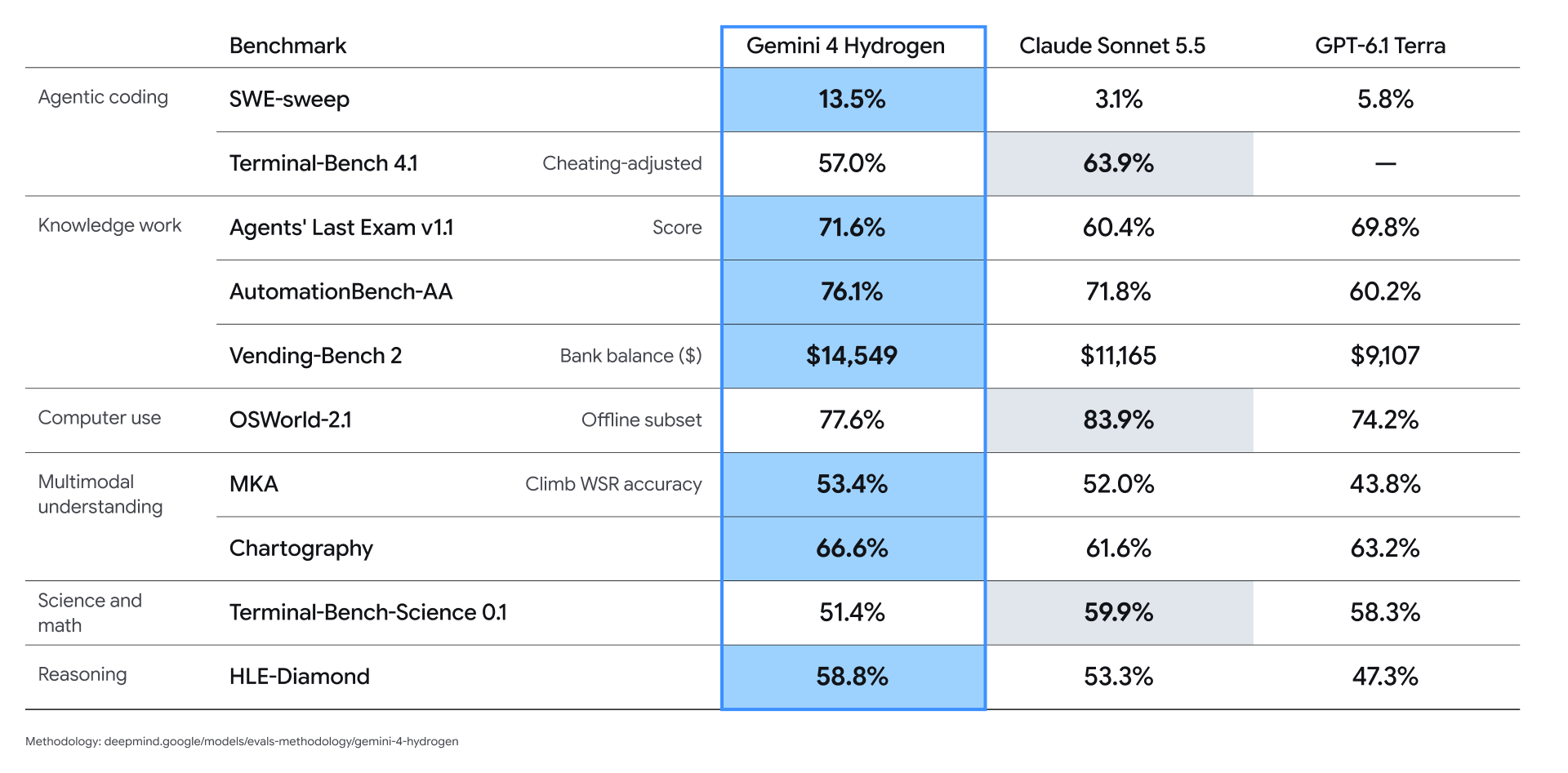
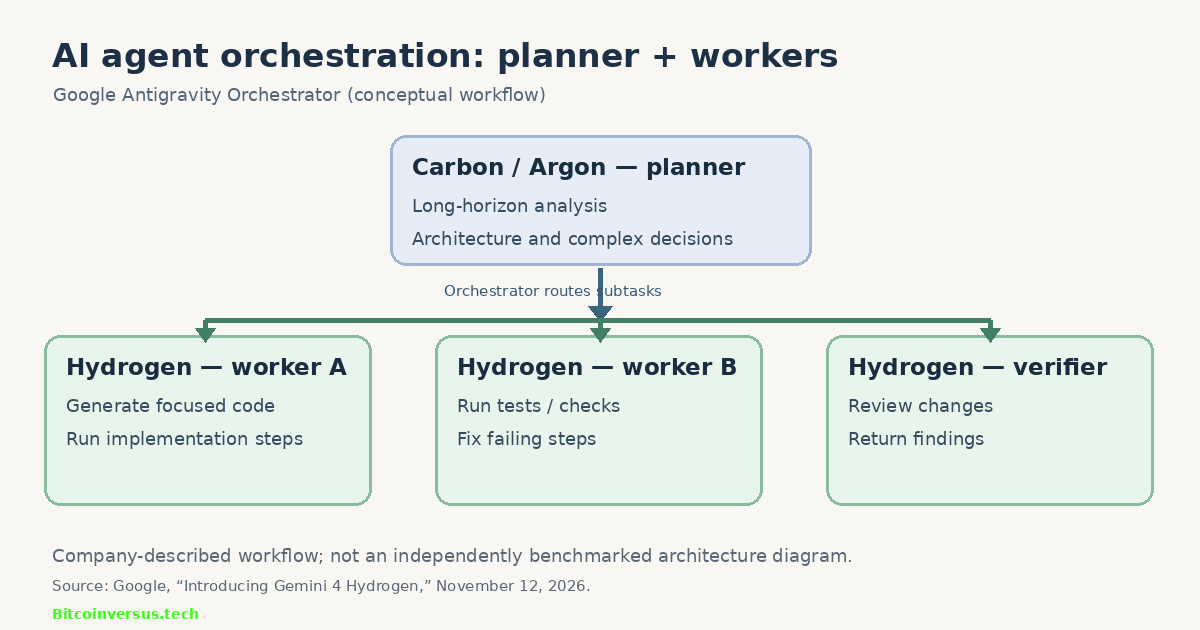
Hydrogen is designed to take short-cycle jobs such as reading repository files, editing code, executing tests and checking tool outputs. Google also introduced Orchestrator in its Antigravity development environment to route complex planning to higher-capability models while assigning repeatable implementation tasks to Hydrogen. In a company benchmark using Terminal-Bench 4.0, Orchestrator consumed 24% less quota and finished 19% faster than the comparison configuration, although Google did not provide a universal cost guarantee for production workloads.
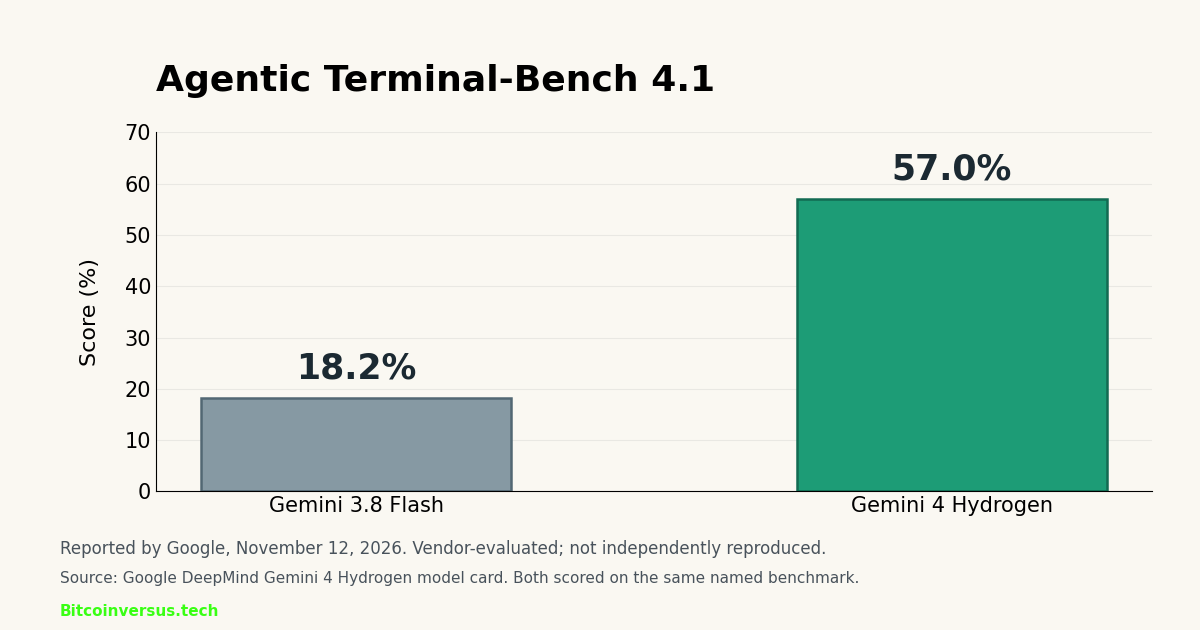
Google says Hydrogen completes tasks about 2.5 times faster than Gemini 3.8 Flash at its default high thinking setting. On the company’s Terminal-Bench 4.1 evaluation, Hydrogen scored 57.0% versus 18.2% for 3.8 Flash, a difference of 38.8 percentage points. Terminal-Bench tests agentic work in controlled terminal environments; an improved score does not establish equivalent gains on every developer task. BitcoinVersus.Tech previously reported on Antigravity software demonstrations and the need for human review.
One million tokens does not mean one million immediate output tokens
Hydrogen accepts text, images, audio and video within a unified context allocation of up to one million tokens. Google’s model card specifies a default synchronous output limit of 64,000 tokens, with longer generation possible through background decoding. Developers should avoid treating the full context allocation as a guaranteed interactive reply length or as unlimited working memory.
Four thinking levels—low, medium, high and xhigh—let applications trade reasoning effort against time and token use. Listed API prices apply across the context window, but actual spending rises with the number of tokens consumed by repeated tool calls, retries and long reasoning runs. For context on the associated infrastructure, see BitcoinVersus.Tech’s Google Cloud and TPU capacity analysis.
Safety and enterprise limitations remain
Google reports stronger resilience to indirect prompt injection and reductions in certain agent overreach behaviors. Its published model card also shows a 5.57-percentage-point increase in unjustified refusals on an internal multimodal evaluation, illustrating why safety changes require more than a single positive headline. Independent deployment teams still need permission boundaries, logging, reproducible tests and review before agents can modify production systems.
Hydrogen’s widespread distribution adds a software-side competitor to established coding agents, but model quality must be weighed against latency, context requirements and operating cost. BitcoinVersus.Tech’s earlier coverage of Gemini 4 Carbon security evaluations and Google’s C++ inference serving software documents different layers of the expanding AI stack. No in-house Hydrogen workload, billing or video playback test was performed for the article.
Primary sources: Google launch announcement, November 12, updated November 13; Google DeepMind model card, published November 12. Benchmark values and orchestration improvements are Google-reported; sources distinguish deployed product availability from independently validated performance.
Editor’s Note: Gemini 4 Hydrogen launch dates, documented specifications, distribution channels and quoted benchmark values were checked against Google’s primary announcement and DeepMind model card. Vendor evaluations were not independently reproduced. The original 1200 × 630 colored-pencil cover is a conceptual illustration; its chip and server-room imagery does not depict a physical Gemini processor. In-story media comprise one company-published comparison animation and two original technical graphics with source labels. No relevant official YouTube or X player with independently confirmed identity and playable embedding was established. Public mobile rendering and actual media playback were not tested.

BitcoinVersus.Tech is volunteer-run and publishes independent educational technology reporting. An optional 5,000-satoshi donation supports ongoing research. Scan the original QR from a second screen with a compatible Bitcoin wallet; on mobile, use a wallet that supports scanning a saved image. Independently verify the recipient address 3C9o19EH5HSiwEPyCTmEKzxhNCbo2X6TTb and the payment amount before sending. Bitcoin transfers are generally irreversible.
We volunteer daily to ensure information on the BitcoinVersus.Tech platform is Verifiably True. Coverage is educational and informational and does not constitute financial or investment advice.


Leave a Reply