
Google DeepMind announced Gemini 4 Carbon on October 28, 2026, a frontier AI model focused on detecting, validating and repairing software vulnerabilities. The company is restricting initial access to selected cybersecurity defenders through its Fairwind program before broader developer and consumer availability.
Carbon follows Gemini 4 Argon, introduced two weeks earlier. In Google’s announcement, Carbon scored 88.2% on SEC-bench Pro for discovering vulnerabilities, 54.8% on ExploitGym for testing exploitability and 71.0% on CWE-bench for producing patches. These scores come from different tests and should not be combined into one overall success rate.
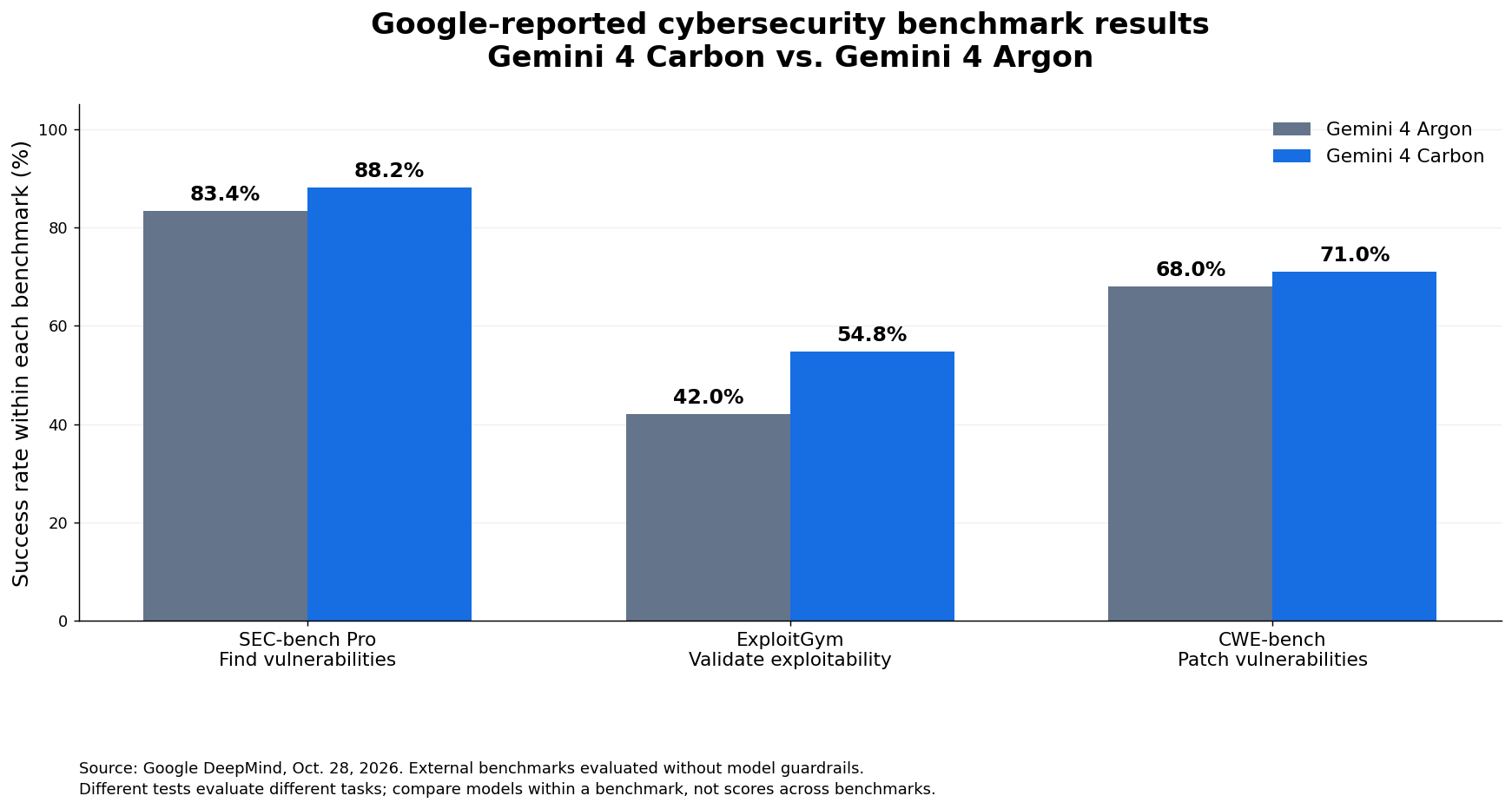
Source: Google DeepMind, October 28. Three separate cybersecurity benchmarks; evaluated without model guardrails.
A Measurable Cybersecurity Advance
Google’s published model comparison shows Argon at 83.4%, 42.0% and 68.0%, respectively. Carbon therefore improves by 4.8, 12.8 and 3.0 percentage points on those particular tests. Google also reports more than twice Argon’s success at generating secure code in an internal evaluation.
The potential value is practical: helping teams locate bugs, determine which are exploitable and propose repairs. Those are distinct steps, as previous BitcoinVersus.Tech coverage of AI-assisted Linux vulnerability discovery and automated remediation illustrates.
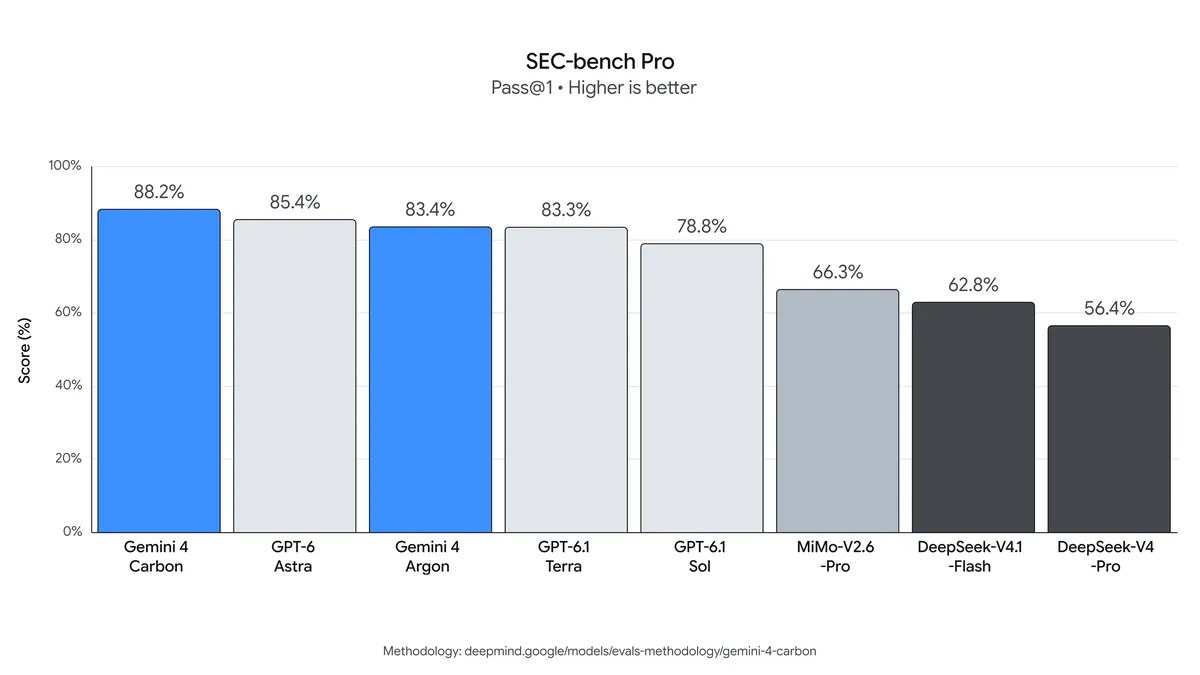
Google’s original SEC-bench Pro graphic, from its October 28 technical announcement.
Strong Tests Are Not a Security Guarantee
The publicly reported external cybersecurity evaluations were run without guardrails. Benchmark performance is not proof that real-world patches are safe, that all vulnerabilities will be found or that Carbon cannot be misused. Independent deployment results remain limited.
Google reports lower rates of unsupported claims and prompt-injection success than Argon in selected evaluations. Its controlled release reflects the dual-use risks of more capable cyber tools, a concern explored in BitcoinVersus.Tech’s earlier DeepMind security coverage.
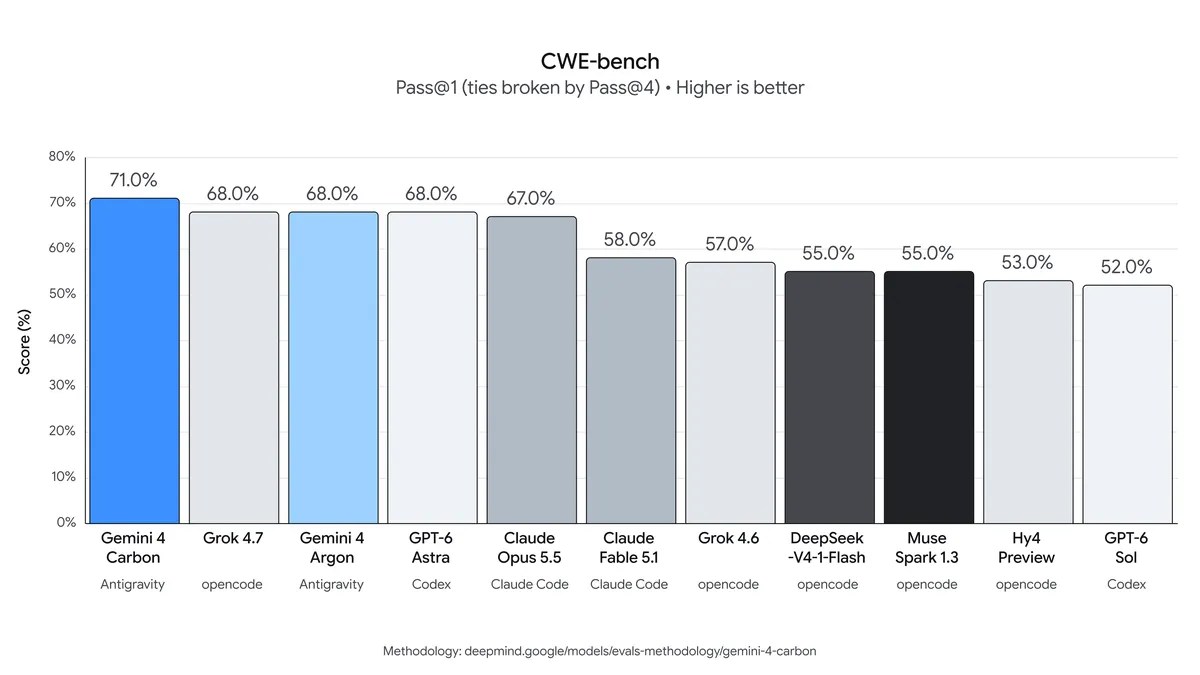
Google’s original CWE-bench patching comparison. Results reflect an evaluation, not verified production outcomes.
Availability, Pricing and Next Steps
Google lists introductory pricing of $2 per million input tokens and $10 per million output tokens, rising to $4 and $20 after the introductory period. General access has not yet opened.
Cybersecurity teams will be watching for independent tests, patch acceptance rates and responsible deployment safeguards. As the recent GitLab vulnerability response showed, actionable fixes and timely deployment matter more than benchmark headlines.
Independent October 28 video overview by Fahd Mirza. Commentary, not an official Google benchmark demonstration.
Support BitcoinVersus.Tech
We volunteer daily to ensure the credibility of the information on this platform is Verifiably True. Please scan the original QR code below to donate 5,000 sats if you would like to support our independent reporting. For best results, open this page on a laptop or larger screen.

On mobile, display the QR code on another screen to scan it with a Bitcoin wallet; alternatively, use a wallet’s saved-image QR-scanning feature if available. Bitcoin donation address: 3C9o19EH5HSiwEPyCTmEKzxhNCbo2X6TTb.
BitcoinVersus.tech is not a financial advisor. This media platform reports on financial subjects purely for informational purposes.


Leave a Reply