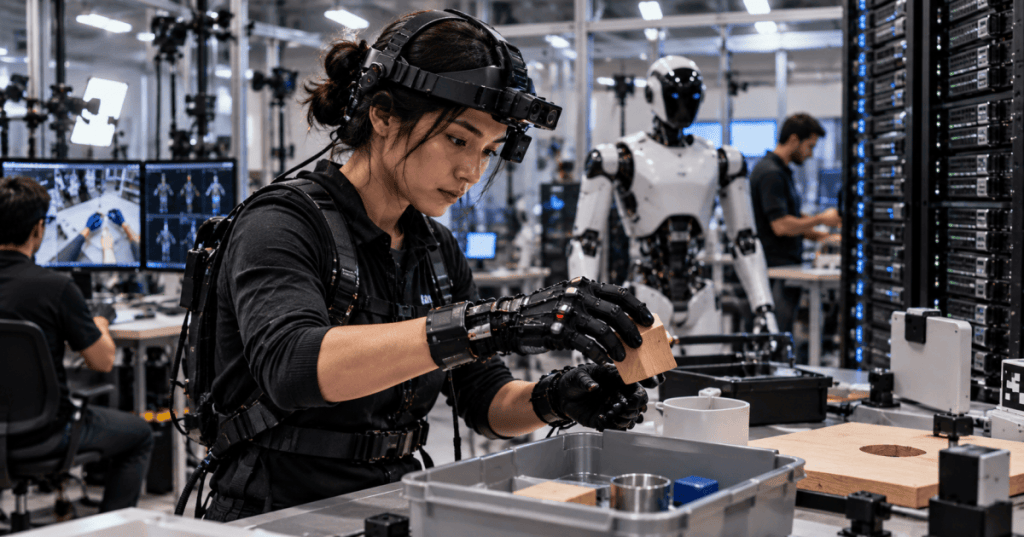
Robotics startup Mecka says training useful robots requires far more than collecting videos. In an October 20, 2026 Sequoia Capital Training Data interview, founder and CEO Josh Gao described a growing industry built around recording human work, measuring touch and motion, and turning those observations into reliable training datasets.
Why robots need a data factory
Unlike language models, which can learn from vast quantities of existing online text, robots must learn how physical actions work. Gao says Mecka captures first-person footage of people cooking, cleaning and performing industrial tasks. It also develops wearable sensors, including tactile gloves, to capture information a camera alone cannot reliably provide, such as how much force someone applies.
In the original interview and transcript, Gao describes a possible training mix involving roughly a million hours of human demonstrations, tens of thousands of hours of robot data, and smaller amounts of task-specific teleoperation. These are his description of an emerging approach, not an independently established industry standard.
The hidden infrastructure behind robot learning
Collecting that information means designing hardware, recruiting contributors and businesses, transferring enormous files, screening fraudulent submissions, and processing raw recordings into structured motion and action data. Gao says some operations require 100-gigabit upload connections. Quality control is as important as volume because duplicated, staged or mislabeled footage can weaken training.

Mecka announced a $60 million Series B led by Sequoia Capital earlier this month. That financing was already covered by BitcoinVersus.Tech; the new development here is Gao’s detailed explanation of the collection operation and why tactile sensing matters.
What comes next
The interview suggests practical, constrained commercial jobs may become feasible before robots can handle every household or factory task. Related work includes robot training facilities and force-sensing robotic hands. Progress will depend on whether training data transfers into dependable performance outside controlled demonstrations.
Editor’s Note: This article distinguishes Mecka’s statements from independently verified results. To support independent technology reporting, donate 5,000 sats by scanning the BitcoinVersus.Tech donation QR code.


Leave a Reply