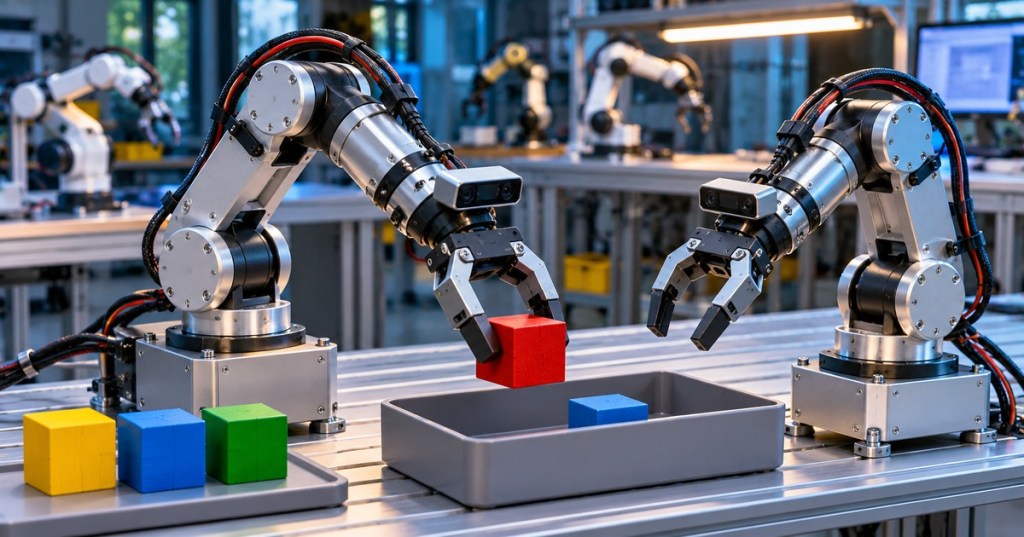
Dream Labs introduced Dream-1 on October 19, 2026, saying its new World Action Model can control two-armed robots it has never trained on. The San Francisco startup emerged from stealth with $90 million in seed funding and opened an API priced from $3 per hour. It is a potentially useful way for researchers and developers to test robots without first collecting extensive demonstrations from every machine.
A World Action Model turns camera observations and commands into physical motion instructions. Dream-1 uses a head camera and two wrist views to predict actions for bimanual robots with parallel grippers. Developers send observations and receive movement commands; the system is cloud-hosted robot-control software, not a newly manufactured robot or an AI chip.
An independent robot-control benchmark
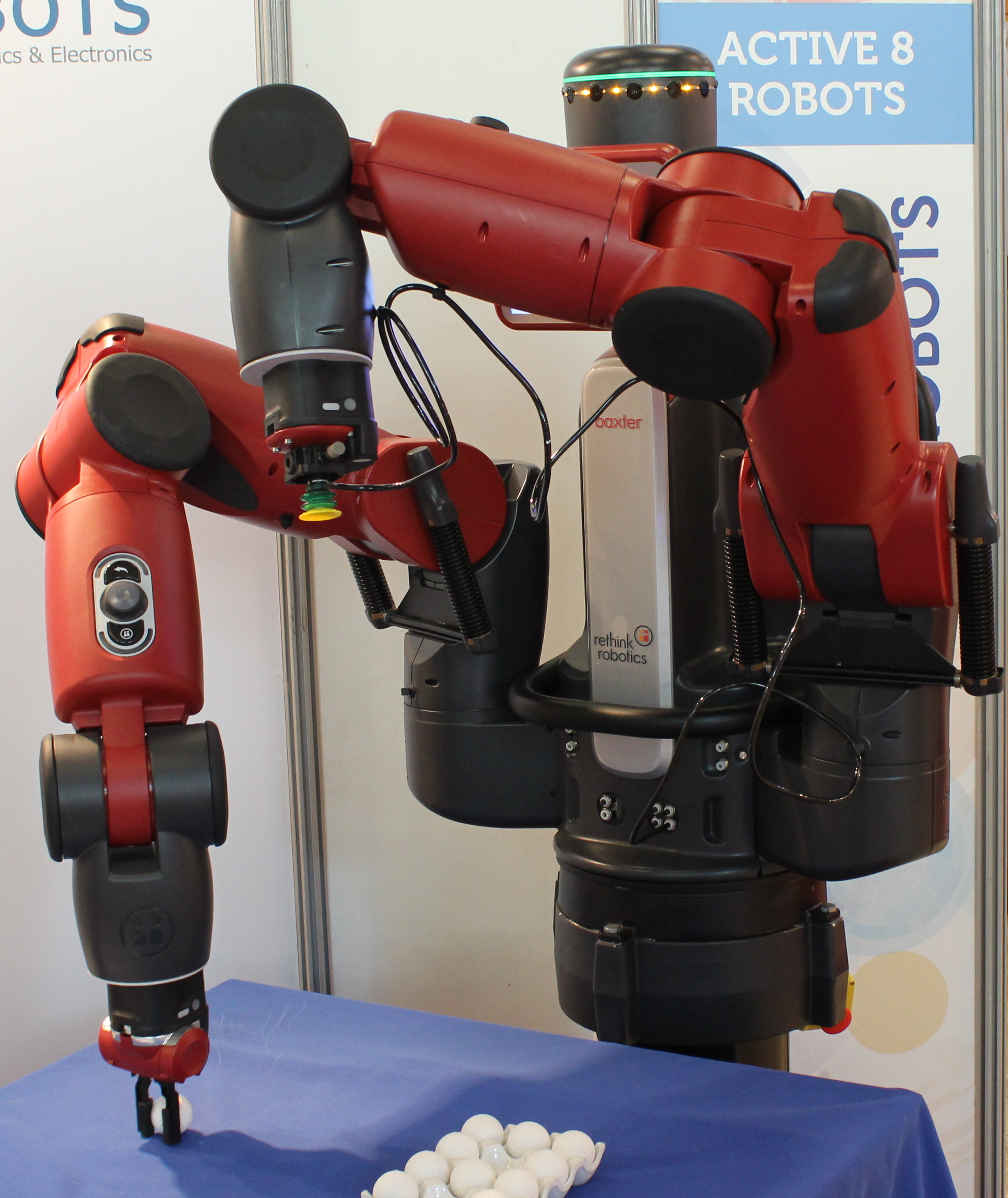
On RoboCurve’s RoboDojo-RC Tier 1 evaluation, Dream-1 earned a 59.3% mean task-progress score, compared with 48.2% for Gemini 4 Argon (high), 38.2% for Opus 5.5 (high), and 18.9% for MolmoAct2. Each configuration was evaluated over 120 attempts. These are partial-credit progress scores, not the percentages of tasks fully completed.
The benchmark uses YAM robot arms, which Dream-1 was already trained on. It therefore tests generalization to tasks under those conditions, not independent transfer across unfamiliar hardware. Dream Labs separately showed examples on other robot types, but their success rates vary, so a handful of demonstrations should not be read as universal reliability.
Why cross-robot software is difficult
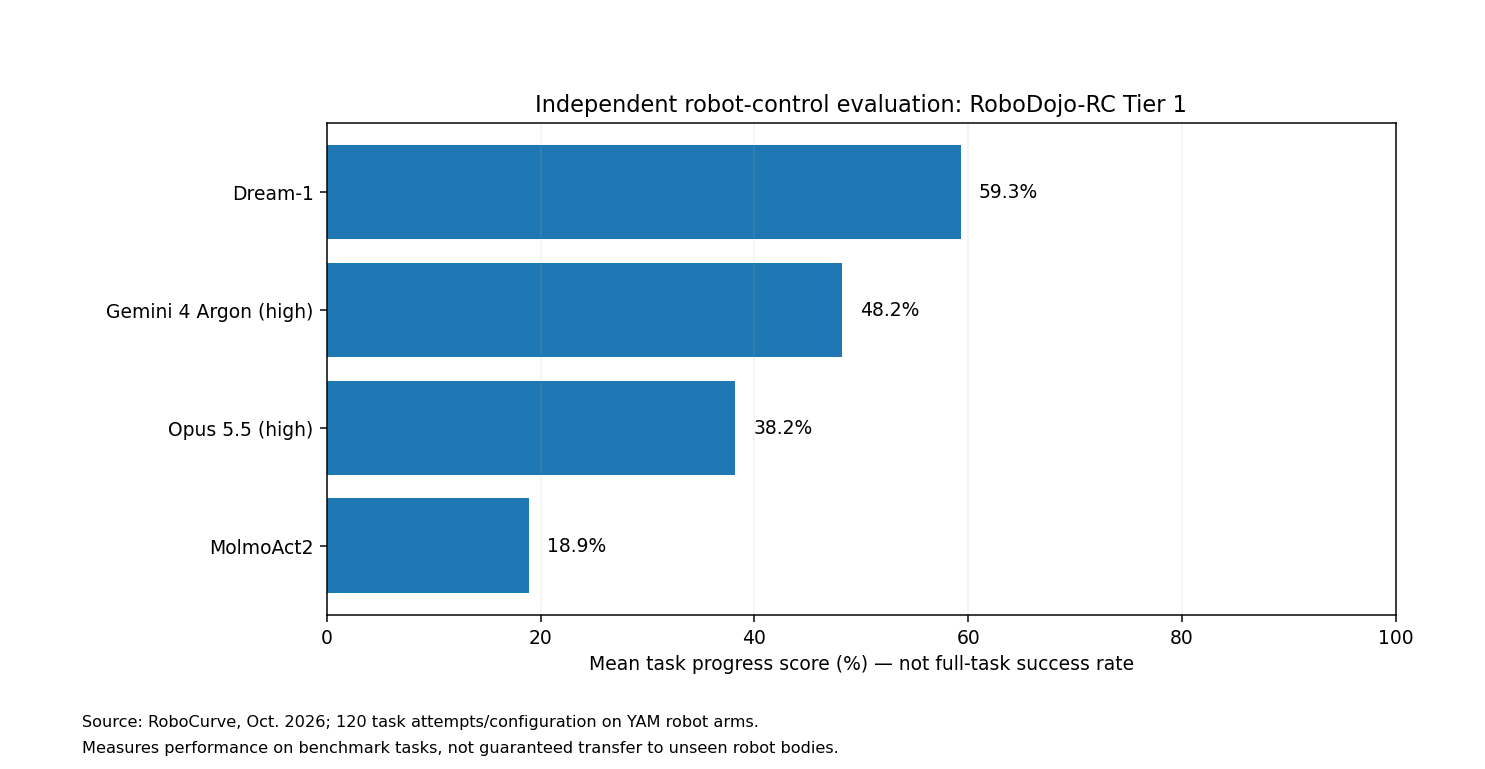
Robot hardware differs in reach, joints, motors and grippers. An instruction that works on one arm may be physically impossible on another. Dream-1 also relies on each robot’s inverse-kinematics solver, and can struggle with obstacles or joint limits. Those practical problems connect to our explainers on robot motion planning and sensor fusion.
What happens next?
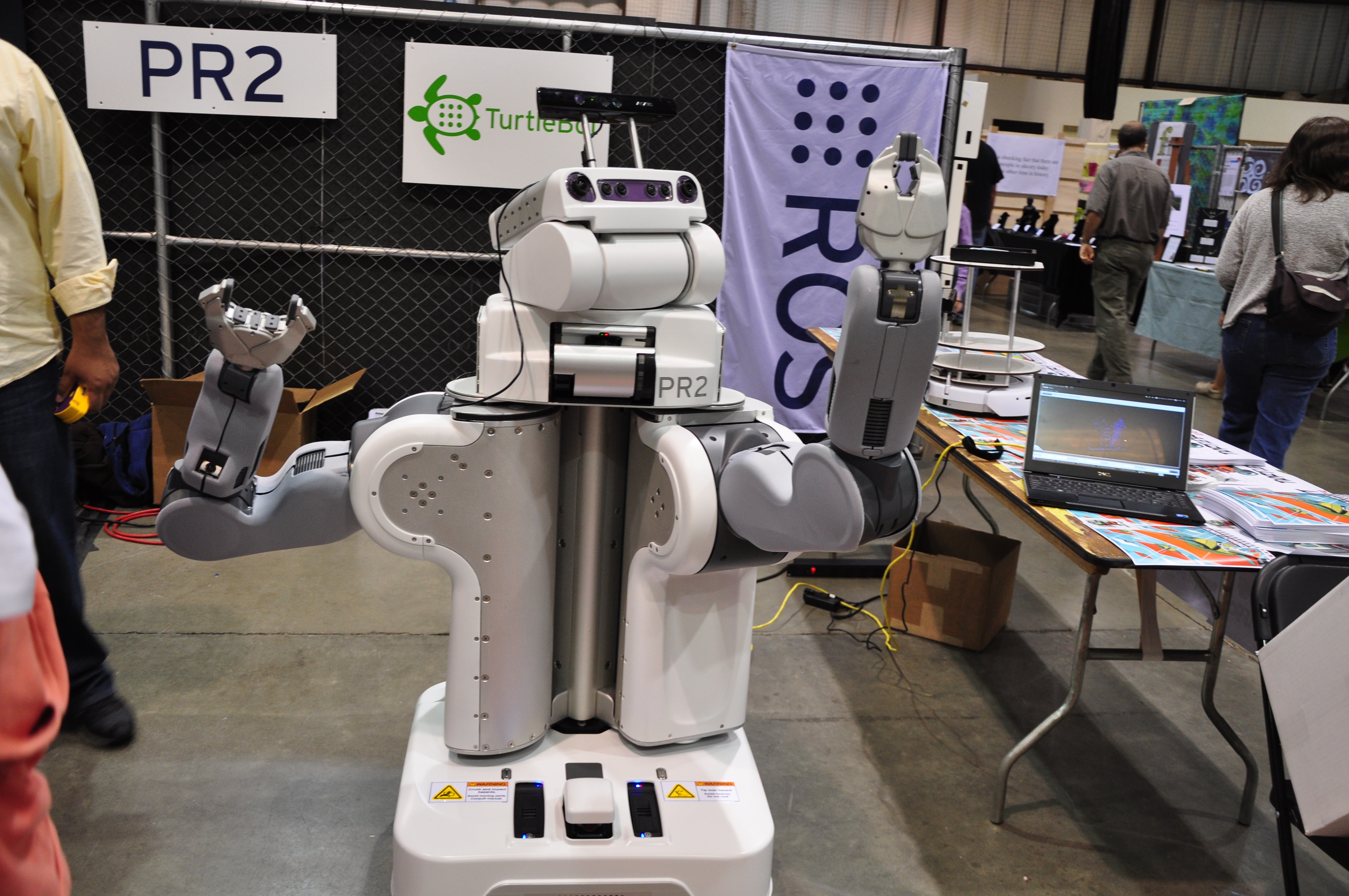
Dream Labs offers a lower-cost $2-per-hour Dream-1-flash tier and says developers can adapt the model using demonstrations from their own machines. The company warns Dream-1 is a research beta that makes mistakes and has not been validated for safety-critical use. Operators should therefore test around people only with appropriate safeguards.
Its broader significance sits alongside efforts to improve robot training data, multimodal robot models and real-world deployment. The next real test is sustained performance on unfamiliar robots, measured independently across varied tasks and environments.
BitcoinVersus.Tech
BitcoinVersus.Tech Editor’s Note: We volunteer daily to ensure the credibility of the information on this platform is Verifiably True. If you would like to support our work and help further secure the integrity of our research initiatives, please scan the QR code below to donate 5,000 sats. For best results, scan the QR code from a laptop or larger screen.

Bitcoin address: 3C9o19EH5HSiwEPyCTmEKzxhNCbo2X6TTb. On a phone, open the QR image on another screen or copy and verify the address in your wallet before sending.
BitcoinVersus.tech is not a financial advisor. This media platform reports on financial subjects purely for informational purposes.


Leave a Reply