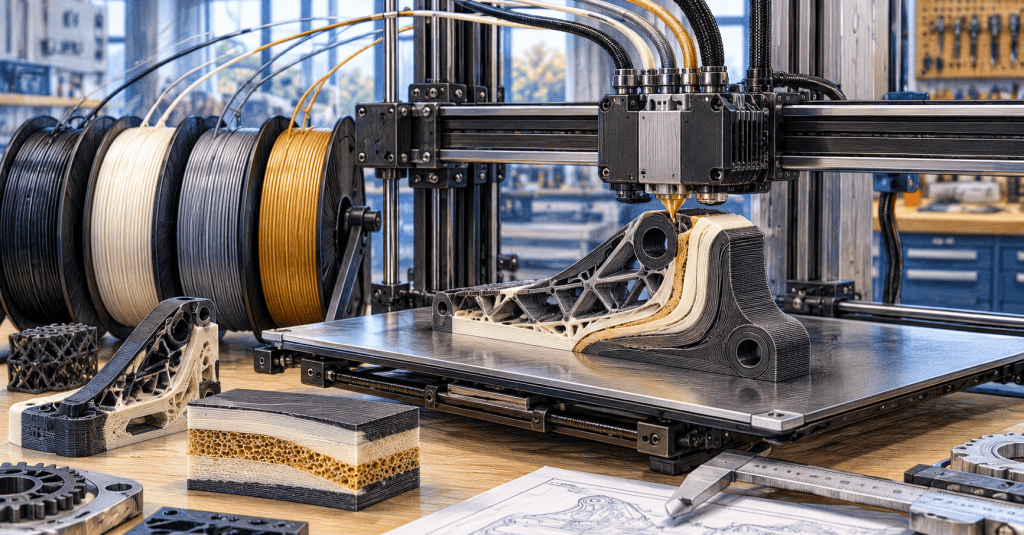
On October 13, 2026, the U.S. Army published a Federal Register notice saying it plans to grant ZYLtech Engineering a partially exclusive license covering Army-developed dual- and multi-material filament technology. The licensed fields include ABS and ASA families, polycarbonate, nylon, and thermoplastic elastomers such as TPE, TPU and PEBA.
This is a licensing step, not a new patent grant or a finished-product announcement. The portfolio includes U.S. Patents 10,968,539, 11,001,945 and 11,566,349, plus published applications 2022/0033998 and 2025/028952. The basic engineering idea is to combine materials with different thermal or flow behavior inside one filament, allowing one phase to preserve geometry while another can flow and strengthen bonding during printing or post-processing.
Rice University’s 2026 post shows another materials-focused direction in additive manufacturing. It is broader 3D-printing context and is not part of the Army licensing action.
The technology also has fresh test data behind it. A September 1 DEVCOM Army Research Laboratory report tested a dual-material ABS+TPE core-shell filament at −40 °C. The researchers reported that it and a PCPBT material showed unusually high cold-weather toughness, with cold in-plane impact strength approaching nearly 10 times that of a benchmark injection-molded nylon part.
A hands-on look at ZYLtech filament provides company and material context for the planned license.
The notice does not disclose commercial terms or a product launch date. It gives interested parties 15 days to submit objections or competing applications.
The move fits a wider shift toward more capable digital manufacturing. BitcoinVersus.Tech has recently followed programmable micro-machine manufacturing, Berkeley’s 3D-printed open-source humanoid, and a student-built 3D-printed mecha suit.
BitcoinVersus.Tech Editor’s Note:
We volunteer daily to ensure the credibility of the information on this platform is Verifiably True. If you would like to support to help further secure the integrity of our research initiatives, please donate using the QR code provided

For best QR-code scanning results, please scan this donation code from a desktop or larger screen. Mobile screens may prevent camera recognition.


Leave a Reply