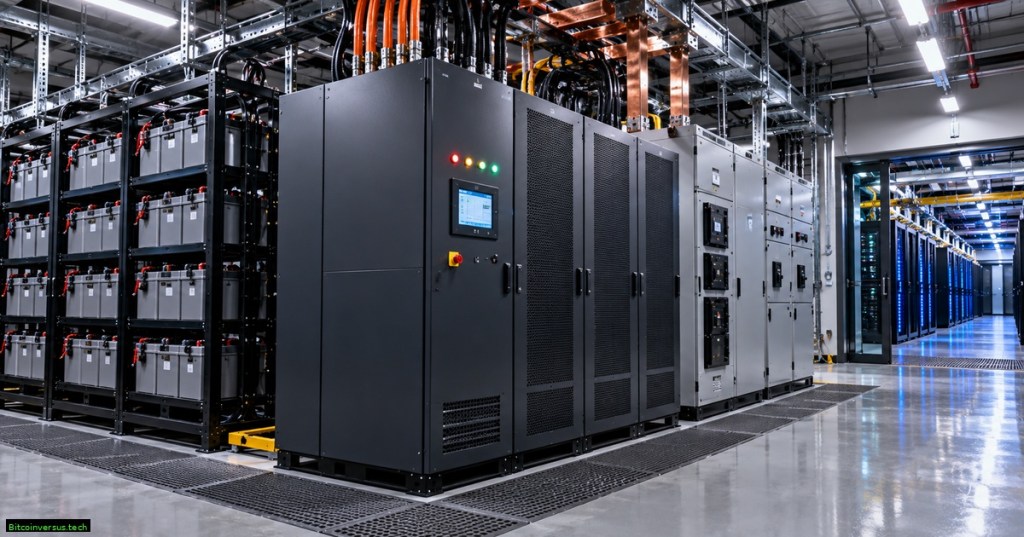
A UPS, or uninterruptible power supply, is the electrical bridge that keeps critical equipment alive when utility power disappears, sags, spikes, or becomes unstable. In a modern data center, the UPS usually sits inside the larger electrical power path between upstream utility/generator sources and the IT load.
The simplest way to think about it is this: the generator is the longer-duration backup source; the UPS covers the gap immediately. A generator needs time to detect the outage, start, reach stable voltage and frequency, and transfer onto the load. A properly designed UPS can keep servers, switches, storage, and control systems powered during that transition.
What a UPS Actually Does
A UPS does more than provide a battery. It can protect equipment from blackouts, brownouts, overvoltage, surges, electrical noise, frequency variation, and other power-quality problems. Eaton describes online UPS systems as the highest-protection topology because they isolate sensitive equipment from raw utility power.
That matters because servers do not care why the power became bad. Whether the upstream problem starts at the utility, a substation, a breaker, a generator transfer, or a facility fault, the IT equipment only sees the voltage and frequency delivered to its power supplies.
The Three Main UPS Types
Standby UPS: utility power normally feeds the load directly. When the UPS detects a failure, it switches to battery/inverter power. This is common for lower-cost desktop and small-office protection.
Line-interactive UPS: utility power still normally feeds the load, but automatic voltage regulation can correct some high or low voltage conditions without immediately using the battery. It is common in network closets, smaller server rooms, and edge deployments.
Online double-conversion UPS: incoming AC power is continuously converted to DC and then converted back to regulated AC. Because the inverter is already supplying the protected load, the battery can support the DC bus without a normal transfer delay when the input source disappears. Schneider Electric identifies online double conversion as the most common operating mode for three-phase UPS systems protecting critical loads.
Inside a Double-Conversion UPS
The basic power train has four important pieces: a rectifier, a DC bus, an inverter, and an energy-storage system. The rectifier converts incoming AC to DC. The inverter turns that DC back into clean AC for the protected load. Batteries connect to the DC bus so they can support the inverter if the upstream AC source fails.
Large systems also include a static bypass. If the inverter is overloaded, undergoing maintenance, or experiences certain internal faults, the bypass can provide an alternate electrical path around the normal UPS power-conversion stage. The exact protection philosophy depends on the facility’s redundancy design.
Why a UPS Is Not the Same as a Generator
A generator produces electrical power for longer outages. A UPS is optimized for immediate continuity and power conditioning. During a utility failure, the UPS can hold the IT load while an automatic transfer system starts and transfers to the generator. Once the generator is stable, it becomes the upstream source feeding the UPS.
This is why data-center backup power is layered instead of choosing “UPS or generator.” Eaton notes that double-conversion UPS systems are particularly useful with generators because they continuously regenerate the output waveform and correct voltage and frequency deviations.
Why UPS Runtime Is Usually Measured in Minutes
A UPS is normally sized to provide enough ride-through time for a generator to start, for redundant feeds to transfer, or for equipment to shut down cleanly. Runtime depends on battery energy, load level, battery age, temperature, conversion efficiency, and the facility’s redundancy plan.
Doubling battery capacity does not automatically mean the whole facility can run for hours. Large IT loads consume enormous power. At megawatt scale, even short ride-through periods represent substantial stored energy, high DC fault current, large battery strings, thermal-management requirements, and significant floor-space or cabinet requirements.
UPS vs. BESS
A UPS and a battery energy storage system can both contain batteries and power electronics, but they are not automatically the same thing. Vertiv distinguishes the two mainly by architecture and purpose: a UPS is primarily a critical-load protection system, while a behind-the-meter BESS is generally optimized for broader energy-storage functions such as peak shifting, grid interaction, or longer-duration energy management.
The distinction is increasingly important as data centers add behind-the-meter generation and storage. A facility may use both systems: the UPS protects the no-break critical path while the BESS participates in the larger site-energy strategy.
kW and kVA Both Matter
UPS equipment is often rated in both kW and kVA. kW describes real power delivered to the load, while kVA describes apparent power. The relationship depends on power factor, so engineers must check both ratings instead of assuming a 1,000 kVA UPS can always support a 1,000 kW load.
Large three-phase UPS systems also have input/output voltage, short-circuit capability, battery voltage, bypass ratings, harmonic-performance limits, and overload curves that have to match the rest of the facility. Those details connect directly to switchgear, switchboards, and PDUs.
How Power Gets From the UPS to the Rack
After the UPS, facility power still has to be distributed to the actual servers. Depending on the architecture, that can involve switchboards, PDUs, remote power panels, transformers, overhead busway, rack PDUs, and dual A/B feeds.
That last step matters because redundancy only works if independent paths remain independent. A server with dual power supplies can use an A feed and a B feed, but if both feeds ultimately depend on the same failed UPS module or breaker, the apparent redundancy disappears.
The Simple Way to Remember It
Utility power is the normal source. The UPS keeps critical equipment alive instantly. The generator carries the longer outage. The downstream distribution system delivers that protected power to the rack.
A UPS is therefore not just a giant battery. It is a fast power-conditioning and continuity system placed directly in the critical electrical path. Its job is to make sure a momentary problem upstream does not instantly become a server outage downstream.
BitcoinVersus.Tech
Advertisement
Editor’s Note
UPS topology, runtime, redundancy, battery chemistry, bypass design, and generator integration vary by facility. Always use the manufacturer’s electrical specifications and the site’s engineered one-line diagram for real operating decisions.
Support and donation options are available through BitcoinVersus.Tech.
BitcoinVersus.tech is not a financial advisor. Content is provided for informational purposes.


Leave a Reply