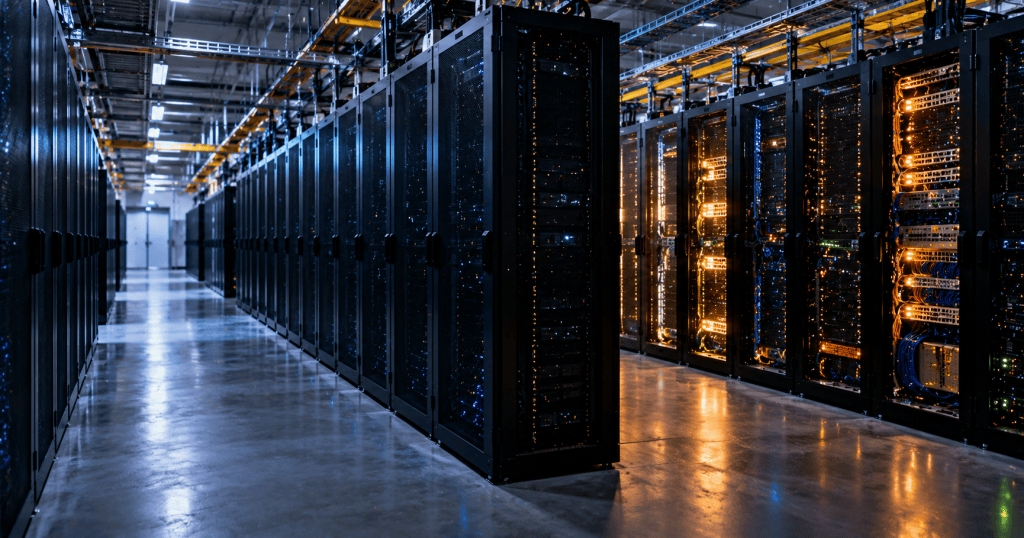
MIT researchers are attacking one of the least visible sources of data-center waste: expensive servers that are powered, cooled, and maintained even when much of their computing capacity sits unused.
MIT profiled associate professor Christina Delimitrou’s work on October 8. Her group uses machine learning to improve resource scheduling, application performance, security, and server architecture so cloud systems can do more useful work with the hardware already installed.
Many Large Systems Were Running At About 15% Capacity
Delimitrou’s earlier work with Stanford professor Christos Kozyrakis found that many large computing systems were operating at only about 15% utilization. The reason is not that operators deliberately want idle hardware. Cloud systems are difficult to schedule because thousands of applications compete for CPU cores, memory, storage, network bandwidth, and accelerators while their demand changes constantly.

Operators also leave headroom because running out of resources can be worse than wasting them. A service that suddenly needs more CPU or memory can slow down or fail if every server is already saturated. That pushes cloud platforms toward conservative allocations that protect reliability but leave large amounts of capacity unused.
MIT Uses Machine Learning To Schedule Resources Better
Delimitrou’s group uses machine learning to automate resource-management decisions that become too complicated for a human operator to optimize across tens of thousands of machines. The goal is to place workloads where they fit best while maintaining the latency, reliability, and performance targets users expect.
One system developed by her group, Seer, uses deep learning to predict performance problems in large web applications before the slowdown spreads through the service. Another tool, Ditto, creates replicas of proprietary applications so researchers can study the behavior of modern cloud workloads without needing direct access to a hyperscaler’s private production stack.
Software Bloat Can Waste Physical Power
A data center can have efficient chillers, pumps, fans, UPS systems, and power distribution while still wasting electricity at the computing layer. If an application requires twice as many servers as necessary because its software architecture is inefficient, improving facility PUE alone does not fix the underlying problem.
That distinction connects directly with BitcoinVersus.Tech’s data-center capacity-planning lesson on IT load, PUE, rack density, and headroom. PUE measures how much facility energy is required to support IT equipment. It does not measure how much useful computation that IT equipment performs.
Modern Applications Made The Scheduling Problem Harder
Cloud applications used to look more like large programs running on individual servers. Modern services are often split into many small microservices that communicate across the network and may move between machines. That makes deployment faster, but it creates a harder resource-management problem.
A single video call, streaming session, search request, or AI workflow can trigger work across many services and hardware components. One overloaded microservice can slow the entire application even when other servers have spare capacity.
The Hardware Is Also Becoming Less Standard
Delimitrou says academic researchers face a second problem: large cloud providers increasingly use proprietary servers, accelerators, networking systems, and software. A scheduling method that works on commodity hardware in a university lab may not behave the same way inside a hyperscale production cluster.
That makes realistic modeling and system replication increasingly important. It also means data-center efficiency is becoming a hardware-and-software co-design problem rather than something that can be solved by facilities engineering alone.
This Could Reduce Pressure To Build More Capacity
The practical implication is simple. If an existing cluster can perform substantially more useful work without increasing its server count, the operator can delay adding racks, transformers, cooling equipment, generators, and new utility capacity.
That does not eliminate the need for new data centers, especially as AI and cloud demand continue growing. It changes the first question operators should ask from “How much more hardware do we need?” to “How much of the hardware we already own are we actually using?”
The same systems-level thinking appears in BitcoinVersus.Tech’s coverage of UPS systems bridging utility power and generators, cooling engineering and liquid cooling, and BMS, EPMS, DCIM, SNMP, and Modbus monitoring. Those systems make infrastructure efficient and observable; MIT’s work asks whether the compute sitting behind them is equally efficient.
What Comes Next
Delimitrou’s group is now adding more explainability to its machine-learning tools so operators can understand why a scheduling or optimization system made a particular decision. That matters in production infrastructure, where an opaque recommendation is difficult to trust if it can affect thousands of servers.
The long-term target is not a perfectly utilized data center running every server at 100%. Real systems still need redundancy and headroom. The goal is to stop paying the electrical and capital cost of large amounts of avoidable idle capacity.
Editor’s Note
The featured image is original photorealistic editorial artwork created specifically for this story and is not reused in the body. The body photograph is an MIT image of Christina Delimitrou credited to Adam Glanzman. The YouTube video is implemented as a responsive native Gutenberg player, and the Reddit discussion is embedded directly in the article. No normal story text is placed inside cards, panels, callouts, or text boxes.
BitcoinVersus.Tech content is provided for informational and educational purposes.


Leave a Reply